

Giant Panda: Complete Species Guide (Ailuropoda melanoleuca)
Last updated: November 16, 2026
10 min read
The giant panda (Ailuropoda melanoleuca) is the bamboo-eating bear of central China, instantly recognised by its black-and-white coat and famously dependent on a near-total bamboo diet. It is a true bear that branched off the rest of Ursidae about 19 million years ago, lives in temperate forest at 1,200 to 4,100 m across six mountain ranges in Sichuan, Shaanxi, and Gansu, and was downlisted by the IUCN from Endangered to Vulnerable in 2016 after the national census reached 1,864.
Key facts at a glance
- Scientific name: Ailuropoda melanoleuca. Family Ursidae (bears).
- Size: 1.2 to 1.8 m long, 60 to 90 cm at the shoulder. Wild males reach about 113 kg, females rarely over 104 kg. Captive animals can be heavier.
- Diet: About 99% bamboo by mass, with adults eating roughly 12 to 38 kg per day, plus rare animal matter.
- Range: Six mountain ranges in Sichuan, Shaanxi, and Gansu (central China).
- Population: 1,864 wild at the fourth national census (fieldwork 2011 to 2014, published 2015). Chinese official statements put the wild figure at nearly 1,900 as of 2025, and China reported 830 captive pandas on 3 November 2026.
- IUCN status: Vulnerable (downlisted from Endangered in 2016).
- Lifespan: About 15 to 20 years in the wild, 20 to 30 in captivity.
What is a giant panda?
The giant panda is a true bear, a member of the family Ursidae, and the only living species in the genus Ailuropoda. Genetic analysis confirms what skeletal evidence already suggested: pandas branched off the bear family tree about 19 million years ago, long before the modern brown bears, polar bears, and Asian black bears diverged from one another. Despite the bamboo specialty, they keep the body plan of a bear: stocky build, plantigrade feet, a heavily built skull, and a short tail.
What sets the giant panda apart is the package of adaptations layered onto that bear body plan. Christiansen and Wroe’s 2007 survey of carnivore bite forces gave the panda a bite force quotient of about 151, the highest of any living bear (the brown bear scores 78 and the American black bear 64). In absolute terms that is a bite of roughly 292 pounds, a figure often misquoted as the quotient itself. It also has enlarged molars and heavy jaw musculature for grinding tough bamboo culms, a modified wrist bone that works as a sixth finger, and a deactivated umami taste receptor (TAS1R1) that helps explain why an animal with a fully carnivorous gut can lose interest in meat. For a fuller comparison with other bears, see our piece on the differences between giant pandas and other bears.
Identification: how to recognise a giant panda
Photo by Snow Chang on Pexels
You will not confuse a healthy adult giant panda with anything else in its range. The body is white to cream, with black ears, black eyepatches, a black band across the shoulders, and black legs. The contrast is famous, but biologists have spent decades debating its function. Caro and colleagues, writing in Behavioral Ecology in 2017, treated each patch of the body as a separate problem and concluded that the white fur camouflages the panda against snow while the dark shoulders and legs give crypsis in shade, and that the conspicuous head markings work as signals rather than camouflage.
Field marks
- Coat: White body with a black saddle, black ears, black legs, and dark eye patches.
- Build: Stocky, barrel-bodied, roughly 60 to 90 cm tall at the shoulder.
- Head: Rounded with a relatively short, broad muzzle and very large jaw musculature.
- Tail: Short and white, long for a bear in proportion but still under 15 cm.
- Tracks: Plantigrade with a clearly offset thumb impression in soft mud.
Differences from sun bears and Asian black bears
Asian black bears (Ursus thibetanus) and sun bears (Helarctos malayanus) share parts of the giant panda’s broader range but have a uniformly dark coat with a pale chest crescent. They are also more slender and more arboreal. A panda is never just dark, and never has a chest crescent. The Qinling subpopulation (sometimes treated as the subspecies Ailuropoda melanoleuca qinlingensis) shows a noticeably browner cast in its dark patches, but the pattern is still unmistakably panda.
Range and habitat
Modern giant pandas live in a narrow ribbon of temperate forest along the eastern edge of the Tibetan Plateau. Their range is split between six mountain ranges in three Chinese provinces, totalling about 25,800 km2 of occupied habitat at the fourth national census. The Giant Panda National Park, piloted from 2017 and formally established in October 2021, pulled the previously separate reserves into one management unit covering roughly 22,000 km2, specifically to start reconnecting the 33 fragmented subpopulations the census identified. For the deep dive on where they live and what is happening to that habitat, see our guide to giant panda habitat.
The six mountain ranges
- Minshan: Northern Sichuan and southern Gansu. The largest single subpopulation, roughly half of all wild giant pandas.
- Qionglai: Central Sichuan. Includes the famous Wolong reserve.
- Daxiangling: Small range south of Qionglai.
- Xiaoxiangling: Very few pandas, and the site of the Liziping release programme.
- Liangshan: Southernmost panda range, in southern Sichuan, with 124 pandas at the fourth census.
- Qinling: Shaanxi province, north of the Sichuan ranges, home of the browner Qinling pandas.
Altitude and microhabitat
Pandas occupy temperate broadleaf and mixed forest at roughly 1,200 to 4,100 m (3,900 to 13,000 ft), according to the San Diego Zoo Wildlife Alliance fact sheet. The southern ranges reach higher, generally up to about 3,600 m, while the northern Qinling Mountains generally top out at about 2,600 m. Trips above 4,000 m are likely brief. The forest type is dense and wet: tall conifers and broadleaf trees overhead, a thick bamboo understorey, cold winters with heavy snow, and warm wet summers. Pandas feed on more than 40 bamboo species, and a population typically needs access to several of them so that seasonal differences and bamboo flowering events do not catch them with no food.
Diet and the pseudo-thumb
Bamboo is roughly 99% of the giant panda diet by mass. An adult eats roughly 12 to 38 kg per day. Bamboo is low in energy and the panda has a carnivore-like gut instead of a ruminant digestive system. Captive bamboo-only trials measured energy digestibility from 9.2 to 34.0 percent, and the panda compensates through high intake. Adults spend 10 to 16 hours a day feeding.
The bamboo diet also explains why a panda’s anatomy looks the way it does. The hugely enlarged radial sesamoid bone in the wrist works as a sixth digit, opposable to the rest of the paw, perfect for gripping bamboo stems. The same trait evolved independently in the unrelated red panda, a classic case of convergent evolution. For more on how a meat-eater ended up locked into a bamboo diet, see how giant pandas became bamboo dependent.
The TAS1R1 mutation
Pandas carry an inactivated copy of TAS1R1, the gene that lets most mammals taste umami, the savoury meat-rich flavour. The mutation is estimated to have arisen roughly 4 million years ago, which lines up with the timeline of the panda’s shift to a bamboo-heavy diet. A panda will sometimes eat small mammals, eggs, or carrion when it finds them, but it lacks the taste-driven motivation to seek meat out. The gut, meanwhile, never adapted: pandas still have the short, simple intestine of a carnivore, with no expanded fermentation chamber.
Behaviour and communication
Pandas are solitary. Adults occupy home ranges of 4 to 6 km2, slightly overlapping with neighbours, and they avoid one another outside the breeding season. They communicate mostly through anogenital gland secretions and urine. Males can urinate in a handstand to place the mark higher on a tree. Vocally, pandas have a rich repertoire of bleats, honks, chirps, and squeals, but most of it is reserved for the brief breeding window in spring.
They are crepuscular to diurnal depending on the season, do not hibernate (the energy budget cannot support it), and tend to move to lower elevations in winter where bamboo is more accessible. For more on the day-to-day rhythm, see our note on whether giant pandas hibernate.
Reproduction and cubs
Photo by Alicia Chai Hui Yi on Pexels
Giant panda reproduction is famously hard, and that has a lot to do with the female’s biology rather than any captivity quirk. Females come into oestrus once a year, in spring, and the receptive window lasts only 24 to 72 hours. Conception is unreliable, gestation is variable (84 to 184 days due to delayed implantation), and pseudo-pregnancy is so common that captive breeding centres often cannot tell from behaviour or hormone profile alone whether a female is pregnant until very late.
Cubs are born tiny, weighing about 100 g, which is roughly 1/900 of the mother’s body weight. They are pink, blind, and essentially fetal-stage embryos that complete development on milk outside the womb. This is thought to be an adaptation to the low energy density of the bamboo diet: a long, expensive gestation is not affordable, so most of the development happens during lactation instead. Twin births are common, but in the wild mothers typically raise only one cub and the second is abandoned. Captive programmes use a twin-swap protocol to raise both, and cub survival now runs at around 88 percent. For the full timeline, see the giant panda life cycle and the more focused piece on why panda reproduction is so complicated.
Conservation: from Endangered to Vulnerable
The giant panda was listed as Endangered by the IUCN for decades, with a low point in the mid-1980s of an estimated 1,114 wild individuals. Three things turned that around: the 1998 national logging ban (a response to catastrophic Yangtze flooding that also happened to be the single biggest gift to panda habitat in modern history), the build-out of 67 nature reserves through the 1990s and 2000s, and a serious investment in captive breeding at Wolong, Chengdu, and Bifengxia.
The fourth national survey counted 1,864 wild pandas through fieldwork from 2011 to 2014, a 16.8% increase over the previous survey. IUCN downlisted the species to Vulnerable in 2016. China still protects it as a National First-Class Protected Animal. Official Chinese figures released in 2025 put the wild population at nearly 1,900, and China reported 830 captive pandas on 3 November 2026. For the story of how the population was pulled back from collapse, see are giant pandas now safe from extinction.
How to see a giant panda
For most travellers, the answer is a captive breeding centre rather than a wild reserve. Wild pandas live at low density in dense, steep forest, and the realistic odds of spotting one without weeks of effort and a research permit are very low. The captive centres around Chengdu are designed for visitors and are also where most of the conservation work happens.
- Chengdu Research Base of Giant Panda Breeding: The default visitor destination, easy day trip from central Chengdu.
- Bifengxia Panda Base: Larger, less crowded, west of Chengdu.
- Dujiangyan Panda Base: Smaller, focused on retired and older pandas.
- Wolong Shenshuping: Closest to the wild end of the spectrum.
- Foping National Nature Reserve: The most realistic place for a wild sighting, with extensive trails and the brown-tinted Qinling subpopulation.
Outside China the list is shorter than it used to be, and it changes as loans expire. As of mid-2026 you can see giant pandas at the Smithsonian’s National Zoo in Washington, Zoo Berlin, Zoo Aquarium de Madrid, and River Wonders in Singapore. Edinburgh Zoo returned its pair to China in December 2023, leaving the UK without pandas, and Japan’s last two left Ueno Zoo in January 2026. France’s ZooParc de Beauval still has the twins Huanlili and Yuandudu, due to leave in January 2027, with a new pair expected the same year. For a curated list of the top places to visit, see our piece on the giant panda sanctuaries you have to see.
Read next
- Giant Panda: The Complete Guide (Biology, Habitat, Diet, Conservation, Where to See)
- Red Panda: Complete Species Guide (Ailurus fulgens, IUCN Endangered)
- Ailuropoda baconi: The Giant Ice-Age Panda
Frequently asked questions
Are giant pandas actually bears?
Yes. Both genetic and skeletal evidence place the giant panda firmly in the family Ursidae. It branched off the rest of the bears about 19 million years ago, long before the modern brown bear, polar bear, and Asian black bear lineages diverged from one another.
How many giant pandas are left?
The last full national census counted 1,864 in the wild. Chinese official statements in 2025 put the wild figure at nearly 1,900, and China reported 830 captive pandas on 3 November 2026.
Are giant pandas still endangered?
The IUCN downlisted them from Endangered to Vulnerable in 2016. They remain a National First-Class Protected Animal in China, and habitat fragmentation remains a real risk: 18 of the 33 subpopulations hold fewer than 10 animals each.
Where do giant pandas live in the wild?
In six mountain ranges across Sichuan, Shaanxi, and Gansu in central China, at 1,200 to 4,100 m in temperate bamboo forest. The Minshan range holds about half of all wild pandas, and the Qinling range holds the genetically distinct, browner subpopulation.
What do giant pandas eat besides bamboo?
About 99% of the diet is bamboo by mass. The rest is opportunistic: small mammals, bird eggs, carrion, and occasionally raided crops near villages. Pandas retain a fully carnivorous gut despite the near-vegetarian lifestyle.
How big do giant pandas get?
The Smithsonian National Zoo puts wild males at up to about 113 kg (250 lb) and notes that females rarely reach 104 kg (220 lb). Both sexes stand 60 to 90 cm at the shoulder and measure 1.2 to 1.8 m long. Well-fed captive animals can exceed those weights.
How long do giant pandas live?
China’s forestry authority gives a wild average of about 19 years. Giant pandas in human care commonly live for 20 to 30 years. Xinxing reached a reported 38 years and four months.
Why are panda cubs born so small?
Cubs weigh about 100 g at birth, roughly 1/900 of the mother’s body weight. They are essentially fetal-stage embryos that finish their development outside the womb on milk. The leading explanation is that a long, expensive gestation is not affordable on a bamboo diet, so the mother offloads most of the energetic cost to lactation instead.
Sources and further reading
- IUCN Red List: Ailuropoda melanoleuca
- WWF: Giant panda species page
- Smithsonian National Zoo: Giant Panda
- Caro et al. 2017, Behavioral Ecology: Why is the giant panda black and white?
- Christiansen and Wroe 2007, Ecology: Bite forces and evolutionary adaptations to feeding ecology in carnivores
- UNESCO: Sichuan Giant Panda Sanctuaries
Updated 16 November 2026: updated the captive giant panda count to 830, as China reported on 3 November 2026, removed the store block, and corrected the Qinling elevation (the northern range sits lower, not higher) with a link to the San Diego Zoo Wildlife Alliance fact sheet.




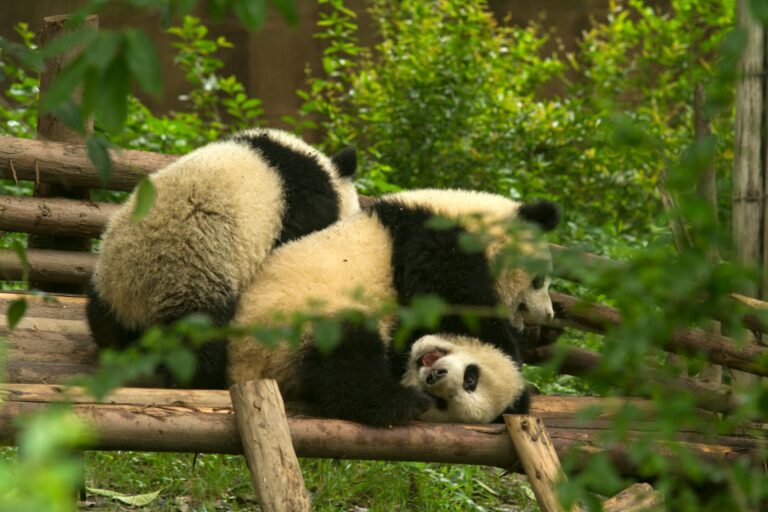

Plantigrade, bamboo-eating, with a fake thumb made of wrist bone. Evolution had a bit of a creative phase with this one.
Could you say a bit more about the Caro et al 2017 coat colour paper? I had heard the camouflage hypothesis but I thought there was a competing communication/signalling argument too.
Hey Ravi, Caro splits it: the body white/black bits are camouflage (snow and shadow respectively) and the facial markings (eye patches, ears) are intraspecific signalling, possibly for individual recognition. It is a hybrid hypothesis really. I will add a paragraph clarifying that in the next refresh.
You did not mention the fact pandas have an extra finger AND they evolved it independently from the red panda’s version. Coolest fact in the species honestly.