
Giant Panda Breeding Programs: Are They Working?
Last updated: November 16, 2026
10 min read
The old “panda breeding programs are failing” framing is dated. The captive population has grown from roughly 100 in the 1980s to 830 in November 2026, and the wild population has climbed from around 1,100 in the 1980s to nearly 1,900 on 2025 data. Twin rotation, hormone monitoring and artificial insemination all work, though not all to the same degree. The genuine difficulties are now narrower: reintroduction is still pilot-stage, the reproductive biology remains awkward, and capacity at the big centres is becoming the real bottleneck.
Key facts at a glance
- Captive population, 1980s: about 100 individuals worldwide
- Captive population, 3 November 2026: 830, announced by China’s National Forestry and Grassland Administration
- Wild population: about 1,100 in the 1980s, nearly 1,900 on 2025 data. The 2015 national survey put the figure at 1,864
- Estrus window: 36 to 48 hours, once a year
- Twin birth rate in captivity: about half of all births
- Twin survival in the wild: one of two cubs is typically rejected by the mother
- Reintroduction: 11 pandas released by the CCRCGP since 2003, 9 of them surviving
- Main breeding hubs: Chengdu Research Base; China Conservation and Research Center (Wolong, Bifengxia, Dujiangyan)
Why people still say panda breeding is “failing”
For most of the 20th century, captive giant panda breeding really did struggle. The first captive birth in modern records was in 1963 at Beijing Zoo, and for the next three decades the captive population barely grew. Cubs died young. Females failed to conceive. Males either ignored females in heat or did not know how to mate. International loans from the 1970s and 1980s often ended without offspring, which is where the “failing” narrative comes from.
Successful breeding starts with courtship. Our piece on the panda mating dance and how giant pandas find a partner explains the behaviour behind it.
That story is now thirty years out of date. The Chengdu Research Base of Giant Panda Breeding, founded in 1987 with six rescued wild pandas, held 237 pandas by 2023. The China Conservation and Research Center for the Giant Panda now runs five bases: Wolong Shenshuping, Wolong Hetaoping, Dujiangyan, Ya’an and Mianyang. The global captive population is managed across a single coordinated studbook.
The reproductive biology is genuinely awkward
The hard parts of panda reproduction are not invented. They are real, and they explain why captive breeding took so long to scale.
A 36 to 48 hour fertile window, once a year
Female giant pandas come into estrus once a year, typically in March or April, and the window of true receptivity is only 36 to 48 hours long. Within that window, peak fertility is a matter of hours. Miss it and the next opportunity is twelve months away. In the wild, females advertise estrus with scent marking and distinctive bleating calls, and males respond from a long way off. In captivity, hormone monitoring of oestrogen and progestagens in urine, increasingly combined with luteinising hormone, is the standard tool for predicting the window down to the day.
Pseudo-pregnancy: hormonal signs without a fetus
Captive females routinely display pseudo-pregnancy: hormone profiles, appetite changes and nest-building behaviour that all mimic a real pregnancy, with no embryo present. Combined with delayed implantation, where the embryo can pause for weeks or months before attaching to the uterine wall, this makes pregnancy detection by behaviour or hormone level effectively impossible. Facilities fall back on late-stage ultrasound, and even then the cub often does not appear on imaging until a week or two before birth.
Captive males that do not know how to mate
Hand-raised males raised in isolation often have no idea what to do with a female in heat. The behaviour is documented from the 1970s onwards. Wolong, in the early 2000s, ran a much-publicised “panda porn” experiment showing captive males footage of other pandas mating. The more lasting fix has been keeping young males in social groups with experienced females and letting natural courtship play out.
Artificial insemination: real progress, commonly overstated
The first successful panda birth through artificial insemination occurred at Beijing Zoo in 1978 and has improved a great deal since, mainly through hormone-driven timing, cryopreserved semen and better post-insemination care. It is worth being precise about how much, because the numbers get inflated in general coverage.
When researchers went back through decades of captive breeding records, the ranking came out the other way round from the popular story. Natural mating produced a birth roughly 61 percent of the time. Pairing natural mating with a backup insemination produced one roughly 51 percent of the time. Insemination on its own managed roughly 19 percent. So the honest summary is that AI has got a great deal better and is genuinely useful as insurance, but it has never beaten a female who mates on her own. That is precisely why the big centres try natural mating first and hold the syringe in reserve.
The global studbook treats the captive population as a single genetically managed group, and each pairing is chosen to maximise diversity. Cubs born at Berlin or Tokyo count toward the same studbook as cubs born at Chengdu. For a population that descends from a small captive founder pool, this is what has kept inbreeding manageable. Frozen semen supports the same goal: when Edinburgh Zoo inseminated Tian Tian, the team topped up fresh semen from Yang Guang with frozen semen from Bao Bao, a genetically valuable male who had lived at Zoo Berlin until 2012.
Twin survival: the rotation technique
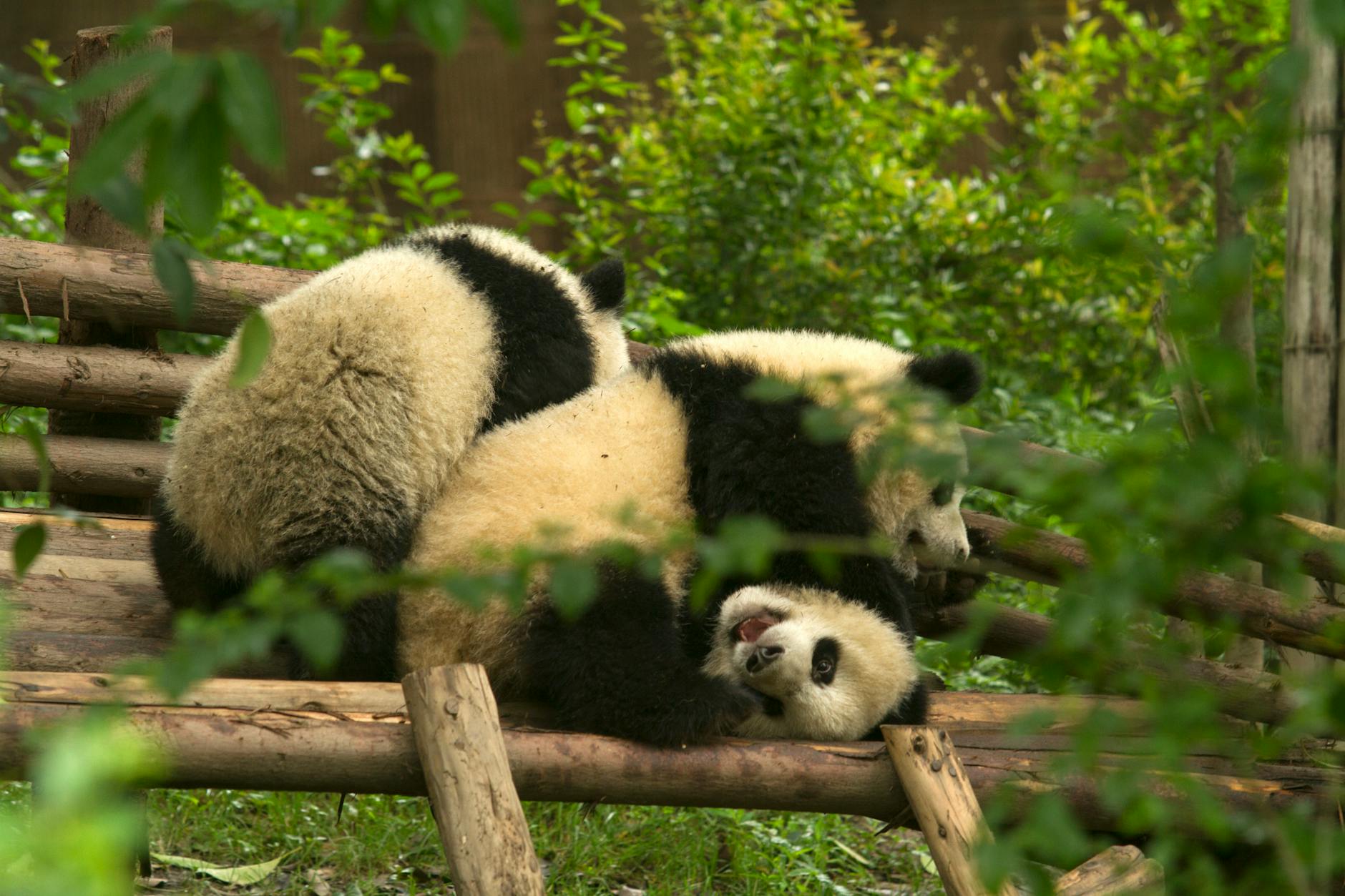
Roughly half of captive panda births are twins. In the wild, the mother almost invariably picks one cub and lets the other die: she cannot produce enough milk or carry both. For captive breeding programs trying to grow the population, that was a large and avoidable loss from every birth cohort.
Vets at Chengdu developed the twin rotation technique in the early 1990s. Both cubs are kept alive: one with the mother, one in an incubator. Every few hours, keepers swap them, sometimes up to ten times a day. The mother accepts the cub she finds in her arms as her own. Both cubs grow on their mother’s milk. The technique now runs across every major Chinese facility and at partner zoos abroad, and reported captive cub survival has risen from roughly a third in the early 1990s to around 88 percent. It is one of the cleanest examples of a captive breeding intervention that works.
The big centres
Chengdu Research Base of Giant Panda Breeding
Founded in 1987 with six rescued wild pandas, Chengdu is the most visible facility in the world. Its resident population grew from 18 in 1994 to 237 in 2023. It runs a year-round visitor program and supports a research arm focused on reproductive biology, genetics and behaviour. It is also the public face of China’s panda cooperation programme, and many high-profile international placements have run through Chengdu.
China Conservation and Research Center for the Giant Panda
The CCRCGP operates five bases: Wolong Shenshuping, Wolong Hetaoping, Dujiangyan, Ya’an and Mianyang. Wolong is the most senior and leads on reintroduction research. Bifengxia in Ya’an took in many of the pandas displaced by the 2008 Wenchuan earthquake. Dujiangyan focuses on older and rehabilitating animals. Note for visitors: Bifengxia and Dujiangyan have both had extended closures for construction and renovation in recent years, so check before travelling.
International partners
Around a dozen international zoos host pandas under long-term research loans. Cubs have been born and reared at several of them, including the Smithsonian’s National Zoo, San Diego Zoo, Zoo Atlanta, Ueno Zoo in Tokyo, Zoo Berlin, Madrid Zoo and ZooParc de Beauval in France. Others never managed it: Edinburgh Zoo tried natural mating and eight rounds of artificial insemination across twelve years without a cub, Adelaide Zoo went fifteen years without one, and no giant panda has ever produced a surviving cub in Britain. As of the 2024 announcement, China reported 71 cubs born through cooperation with institutions in 20 countries. Each loan typically runs ten years, after which the animals and any cubs return to China, and the fee is directed into conservation work at the Chinese end.
Captive numbers over time
The numerical track record is the clearest answer to the “is it working” question.
- 1980s: roughly 100 captive individuals globally, almost all in China, almost none breeding successfully.
- 2020: 633 captive individuals on the global studbook.
- November 2025: 808 captive individuals, announced by China’s forestry administration.
- November 2026: 830 captive individuals, announced at the Global Panda Partners conference in Chengdu.
The interesting question now is not whether captive breeding works, but how many captive pandas the conservation program actually needs. Once captive numbers are large enough to support the wild population through reintroduction, the priority shifts back to wild-habitat work. That is close to a complete reversal of the 1990s situation, where fertility was the binding constraint.
Reintroduction is the genuine remaining challenge
Putting captive-bred pandas back into the wild is genuinely hard. The first release of a captive-bred panda, in 2006, was Xiang Xiang at Wolong. Xiang Xiang was found dead in February 2007, apparently after conflict with wild males. The setback paused the program and forced a redesign. From 2010 onwards, releases used pandas raised in semi-wild enclosures from cubhood, exposed to bamboo foraging, threat recognition and minimal human contact.
The CCRCGP reported in early 2025 that it had released 11 pandas since 2003, of which 9 survived. Seven have joined the wild population in the Xiaoxiangling mountains, where the local population had been at risk of dying out, and two joined the Minshan population. Tao Tao, released in 2012, was the first captive-bred panda confirmed to be surviving in the wild, and Zhang Xiang, released in 2013, was the first female. Set against a captive population of 830, that is a small number of releases: reintroduction is best thought of as a pilot phase whose purpose so far has been to refine the rearing protocol and reinforce specific at-risk populations, not to repopulate the wild at scale.
So is the program failing?
By any honest measure, no. Captive breeding works. Wild numbers are rising, driven mainly by habitat protection: logging bans and Giant Panda National Park, established in 2021 across about 22,000 square kilometres and later reported to integrate 73 reserves. Genetic management is in place. Twin survival is at an all-time high.
The narrower honest assessments are these: reintroduction at scale has not been demonstrated, artificial insemination is a useful backup rather than a solved problem, the captive population may now be at or above the level the wild can absorb, and bamboo flowering cycles and climate change still threaten the wild range regardless of how many captive pandas are produced. Those are real concerns, but they are different concerns from “the breeding program is failing”.
If you want context on what made the original crisis so acute, our piece on what caused giant pandas to become endangered in the first place covers the habitat loss and poaching pressure of the 20th century. The companion piece on whether pandas are still endangered covers the IUCN status side.
Read next
- Panda Facts: 50+ Surprising Things About Giant Pandas and Red Pandas (2026)
- Giant Panda Habitat: Where They Live, Why It Shrank, and How It Is Coming Back
- Giant Panda Reproduction: Why Breeding Is So Hard
Frequently asked questions
Why are giant pandas so hard to breed?
Three reasons: females are receptive only 36 to 48 hours a year, captive males raised in isolation often lack the social skills to mate, and pregnancy is hard to detect because of pseudo-pregnancy and delayed implantation. Hormone monitoring, twin rotation and artificial insemination have each addressed one of those bottlenecks, but the underlying biology is still narrow.
Are panda breeding programs failing?
No, by any reasonable measure. The captive population has grown from about 100 in the 1980s to 830 in November 2026, twin cub survival has gone from roughly a third to around 88 percent, and wild numbers have risen from about 1,100 in the 1980s to roughly 1,900. The “failing” narrative comes from the genuine struggles of the 1970s and 1980s and has not been updated.
How many pandas are in captivity right now?
China reported 830 on 3 November 2026, the majority in Sichuan-based Chinese facilities. The international zoos that hold pandas under long-term loan agreements hold the remainder, typically one or two animals at a time.
Why do panda mothers reject one twin in the wild?
A wild mother cannot produce enough milk for two cubs and cannot carry both safely. She picks one and abandons the other. In captivity, keepers swap twins between mother and incubator every few hours so each receives milk from the mother and supplementary care from staff. The rotation technique was developed at Chengdu in the early 1990s and is now standard.
Have pandas been successfully reintroduced into the wild?
Partly. The CCRCGP reported 11 releases since 2003 with 9 survivors. The first captive-bred release, Xiang Xiang in 2006, died within months. Later releases, raised in semi-wild enclosures, have done much better: Tao Tao (2012) was the first confirmed survivor and Zhang Xiang (2013) the first female. The program is a pilot phase, not a scaled repopulation effort.
How long is a panda pregnancy?
84 to 184 days, complicated by delayed implantation: the fertilised egg can pause for weeks or months before attaching to the uterine wall. That makes due dates effectively unpredictable. Combined with pseudo-pregnancy, pregnancy detection relies on late-stage ultrasound and is often confirmed only a week or two before birth.
What is the artificial insemination success rate for pandas?
Lower than most coverage suggests. Published analysis of captive records puts births at roughly 19 percent for AI alone, roughly 51 percent for natural mating combined with AI, and roughly 61 percent for natural mating. Reviews of worldwide practice have reported around 25 percent for AI. It works, and hormone timing has improved it, but it is a backup rather than a replacement for natural mating.
Where are the main panda breeding centres?
All in Sichuan, China. The Chengdu Research Base of Giant Panda Breeding and the China Conservation and Research Center for the Giant Panda, which operates Wolong, Bifengxia and Dujiangyan. Around a dozen partner zoos worldwide hold smaller groups under long-term research loan agreements.
Sources and further reading
- IUCN Red List: Ailuropoda melanoleuca
- China National Forestry and Grassland Administration, Global Panda Partners 2024 announcement
- China Conservation and Research Center for the Giant Panda reintroduction reporting
- WWF: giant panda species profile
- Smithsonian National Zoo giant panda programme
For more on the wider conservation picture: conservation efforts to save the giant panda, why panda reproduction is so tricky, and the giant panda life cycle from birth to adulthood.
This article is part of our panda conservation guide, which links all our reporting on threats, breeding and release.
Updated 16 November 2026: updated the captive count to 830 (China, 3 November 2026), corrected the date of the 808 figure to November 2025, and removed the store block.



Good push back on the failing narrative. The captive population going from ~100 in the 80s to 600+ today is the single number people should remember when arguing about this.
So if breeding is largely solved, what is the actual bottleneck now? You mention reintroduction. Is the issue finding suitable release sites or training captive-born animals to survive?
Lara, both. The behavioural training piece is partly solved by the Hetaoping soft-release programme (cubs are reared by mothers in semi-wild enclosures with minimum human contact), but suitable release sites with genetically isolated subpopulations that need new individuals are the harder constraint. The Daxiangling release work is the current test.
Capacity becoming the bottleneck instead of biology is the kind of problem you want to have. Build more bases.