Au Revoir, Huan Huan and Yuan Zi: France’s First Panda Pair Have Gone Home
Last updated: November 5, 2026
5 min read
Here is a sentence I never expected to write when I started covering pandas. The wife of the French president was the godmother of a giant panda born in the Loire Valley, and that panda has gone home to China. So have his parents, two years later and a year ahead of schedule.
This is the rhythm of the loan model working roughly as designed, and Beauval handled it with more grace than most. But the story of the ZooParc de Beauval pandas is one of the strangest and most charming chapters of recent panda diplomacy, and the November 2025 departure deserves a proper look, along with one detail most of the coverage skipped: France is not actually panda-free.
A Loire Valley zoo becomes a panda capital
Beauval is in Saint-Aignan, a quiet town in the Loir-et-Cher department of central France, about 200 kilometres southwest of Paris. The Loire Valley is mostly known for chateaux, vineyards and slow river bends, which is not the obvious backdrop for one of Europe’s headline panda exhibits. The zoo itself is one of the largest in France, but for most of its life it was not on the international map.
That changed on 15 January 2012. Huan Huan, a female whose name means happy, and Yuan Zi, a male whose name means chubby, landed in France on a ten-year breeding loan from the China Wildlife Conservation Association. They were the first giant pandas in the country since Yen Yen, one of the pair given to President Pompidou by Zhou Enlai in 1973, died at the Vincennes zoo in January 2000. Beauval became, overnight, the only zoo in France with pandas on display.
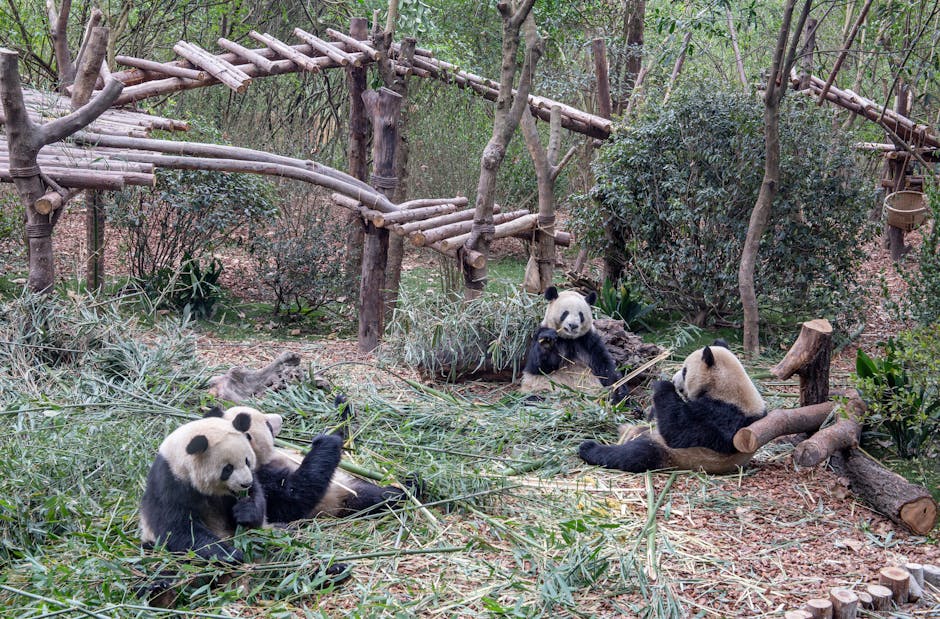
Beauval had spent years preparing the ground. The dedicated panda enclosure does not look like a typical European zoo exhibit. It mimics the cool, humid forests of Sichuan: shaded slopes, climbing structures, and a constantly replenished supply of fresh bamboo. The keepers learned to handle a species that, for all the public affection, is famously fussy about temperature, humidity and food. The shaded enclosure gives the pandas cooler areas during warm weather.
For nearly fourteen years, this corner of the Loire Valley was the only place in France where you could stand in front of a giant panda. Long enough for two French presidents, three Beauval-born cubs, and a generation of French schoolchildren who grew up assuming pandas were normal local fauna.
Three cubs, three famous godparents
Here is where the story tips into something only France could pull off.
On 4 August 2017, Huan Huan gave birth to a male cub. He was the first giant panda born in France. His name, chosen in a ceremony that drew global press, was Yuan Meng, meaning the realisation of a wish. His godmother was Brigitte Macron, wife of President Emmanuel Macron. She turned up to the naming ceremony, stood next to a Chinese delegation, and treated the role as if it were a normal item on a head of state’s diary. She later visited him again in China.
I find this funny and lovely in equal measure. The British equivalent would be the Queen solemnly accepting godmother duties for a panda cub in Edinburgh. It would be in every tabloid for a year. In France it was treated as the obvious thing for the country to do, because the country had decided years earlier that pandas at Beauval mattered.
Then on 2 August 2021, Huan Huan delivered twins. Two female cubs, named Yuandudu and Huanlili after a public consultation. Their godparents were Kylian Mbappe, at that point the most famous footballer in the world, and Zhang Jiaqi, a Chinese Olympic diving gold medallist. Picture Mbappe at a panda photo call, both parties looking slightly bewildered, and you have one of the more surreal images of the post-pandemic sporting year.
The godparent ritual was Beauval’s invention, in collaboration with the Chinese conservation authorities, and it was not merely a publicity stunt. The names matter to the partnership, and so do the public faces attached to the bears. The French press covered every weighing, every health update, every wobbling first step. Yuan Meng, Yuandudu and Huanlili were treated less like animals on display and more like minor French celebrities with Chinese passports.
Yuan Meng flew home in July 2023, shortly before his sixth birthday and later than the usual schedule, partly because of pandemic-era logistics. Brigitte Macron saw him off at Charles de Gaulle. The twins are still in France, which is the part worth holding on to.
The November 2025 farewell
Which brings us to the parents.
Huan Huan and Yuan Zi had been at Beauval since 2012, and their loan had already been extended once. The departure, when it came, was not a diary date. Huan Huan has chronic renal failure, and the decision to send both animals back early was made so she could be treated at the Chengdu base, where the veterinary team has more experience of the condition than anyone in Europe. They flew out on 25 November 2025 and landed in Chengdu the following morning, accompanied by keepers from both countries.
The send-off was understated, which I appreciated. Beauval ran farewell viewings in the weeks before the departure. There were no fireworks and no speeches dressed up as state occasions. Just queues of French families standing patiently in front of the enclosure on cold autumn days, saying goodbye to two animals that had been part of the national landscape since 2012. The keepers, several of whom had worked with these specific bears the whole time, travelled with them.
What is actually left at Beauval, and what comes next
The enclosure is not empty. Yuandudu and Huanlili stayed behind when their parents left, and they are due to remain at Beauval until the current cooperation period ends in January 2027. If you want to see a giant panda in France in 2026, you still can, and you are looking at two French-born animals rather than the founding pair.
After that the plan is continuity rather than closure. On 4 December 2025, the China Wildlife Conservation Association and Beauval signed a letter of intent to continue panda cooperation. The announcement did not confirm an arrival date or a ten-year term. The enclosure will still be there, the keepers are still on staff, and the bamboo supply chain does not need rebuilding. What we do not yet know is which pandas will come.
China pairs new arrivals with host institutions carefully, weighing the host’s track record. Beauval’s is strong: three surviving cubs from one breeding pair, all healthy, and a fourteen-year run with no serious incident. That is the sort of programme that gets renewed. For a country that had gone twelve years without a panda before 2012, the next intermission looks like a short one.
This article is part of our giant panda guide, which links every species, evolution and zoo article on the site.
Updated 14 September 2026: corrected factual details after a full review against primary sources.