How to Visit the Chengdu Research Base
Last updated: November 16, 2026
6 min read
The Chengdu Research Base in Sichuan gives visitors a close view of giant pandas across a large network of pavilions, villas and nursery houses.
I want to describe the visit itself here, because that is the question readers ask me most often when they are planning a trip. Not “what is the base” or “how do I book a ticket”, but the thing underneath those questions: what is it actually like. This is not a TripAdvisor entry. There are plenty of those, and they will tell you the gate price and the bus number. This is the version I wish I had read before my first visit.
The drive in
The Chengdu Research Base of Giant Panda Breeding sits on Futou Hill in the north of the city, about a thirty-minute drive from the centre. You leave behind the elevated ring roads and the spicy-broth smell of the city, and within ten minutes the buildings thin out. By the time you turn into the base you are surrounded by planted bamboo. It does not look like a zoo approach. It looks like the edge of a forest park, which is essentially what it is.
Entry starts at 7:30 from March through October and at 8:00 from November through February. Reserve online through an official channel before you go, and take the original identity document used for the booking. Aim to arrive at opening time, not at 9 and not after lunch. The single biggest difference between a Chengdu visit that people rave about and one that they shrug at is what time the visitor walked through the gate.
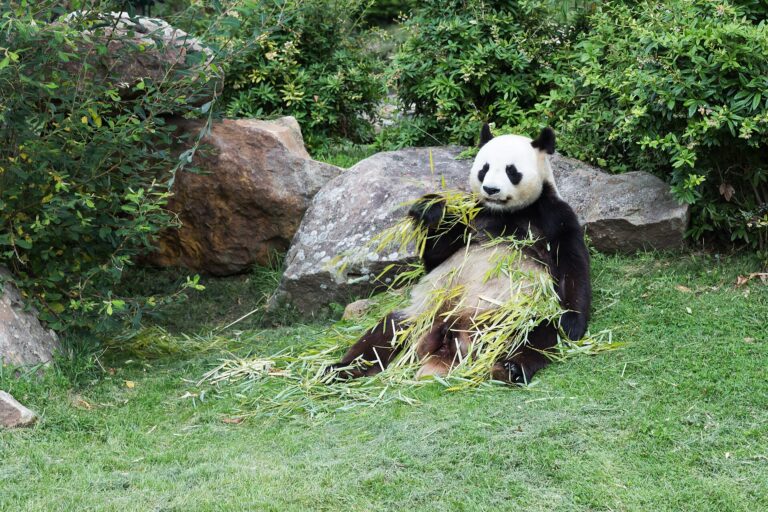
The planted slopes and bamboo create a shaded setting around the panda enclosures.
The first one
The official map divides the expanded base into several visitor zones linked by walking routes.
The first panda I saw was lying on his back along a horizontal wooden platform, one back leg dangling off the side, holding a length of bamboo across his chest with both forepaws like a clarinet. He was working his way along it methodically: bite off a six-inch section, chew with that slow rolling jaw motion they all have, swallow, slide the grip down to the next section. The whole performance had the calm, slightly dismissive air of someone reading a newspaper in a cafe. He did not look at the visitors. He did not need to.
What surprised me, what I had not expected from years of documentaries, was the scale. They are bigger than you think. Even a sub-adult is a serious bear. The forelegs are heavy with muscle. The skull is large. When he eventually shifted position, propping himself up on one elbow, the sheer mass of him was startling. The screens flatten them.
The sound surprised me too. Pandas eating bamboo are loud. The fibrous splinter of the cane as the molars come down, the wet click of the jaw, the soft snort of breath through the nostrils. From ten metres away, in a quiet enclosure, you hear all of it.
The morning rhythm
Morning visits can improve viewing odds, but activity varies by animal, season and feeding schedule. Pandas can feed or move at several points through the day. The morning matters not because of crowds but because of the bears. They are not on the same schedule as a normal tourist.
Allow several hours to cover the main visitor routes. The expanded base has multiple zones with more than twenty named panda pavilions, villas and nursery houses, plus a red panda area. A few moments stayed with me. A juvenile climbing a sloping pine trunk one paw at a time, pausing at every metre to look around. A mother and a year-old cub sharing a bamboo pile, the cub repeatedly trying to take the mother’s piece and being repeatedly batted away with what I can only describe as motherly patience. Two adult bears in adjacent enclosures sitting back to back with the fence between them, eating in companionable silence with their backs pressed together through the wire.
You do not need to be a panda obsessive to find those moments quietly moving. You only need to be there at the right time.
How it is different from a zoo
I have been to several zoos with pandas. Chengdu is different in a way I find hard to articulate, but I will try. In a Western zoo, even a good one, the pandas are the rare exotic at the centre of a wider collection. The signs and the architecture frame them as visitors from elsewhere. At Chengdu, the pandas are the species the place is built around. The architecture, the planted bamboo, the slopes, the mist, the temperature of the air, are all in some sense their habitat. You feel like the foreigner.
That feeling is reinforced by the science. The base was founded in 1987 with six pandas rescued from the wild during the bamboo flowering crisis, and its own website listed more than 270 giant pandas when we checked on 16 November 2026, up from 237 at the end of 2022. It also keeps a smaller group of red pandas. It is one of the central nodes of global panda research. The labs and breeding facilities are not visible to the public, but you can feel them around you, and the visitor signs carry real information about reproductive biology, cub development, nutrition. You do not need to know any of that to enjoy the morning, but it gives the morning a texture that a zoo cannot match.
The habitats themselves are enormous. Proper terrain: rockwork, slopes, climbing trees, bamboo plantings, mud, leaves. The bears can disappear into the back of an enclosure if they want to, and they often do. When you do see one, it is because the bear has chosen to be visible, not because the enclosure forces it. That changes the encounter.
Can you still hold a panda?
No. Visitors cannot hold, hug or pose with a panda at the Chengdu base, and you should not trust any tour that still sells it. After photos of visitors posing with pandas caused an online row in January 2018, the base said only its breeders, vets and researchers may get physically close to its pandas. In October 2018 Sichuan's provincial forestry bureau told every facility with captive pandas in the province to stop activities that let paying visitors get close to them, such as feeding sessions and photos with a panda (CGTN report). Older travel posts that describe holding a panda for a fee describe something that ended in 2018.
The wider Sichuan context
If Chengdu is the central node of captive panda work, the deeper conservation story plays out in the mountains west of the city. The China Conservation and Research Center for Giant Pandas at Wolong is the major working facility for reintroduction research, deeper in the Qionglai Mountains and not built for tourism the way Chengdu is. The original Wolong base was destroyed by the 12 May 2008 Wenchuan earthquake. The captive pandas were evacuated to the Bifengxia Panda Base near Ya’an, which became their temporary home for years, and a new Wolong base, Shenshuping, was rebuilt on safer ground and is now the main reintroduction-research site. Most visitors do not make it to either, and I think that is fine. Chengdu shows you the species. The reserves show you the work behind the species.
Beyond the captive facilities, the wild population lives in the mountains of Sichuan, Shaanxi and Gansu, with about three quarters of it in Sichuan. The fourth national survey (2011 to 2014) counted 1,864 animals; China's National Forestry and Grassland Administration put the figure at nearly 1,900 using 2025 data. The IUCN reclassified the species from Endangered to Vulnerable in September 2016, and China did the same on its own list in 2021. China reported 830 giant pandas in captivity on 3 November 2026. The Giant Panda National Park, formally established in 2021, joins dozens of separate reserves across the three provinces into a single conservation area of about 22,000 square kilometres, more than twice the size of Yellowstone. The pandas at Chengdu are the visible face of all of that.
Would I recommend it
Without reservation. Chengdu is the single best panda viewing experience anywhere in the world. There are zoos in Europe and Asia and North America that hold pandas in beautiful enclosures and care for them well. None of them match the scale, the setting, the science, or the morning. If you can get to Sichuan, go. Go early, plan a full morning, take a warm layer because Chengdu in autumn is cooler and damper than you might expect, and accept that the afternoon is for sleeping bears and that this is fine.
Check the official ticket page before visiting because opening times, reservation rules and access arrangements can change.
This article is part of our giant panda guide, which links every species, evolution and zoo article on the site.
Read next
- Panda Facts: 50+ Surprising Things About Giant Pandas and Red Pandas (2026)
- Madrid's Pandas: Europe's Longest Panda History
- Qizai, the Brown Panda: The Untold Story of the Qinling Lineage
Updated 16 November 2026: added that visitors cannot hold pandas (Sichuan ended paid close contact in October 2018), linked the population and status figures, and updated the base’s panda count to more than 270, from its own website on 16 November 2026.