

Zhen Zhen: The Panda Who Walked Into a Chinese Town
Last updated: November 16, 2026
3 min read
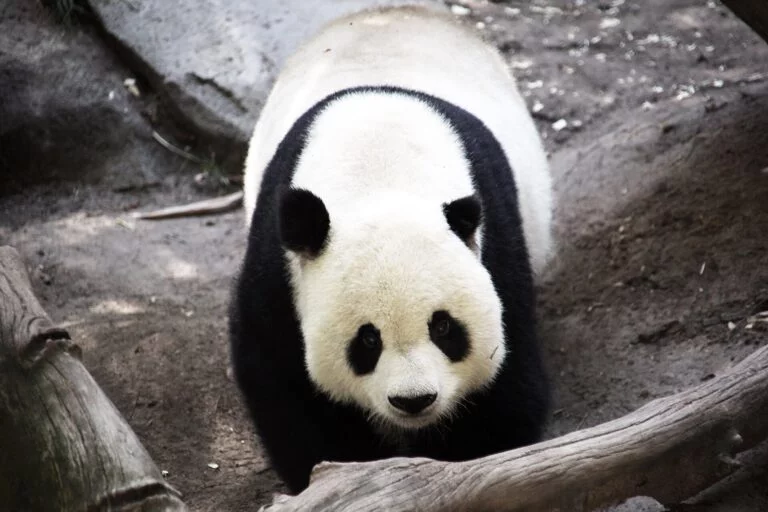
On 31 May 2018 a giant panda entered a village on the edge of Wenchuan County, Sichuan Province, while in oestrus and searching for signs of wild pandas. She walked past a vegetable garden, crossed a dirt road, climbed a tree, and drew a crowd of onlookers who filmed the whole thing. The clip went round the world. What most of the coverage missed is who she actually was.
She was not a wild-born panda
Researchers at the China Conservation and Research Center for the Giant Panda identified her as Zhen Zhen, and they knew her well. Zhen Zhen was born on 3 August 2007 at San Diego Zoo, to Bai Yun and Gao Gao. She moved to China in September 2010, and in 2018 she was taking part in a monitored wild-breeding trial intended to mate a captive female with a wild male.
So the video is not a rare glimpse of a shy wild animal. It is a captive-born bear on a soft release, doing what a hungry panda does when a village happens to sit between her and the next patch of bamboo.
What happened next
She was allowed several hours to explore, then sedated and taken back to the Wolong Shenshuping Panda Base the same afternoon. Reports at the time described her as an 11 year old female, which is roughly right for a bear born in 2007.
Her story did not end there. In 2019 Zhen Zhen gave birth to a male cub, Yun Chuan. In 2024 Yun Chuan flew to San Diego Zoo, the place his mother was born, as one of the pair that ended America’s short panda drought.
Where Wenchuan sits in the panda map
Wenchuan County sits in the Minshan and Qionglai mountain country of western Sichuan, next door to the Wolong National Nature Reserve. The county lost most of its built environment in the 2008 Wenchuan earthquake, which also wrecked the original Wolong breeding facility. Reconstruction since then has produced a patchwork of restored forest and rebuilt rural roads, which is exactly the kind of edge habitat where a bear in a monitored wild-breeding trial is going to meet people.
For deeper background on the reserve and its breeding programme see our piece on the Wolong National Nature Reserve.
Are wild panda sightings really that rare?
Yes. The Fourth National Giant Panda Survey, published in 2015, counted 1,864 wild giant pandas across six mountain ranges in Sichuan, Shaanxi and Gansu, spread over roughly 25,800 square kilometres of habitat. Pandas are solitary, they move mostly at dawn and dusk, and dense bamboo hides them at a few metres. Field researchers who work in those forests every day can go years without a clear sighting.
That is the honest reason a clip like this travels. A panda on a road in daylight is unusual whether she was born in a forest or in a zoo in California.
What releases like this are for
China’s Giant Panda National Park, formally established in 2021, folded 67 separate reserves into one protected area of about 27,134 square kilometres across Sichuan, Shaanxi and Gansu, with corridors designed to let pandas move between sub-populations. Releasing captive-bred animals into those corridors is the other half of the plan: the Fourth National Survey found 33 isolated wild populations, 18 of them holding fewer than ten animals, and small isolated groups do not fix themselves.
Zhen Zhen’s walk through a village is a small, slightly comic illustration of how difficult that work is. You cannot teach a bear where the reserve boundary runs.
FAQ
Was Zhen Zhen a wild panda? No. She was born at San Diego Zoo in August 2007, moved to China in 2010, and was released into the wild with a tracking collar as part of a research project in 2018.
Was she relocated after the sighting? Yes. Staff let her explore for a few hours, then sedated her and returned her to the Wolong Shenshuping Panda Base.
How did anyone know which panda it was? She was wearing a tracking collar and was already part of a monitored wild-breeding trial, so identification was straightforward.
How big is an adult female giant panda? Adult females typically weigh 70 to 100 kg and measure about 1.2 to 1.5 m head to rump. The median lifespan in the wild is roughly 18 to 20 years.
How many wild giant pandas are there? The last full national survey counted 1,864 in 2014. China’s forestry administration put the wild figure at close to 1,900 in 2025. China reported 830 in captivity on 3 November 2026.
Why was the IUCN status changed to Vulnerable? The 2016 reassessment cited the roughly 17 percent rise in the wild population between the third and fourth national surveys, more protected habitat, and stronger anti-poaching enforcement. Critics point to climate projections for bamboo and to continued habitat fragmentation as reasons the gain may not hold.
This article is part of our panda conservation guide, which links all our reporting on threats, breeding and release.
Read next
- Panda Facts: 50+ Surprising Things About Giant Pandas and Red Pandas (2026)
- Red Panda Subspecies: Himalayan vs Chinese Red Panda
- Madrid's Pandas: Europe's Longest Panda History
Updated 16 November 2026: updated the captive giant panda count to 830, as China reported on 3 November 2026, with a link to the report.



Workers halting road repairs to let a panda wander through is the most Chinese rural conservation story possible. Love it.
11 years old taking a stroll out of habitat is a meaningful behavioural data point too. Probably searching for food or a mate. Hope she got back into protected forest safely.