
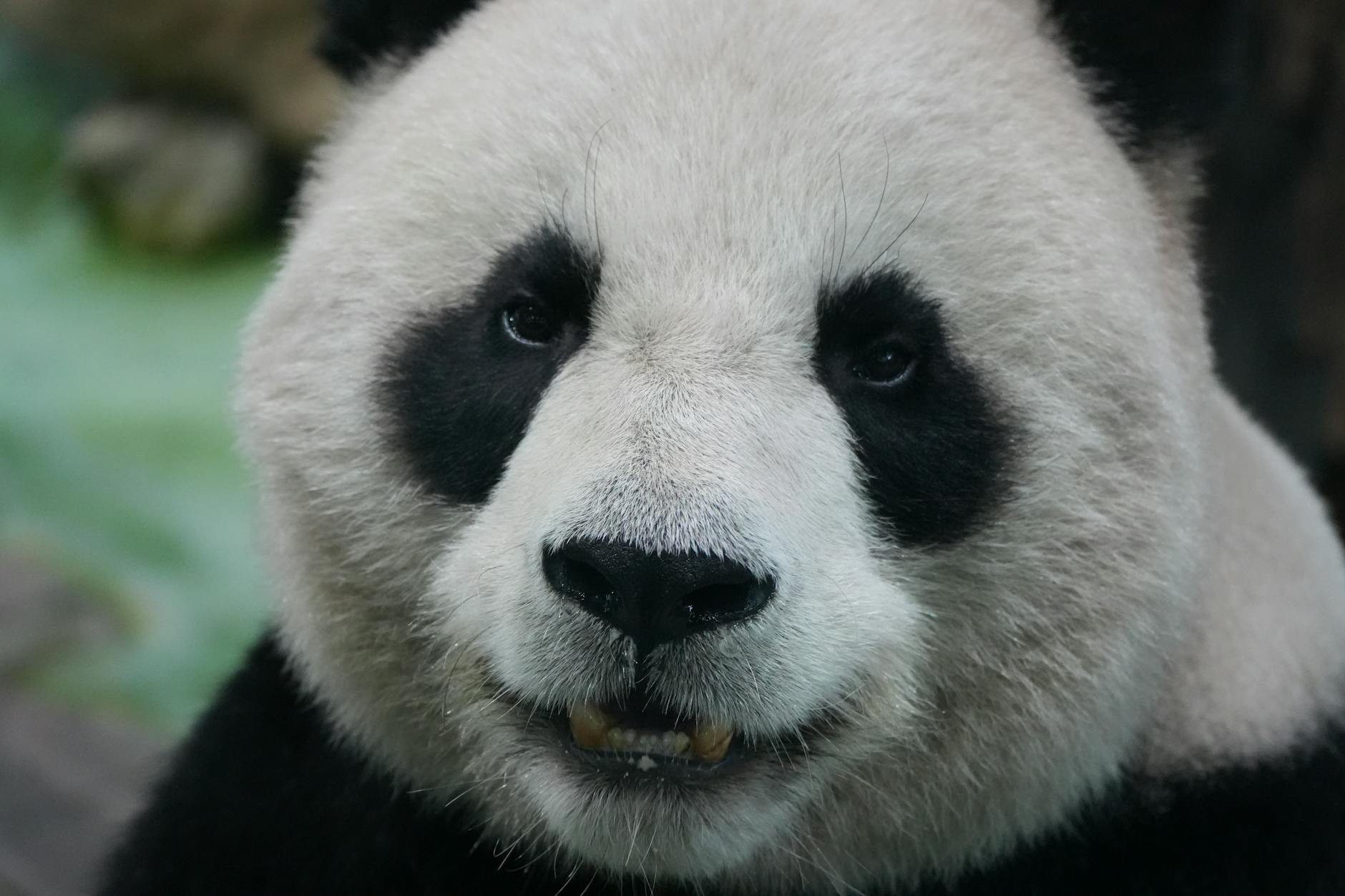
Here’s Why Giant Pandas Are Colored Black And White
Last updated: November 5, 2026
3 min read
Why is a giant panda black and white? The question sat unanswered for decades because there is no other mammal built like this to compare it with. A 2017 study finally got at it by refusing to treat the panda as one animal, and instead treating every patch of fur as a separate problem to be explained.
The study
The work was led by Tim Caro of the University of California, Davis, with Ted Stankowich of California State University, Long Beach, and it was published in Behavioral Ecology in early 2017. Caro’s team had already done the equivalent job on zebras, where the striping turned out to be best explained as a defence against biting flies.
The method was comparative. They scored the panda’s body region by region, then compared each region against the corresponding fur colour of 195 other carnivore species and 39 bear subspecies, asking what those animals had in common where they shared the panda’s colouring. As Caro put it, understanding the panda’s coloration had been a long-standing problem in biology precisely because virtually no other mammal looks like this, which makes analogies hard.
The answer: two jobs, not one
The regions did not all line up with the same explanation, which is the interesting part. The white areas, the face, neck, belly, flank and rump, matched animals living in snowy habitat. The dark shoulders and legs matched animals living in shade. The head markings matched neither, and instead lined up with species that use their faces to signal.
So a panda is camouflaged twice over, for two different backgrounds, and communicating with its head.
Why it needs both
This is where the diet comes in. A panda lives almost entirely on bamboo, and bamboo yields so little energy that it cannot build the fat reserves other bears use to sleep through the winter. It has to stay awake and keep moving all year, which means it spends part of the year on snowy ground and part of it in dark forest. An animal that has to be in both places does not get to pick one background to blend into.
The rest of its behaviour follows the same logic. Adults are solitary except for mothers with cubs, and they cover a lot of ground looking for feeding sites. Our piece on how pandas became bamboo dependent covers the diet itself, and a 2015 study in mBio showed the underlying problem: the panda’s gut microbiome is still that of a carnivore, with very little of the bacterial machinery that would make bamboo pay.
The face is a name tag
The dark eye patches were the part everyone assumed was about looking fierce. The comparative data pointed elsewhere: the patches sit with the group of species that use facial markings for recognition and for signalling to their own kind. Pandas may well be reading each other’s faces. The dark ears fit a different pattern again, matching species that use ear markings as a warning to predators.
Cubs are not born with any of it. A newborn panda is pink, blind and almost hairless. White fur comes in within about two days, black fur starts on the ears, eye patches and shoulders at about a week, and the pattern is in place by about three to four weeks.
Who eats a panda cub anyway
Adult pandas have effectively no natural predators. Cubs are a different matter, and the realistic list is snow leopards, dholes, yellow-throated martens and Asian black bears, none of which is a specialist panda hunter. Our piece on what actually hunts a giant panda goes through each one.
Stankowich’s own summing up was less about pandas than about research: it takes hundreds of hours of hard work to answer what looks like the simplest of questions.
Panda merchandise
Browse panda-themed panda plushies and gear at our store, store.welovepandas.org.
What is still unknown
The analysis compares one species against a dataset. It does not measure what a panda does when it sees another panda’s face, and nobody has run the behavioural experiment that would settle it. Eye patch shape does vary between individuals, and keepers use it to tell cubs apart, which fits the idea that pandas could use the same cue.
Frequently asked questions
Why do pandas have black eye patches?
The best current answer is communication. The patches probably help pandas recognise each other and may sharpen an aggressive stare.
Are panda eye patches camouflage?
Probably not. In the 2017 Caro analysis the camouflage signal sat with the body, not the head.
When do cubs get their patches?
Black fur starts on the ears, eye patches and shoulders at about a week, and the pattern is in place by about three to four weeks.
Sources
- Why pandas are black and white (UC Davis, March 2017)
- UC Davis College of Agricultural and Environmental Sciences
- mBio (2015): the bamboo-eating giant panda harbours a carnivore-like gut microbiota
This article is part of our panda facts guide, which links every article on panda biology, behaviour and culture.
Updated 5 November 2026: added detail on eye patches from our former eye patch article, which now redirects here, and corrected the timing of cub markings.





The fact the same team that solved the zebra-stripes mystery also tackled the panda was the bit I did not know. Caro keeps coming up. Two of biology’s longest-standing colour puzzles in one career.
195 species and 39 bear photos scored against habitat is a serious dataset. Conservation biology rarely gets that thorough. The dual camo plus signalling answer fits the field obs too.
The eye-patches as individual-recognition signals theory always made the most sense to me. Pandas are solitary but they still need to identify each other quickly during the short estrus window.