

Giant Panda Predators: What Actually Hunts a 100 kg Bamboo Bear?
Last updated: November 5, 2026
9 min read
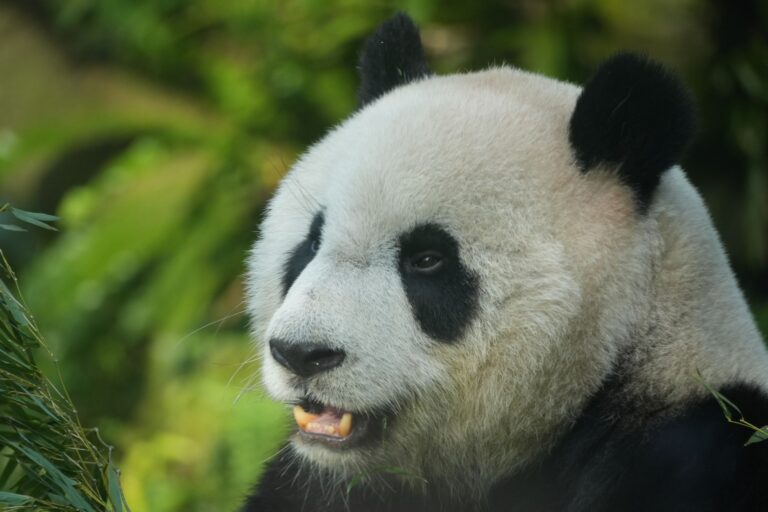
Adult giant pandas are essentially predator-free in the wild. At up to 160 kg, with a bite force quotient around 151 (higher than a lion’s, on the Christiansen and Wroe 2007 measurements), and a habitat of steep, broken mountain forest, a healthy adult panda is not on anyone’s menu. The real predator risk is to cubs in their first 18 months, and the realistic predator list is short: snow leopards, dholes (Asian wild dogs), yellow-throated martens, Asian black bears, with golden eagles proposed as a possible threat to young cubs. The one meaningful adult-stage predator is humans, almost entirely through habitat loss and incidental snaring.
Key facts at a glance
- Adult pandas: Essentially no natural predators. Too big, too well-armed, too sparse, in too steep terrain.
- Cub mortality (wild): Not reliably measured. Wild dens are rarely found, and the mortality rates quoted online usually come from captive records.
- Main cub predators: Snow leopards, dholes, yellow-throated martens, Asian black bears, golden eagles.
- Bite force quotient: About 151, ahead of a lion (about 124) and a spotted hyena (about 100).
- Panda density: 1 panda per 3 to 6 km2. Low return on investment for any specialist predator.
- Real threat: Habitat fragmentation, road kill, and incidental snaring set for other species.
Adults: nearly predator-free
It is easy to overstate the threat posed by snow leopards or wild dogs to giant pandas, because their ranges overlap and they look like the right kind of predator. The honest answer is that none of them is a serious threat to an adult panda. The size differential alone is decisive: a wild adult male panda weighs up to about 113 kg and a wild adult female rarely reaches 104 kg, while the largest snow leopards top out around 55 kg and dholes are 15 to 20 kg. A 40 kg cat does not pick fights with a 130 kg bear that can crush bamboo.
Size and bite force
Pandas have evolved one of the strongest bites in the carnivore world relative to body size. On the bite force quotient, a measure that controls for body mass, Christiansen and Wroe put the giant panda at about 151, ahead of the lion (about 124), the spotted hyena (about 100) and the leopard. In absolute terms that is a bite of roughly 1,300 newtons at the canines, comparable to a lion’s despite the panda being a much smaller animal. The jaw muscles that crush 5 cm bamboo culms in normal feeding also work perfectly well as a defensive weapon. Pandas rarely use their bite on other animals (encounters are rare, and pandas are not aggressive by default), but the equipment is there.
Habitat that hides the panda
The terrain is the second line of defence. Pandas live on steep slopes (often 25 to 45 degrees), in dense bamboo with poor visibility, and at densities of one animal per 3 to 6 km2. A large predator looking for a panda spends a lot of effort to find one, and a panda that hears trouble can simply walk off into the bamboo and disappear, or climb. Adult pandas climb less than younger ones but can still ascend a tree quickly if they feel threatened.
Cub predators
The picture changes for cubs. Newborn pandas weigh about 100 g and are blind, helpless, and confined to a den cavity in a hollow tree or rock crevice. The mother leaves the den briefly to feed and drink, and any predator that finds the den when she is away has an easy meal. Even older cubs, before they reach roughly 18 months and a body mass that puts them out of the easy-target range, are vulnerable if they get separated from the mother.
Snow leopards
Snow leopards (Panthera uncia) are the most often cited “natural predator” of giant pandas. Their range overlaps with the upper limits of panda habitat in parts of Sichuan, and they are agile, patient ambush hunters. Snow leopards focus heavily on bharal (blue sheep), ibex, and marmots. Panda cubs are taken occasionally and opportunistically, but pandas are not a regular component of snow leopard diet studies. Adult pandas are simply too large, and the snow leopard’s preferred steep, rocky habitat does not overlap fully with the bamboo forest where pandas spend most of their time.
Dholes (Asian wild dogs)
Dholes (Cuon alpinus) are pack-hunting canids weighing 15 to 20 kg. A pack of 5 to 12 dholes can theoretically threaten a subadult panda, and historic accounts include dhole attacks on panda cubs. In practice, documented dhole-on-panda predation is rare, partly because dhole populations across panda range have crashed in the last century. The species is itself Endangered today.
Yellow-throated martens
The yellow-throated marten (Martes flavigula) is the most cited predator of newborn pandas. At 2 to 6 kg it is small, but newborns are essentially defenceless and the marten is agile enough to enter the same tree hollows and rock crevices that pandas use as dens. The risk window is the first six weeks or so, when the mother cannot leave the cub for long without putting it at risk. After the cub is mobile and the mother resumes a normal feeding pattern, the marten threat drops sharply.
Asian black bears
Asian black bears (Ursus thibetanus) share panda range and are larger than the cub predators above. They are omnivores and will take a dependent panda cub if the opportunity arises, although the encounter is uncommon. Adult pandas can stand their ground against an Asian black bear, but a mother defending a cub at the den is at greater risk because she cannot retreat without abandoning the cub.
Golden eagles
Golden eagles appear on most published lists of panda cub predators, though confirmed kills are scarce and the risk is limited to the very youngest cubs in dens that are open to the sky. Mothers usually settle deeper inside the den. Once the cub is more than a few weeks old, its size puts it above the eagle’s practical lifting capacity.
The human factor (the only meaningful adult predator)
If you want the honest answer to “what predator threatens adult giant pandas”, the answer is humans, and not in the obvious way. Direct hunting was historically real (imperial-era records describe panda skins used as luxury bedding, and there was a small pelt trade in the twentieth century), but it has been illegal since the late 1980s and is now essentially gone. Modern human pressure is indirect, but it is the dominant cause of adult panda mortality.
Snares set for other animals
Wire snares set for musk deer (whose musk gland is valuable in traditional medicine) or for Asiatic black bears (whose bile is used the same way) occasionally take pandas as bycatch. Pandas walk into snares set on game trails and are caught by the leg or the neck. Anti-poaching patrols across the Giant Panda National Park have reduced this risk substantially, but the danger has not disappeared. For more on what tipped the species toward extinction in the first place, see what caused giant pandas to become endangered.
Roads, railways, and habitat fragmentation
Roads and rail lines cutting through panda habitat lead to two distinct problems: direct strikes (rare but they do happen) and population isolation (much more important). When a road cuts a panda subpopulation in two, individuals on either side cannot meet, and gene flow stops. Wildlife underpasses and corridor reforestation, both included in the Giant Panda National Park plan, are the standard fix.
How pandas defend themselves
Pandas are not famously aggressive, but they are not pacifists either. Threatened pandas typically respond in three stages. First, they freeze and try to assess the threat through hearing and smell rather than vision (panda eyesight is mediocre). Second, they retreat, usually downslope and into the densest available bamboo, or up a tree if a tree is closer than cover. Third, if cornered, they will charge, swat with the front paws, and bite. Mothers with cubs are noticeably more willing to confront a perceived threat. Researchers at Wolong have been chased up trees and bitten on the calf when they approached dens too closely.
Why no top carnivore specialised in pandas
One question often comes up: with all that bamboo-eating mass walking around, why has no specialist predator evolved to hunt pandas? Three reasons. First, density. At one panda per 3 to 6 km2, a predator burns more calories searching than it could ever extract from the prey. Second, energy return. A bamboo eater is low in fat compared to a deer or wild pig, so even a successful kill is a mediocre meal. Third, terrain. Steep bamboo forest is hard hunting ground for a large predator, and the easier prey (ungulates, smaller mammals) is more abundant elsewhere.
This is the same reason giant pandas can get away with their unusual lifestyle in the first place. The combination of low population density, low energy density, and difficult terrain insulates them from predation. The trade-off is that the same combination makes them very vulnerable to any rapid change (habitat loss, bamboo flowering, climate shifts), which is why conservation focuses on stable, connected habitat rather than predator control. For the related discussion of how this bamboo-dependent lifestyle came about, see how giant pandas became bamboo dependent.
Red pandas: a different predator picture
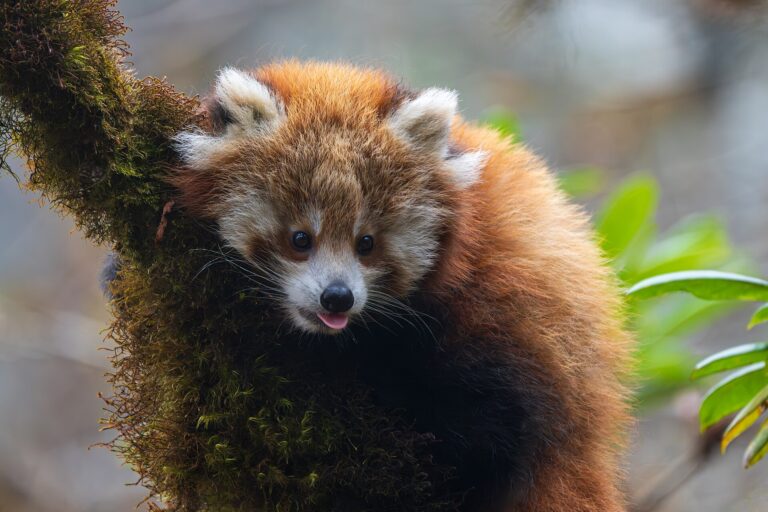
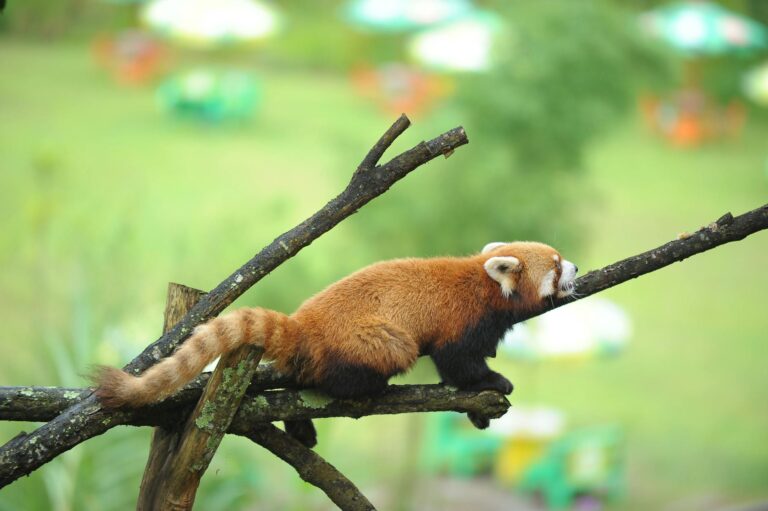
Red pandas (Ailurus fulgens) face a very different predator landscape. At 3 to 6 kg they are firmly in the prey-size range of snow leopards, yellow-throated martens, mountain hawk-eagles, and feral dogs near villages. Arboreal life is their main defence: a red panda spends most of its time in trees and can climb faster than any of its predators. On the ground, however, it is vulnerable, and dog predation in particular is a serious conservation concern in eastern Nepal and parts of India. For the full picture, see our red panda species guide.
Panda merchandise
Browse panda-themed panda plushies and gear at our store, store.welovepandas.org.
Frequently asked questions
What animals eat pandas?
Adult giant pandas are essentially predator-free in the wild. Cubs can be taken by snow leopards, dholes (Asian wild dogs), yellow-throated martens, Asian black bears, and occasionally golden eagles on very young cubs in den caves. The only meaningful threat to adult pandas is humans, almost entirely through habitat loss and incidental snaring set for other animals.
Do snow leopards eat pandas?
Their ranges overlap in some Sichuan reserves, and snow leopards have been recorded taking panda cubs opportunistically. They are not regular panda predators: their main prey is bharal (blue sheep), ibex, and marmots, and adult pandas are too large for a snow leopard to take.
Why do so few animals hunt pandas?
Pandas are big (up to 160 kg), have a very powerful bite, live at low density (one per 3 to 6 km2) in steep terrain, and have low fat content compared to other large mammals. A predator burns more calories looking for them than it can extract from a kill, and the alternatives (ungulates, smaller mammals) are usually more abundant.
What is the panda’s main predator today?
Humans, almost entirely through habitat fragmentation and incidental snaring. Direct hunting has been illegal since the late 1980s and is now rare. Wire snares set for musk deer or Asian black bears occasionally catch pandas as bycatch.
How strong is a panda’s bite?
Bite force quotient about 151 on the Christiansen and Wroe measurements, ahead of a lion (about 124) and a spotted hyena (about 100). Adult pandas can crack bamboo culms 5 cm thick in normal feeding. The same equipment makes them very capable defensively, even though they are not typically aggressive.
Are panda cubs ever killed in zoos?
Captive cub mortality was high in the early days of panda breeding, sometimes from accidental crushing by inexperienced mothers. Modern protocols at Wolong, Chengdu, and Bifengxia (including twin-swap and incubator support for the second cub) have pushed captive survival above 90%. Predation is not a factor in zoo or breeding centre settings.
Have wolves ever attacked pandas?
Wolves historically overlapped the northern edges of panda range, but they are rarely if ever recorded as panda predators. Wolves prefer ungulate prey, and the steep, dense bamboo terrain that pandas occupy is poor wolf habitat. The modern Chinese wolf population is also small and patchy.
What threatens red panda cubs?
Snow leopards, yellow-throated martens, and raptors (mainly mountain hawk-eagles) take red panda cubs. Adult red pandas are also vulnerable to feral dog predation near villages. Their main defence is arboreal life: they climb faster than most predators and spend most of their time off the ground.
Sources and further reading
- IUCN Red List: Ailuropoda melanoleuca (giant panda)
- IUCN Red List: Panthera uncia (snow leopard)
- IUCN Red List: Cuon alpinus (dhole)
- WWF: Giant panda
- National Geographic: Giant panda facts
- Christiansen and Wroe 2007, Bite forces and evolutionary adaptations to feeding ecology in carnivores (Ecology)
For more on panda biology and the conservation context, see our complete giant panda species guide, the giant panda life cycle, and giant panda habitat.
This article is part of our giant panda guide, which links every species, evolution and zoo article on the site.
Updated 14 September 2026: corrected factual details after a full review against primary sources.


The 40 percent first-30-days cub mortality stat is grim. Modern monitored reserves halving that is one of the under-told wins of the breeding programme.
Quick question: are there any documented snow leopard predations on a panda cub? Or is that mostly inferred from range overlap?
Ed, there are a few inferred kills from scat analysis (cub bone fragments in snow leopard scat from Wolong) but no direct field observation. The realistic predator list is built mostly from forensics on cub remains found in den areas.