

Panda Diet: How a Bear Became a Bamboo Specialist
Last updated: November 5, 2026
8 min read
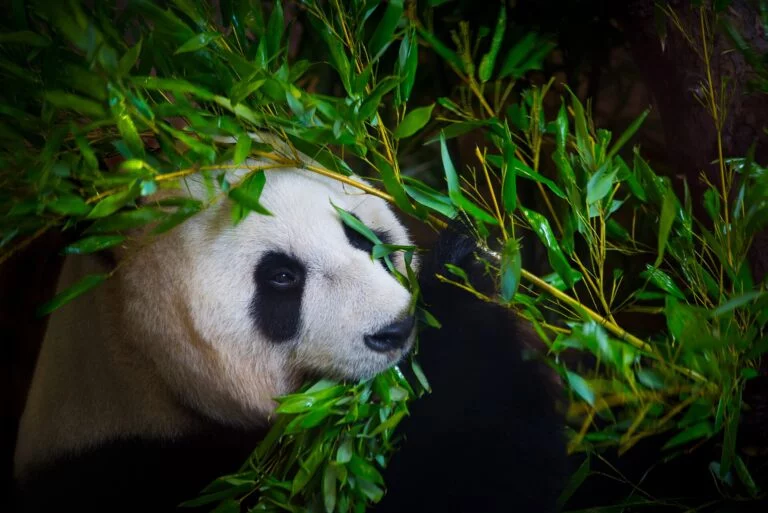
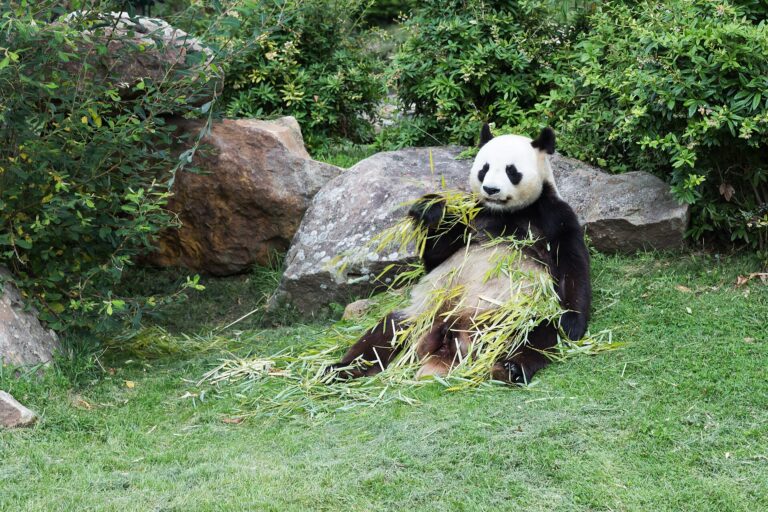
An adult giant panda eats roughly 12 to 38 kg of bamboo each day, despite having a carnivore-like digestive system. The diet is roughly 99 percent bamboo by mass, with the occasional small mammal, bird egg, or piece of carrion thrown in. The switch from a mixed bear diet to near-pure bamboo took millions of years and required an inactivated umami taste gene (TAS1R1), the evolution of a sixth-finger-like pseudo-thumb, and a gut that never quite caught up.
Key facts at a glance
| Daily bamboo intake | About 12 to 38 kg (26 to 84 lb) for an adult |
|---|---|
| Diet composition | About 99 percent bamboo by mass |
| Bamboo species eaten | More than 40 across the range |
| Measured energy digestibility | 9.2 to 34.0 percent in captive bamboo-only trials |
| Daily feeding time | 10 to 16 hours |
| Water | Mostly from the bamboo itself, topped up by drinking from a stream once or twice a day |
| Umami taste gene (TAS1R1) | Pseudogenised; Zhao et al. 2010, Molecular Biology and Evolution |
| Pseudo-thumb origin | At least 6 million years ago (Ailurarctos fossils) |
| Bamboo flowering cycle | Synchronous, every few decades to a century depending on species |
| Mass die-offs | Sichuan, mid 1970s and 1983; more than 200 dead pandas recovered |
What giant pandas actually eat
The headline figure (99 percent bamboo by mass) hides the seasonal detail. Pandas eat different parts of the plant at different times of year, and they prefer specific species over others depending on what is growing.
- Spring (March to May): Bamboo shoots. Tender, high in protein, and mostly water. The most nutritious part of the plant. Pandas peel away the outer sheath with the pseudo-thumb and eat the soft inner core.
- Summer (June to August): Bamboo leaves. Lower in moisture but high in fibre. Pandas strip leaves from the stems using the front teeth and a sideways head motion.
- Autumn and winter (September to February): Bamboo culms, the woody stems. Hardest to digest and lowest in moisture, but available year-round. Pandas crack them open with their molars to reach the softer interior.
The non-bamboo 1 percent matters. Wild pandas have been observed killing and eating pikas and bamboo rats, taking bird eggs, and scavenging carrion when they find it. Several Sichuan reserves have documented pandas raiding maize and sweet potato along the reserve edge. None of this is enough to count as omnivory by mass, but it confirms the gut and the inclination are still bear-like.
Why pandas eat bamboo despite being bears
Three biological adaptations underwrite the bamboo diet. None of them is quite enough on its own, but together they make the diet viable.
TAS1R1: the broken umami gene
Huabin Zhao and colleagues, writing in Molecular Biology and Evolution in 2010, showed that the giant panda’s Tas1r1 gene, one of the pair that codes for the umami taste receptor, is a pseudogene: still present in the genome, riddled with stop codons, and producing no functional protein. Pandas cannot taste the savoury, meat-associated umami flavour. The authors estimated that the functional constraint on the gene relaxed roughly 4.2 million years ago, which lines up with the timing of the diet shift. The causal arrow probably runs both ways: pandas were already eating less meat, the gene drifted, and now meat is less rewarding.
The pseudo-thumb
The famous sixth finger is not a finger at all. It is an enlarged wrist bone, the radial sesamoid, repurposed to oppose the actual five digits and grip bamboo. Pandas use it constantly, peeling sheaths off shoots and holding culms steady while gnawing. The earliest known example comes from Ailurarctos fossils at Shuitangba in Yunnan, described in Scientific Reports in 2022 and dated to about 6 to 7 million years ago, which pushes the bamboo habit back well before the modern panda. The red panda evolved a strikingly similar pseudo-thumb independently, in a completely separate family. Convergent evolution at its clearest.
The pseudo-thumb is just one of the panda’s many adaptations. Our complete giant panda species guide covers the rest.
Bamboo’s year-round availability
The third advantage is dull but important. Bamboo never has an off-season in the panda’s habitat. Shoots emerge in spring, leaves persist through summer, and culms remain edible through winter. A bear that switches to a year-round abundant resource avoids the boom-and-bust calorie cycle of seasonal fruit and meat. That is also why pandas do not hibernate despite living in cold mountain forest: there is always something to eat.
A carnivore’s gut on a herbivore’s diet
Here is where the panda becomes genuinely strange. The digestive anatomy is still bear: a short intestine, no rumen, no caecum capable of fermenting fibre at scale. A panda’s gut is built to process meat. The fact that it instead processes bamboo is the part anatomy cannot explain.
Captive bamboo-only trials measured energy digestibility from 9.2 to 34.0 percent, depending on the bamboo parts eaten. The panda compensates through selective feeding, rapid passage and high intake. Adults eat roughly 12 to 38 kg of bamboo a day. The microbiome does not close the gap either. Xue and colleagues, sequencing 121 faecal samples from 45 pandas at the Chengdu base for mBio in 2015, found a gut community that looks carnivore-like, dominated by Escherichia, Shigella and Streptococcus, low in diversity and wildly variable across seasons, with none of the specialist fibre fermenters a true herbivore carries. Pandas conserve energy through low daily expenditure and long feeding and resting periods.
When the diet shift happened
The fossil record traces the bamboo habit backwards through three genera.
- Ailurarctos (about 7 to 6 million years ago): Already had a thumb-like radial sesamoid and tooth wear suggesting bamboo chewing. It provides the earliest direct fossil evidence of the panda false thumb.
- Ailuropoda microta (about 2 million years ago): Smaller than modern pandas, with a fully developed pseudo-thumb and a skull already optimised for bamboo crushing.
- Ailuropoda melanoleuca (today): The modern giant panda. Same skull pattern as A. microta, scaled up. The specialisation is now total.
Fossils show that the panda lineage was using bamboo by the late Pliocene or early Pleistocene. The evidence does not establish one climate event as the cause of that dietary shift.
Red panda: convergent evolution
The red panda is not closely related to the giant panda. They share an order, Carnivora, but their lineages parted tens of millions of years ago. The red panda is in its own family, Ailuridae, while the giant panda is in Ursidae with the other bears. Yet the red panda is also a bamboo specialist and has also independently evolved a pseudo-thumb from the same wrist bone. Two unrelated lineages stumbled into the same solution. For more on this, see our piece on the red panda species profile.
Energy economy of the bamboo diet
Pandas extract little energy from bamboo, but measured digestibility varies with the bamboo parts eaten. It explains the slow movement, the long daily feeding window of 10 to 16 hours, and the avoidance of energetically expensive activities like long-distance running or fighting.
It also explains the unusually small newborn. A baby panda is about 100 g at birth, roughly one nine-hundredth of the mother’s body weight, the smallest ratio of any placental mammal. The cause remains unresolved. Low maternal nutrition has been proposed, but skeletal studies do not show that panda cubs are unusually premature. For more on this end of the panda’s biology, see our piece on the giant panda life cycle from birth to adulthood.
Pandas still eat meat occasionally
Wild observations going back to the 1980s record pandas killing and eating pikas and bamboo rats opportunistically. There are documented cases of pandas scavenging deer carcasses, eating bird eggs, and taking chickens from farms along the reserve edge. The 1 percent meat figure is probably a slight underestimate of opportunistic intake. None of it changes the basic story: bamboo is the dominant food by mass, and the entire biology is built around it. Captive pandas are typically given balanced biscuits to supplement the bamboo diet.
Bamboo flowering events
Bamboo has a strange reproductive strategy. Most species reproduce vegetatively for decades, sometimes a century, then flower and set seed across an entire population at once in a synchronised gregarious mast. After flowering, the plant dies, and it takes years for seedlings to grow into mature stands.
For pandas this is catastrophic. Sichuan panda country was hit twice inside a decade: a mass flowering in the Min Mountains in the mid 1970s, then arrow bamboo flowering across Wolong and the Qionglai range from 1983. Chinese surveys recovered more than 200 dead pandas across the two events, and in Wolong the local population may have halved. The second die-off is what turned panda conservation into an international campaign. Because the cycle is so long and so synchronised, the risk cannot be designed away, only spread: the Giant Panda National Park’s habitat-corridor design is partly an answer to it, because when one bamboo stand dies, pandas need somewhere else to walk to.
Panda merchandise
Browse panda-themed panda books and gear at our store, store.welovepandas.org.
Frequently asked questions
What do giant pandas eat?
About 99 percent bamboo by mass: shoots in spring, leaves in summer, culms in winter. The remaining 1 percent is occasional pikas, bamboo rats, bird eggs, carrion, and raided farm crops along reserve edges.
How much bamboo does a giant panda eat a day?
An adult eats roughly 12 to 38 kg, with intake and bamboo selection varying by animal and season. Pandas need that volume because bamboo is low in energy and their digestion is inefficient.
Why do pandas eat bamboo if they are bears?
Their gut is still carnivore-shaped, but their umami taste gene is broken, so meat no longer tastes especially rewarding, and bamboo is abundant year-round in their habitat. Taste loss, bamboo availability and the pseudo-thumb together cemented the shift over millions of years.
Are giant pandas vegetarian?
Functionally yes, at about 99 percent plant material, but they eat meat opportunistically when the chance arises. The gut is still set up to digest meat efficiently; the issue is finding it, not processing it.
Why do pandas have to eat so much?
Bamboo is low in energy and panda digestion is inefficient. Captive bamboo-only trials measured energy digestibility from 9.2 to 34.0 percent, so pandas compensate through selective feeding and high intake.
Can pandas survive without bamboo?
In captivity, yes, on a mix of bamboo, specialised biscuits and supplements. In the wild, no. The Sichuan die-offs of the 1970s and 1980s killed pandas in numbers, and bamboo availability remains the single most important factor in wild panda survival.
Do red pandas eat the same things as giant pandas?
Mostly. Red pandas are also overwhelmingly bamboo eaters, taking mainly leaves and tender shoots rather than woody culms, supplemented by berries, acorns, lichen, eggs and small rodents. They arrived at that diet independently.
Why does all the bamboo die at once?
Most bamboo species reproduce vegetatively for decades, then flower and set seed simultaneously across an entire population. Once they flower, they die. The synchronised die-off can wipe out a wild panda’s food supply across a whole valley.
Sources and further reading
- IUCN Red List: Ailuropoda melanoleuca
- WWF: giant panda species profile
- Zhao et al. 2010, Pseudogenization of the umami taste receptor gene Tas1r1
- Xue et al. 2015, The bamboo-eating giant panda harbors a carnivore-like gut microbiota
- Wang et al. 2022, Earliest giant panda false thumb
For more on related panda biology: how pandas differ from other bears, a brief history of the giant panda, and 21 cool facts about pandas.
This article is part of our giant panda guide, which links every species, evolution and zoo article on the site.
Updated 14 September 2026: corrected factual details after a full review against primary sources.



The TAS1R1 pseudogenisation is one of those evolutionary stories that almost reads as a punishment. Cannot taste meat, cannot extract meat-quality energy from food, has to live in a salad bar.
Worth mentioning: pandas occasionally eat carrion or small mammals. The 1 percent non-bamboo is not zero and probably matters more nutritionally than the percentage suggests.
The synchronous bamboo flowering every 60 to 120 years is the kind of fact that sounds invented. Whole bamboo forests dying simultaneously every century like a forest-wide clock.