

Pandamonium: How Giant Pandas Became So Popular In The West
Last updated: November 5, 2026
4 min read
The giant panda is one of the first things people outside China picture when they think of China at all. That is a recent development. For sixty years after Western science first described the species, almost nobody in Europe or America had seen one alive. This is how the panda went from a pelt in a Paris museum to a global mascot.
The pandas held by zoos outside China are leased, not owned. Our article on the costs and conditions for renting giant pandas explains how that works. And the panda became a global icon partly because of how close it came to disappearing: see why giant pandas became endangered.
1869: a pelt reaches Paris
The first Westerner to record the animal was Armand David, a French missionary and naturalist working in Sichuan. In 1869 he obtained a skin from a hunter near Baoxing and sent it back to the Natural History Museum in Paris. He took it for a new kind of bear and proposed the name Ursus melanoleucus; Henri Milne-Edwards formally described the species the following year and moved it to its own genus.
That the panda really is a bear was argued about for the next century. The question was only settled in 1985, when Stephen O’Brien and colleagues compared protein chemistry, chromosomes and DNA across pandas, bears and raccoons and placed the giant panda firmly inside the bear family as an early-branching lineage.
The trophy years
The immediate consequence of Western interest was not affection. It was shooting. In 1929 Theodore Roosevelt Jr. and Kermit Roosevelt, sons of the former president, killed a panda on a Field Museum expedition and wrote a book about it, Trailing the Giant Panda. Their account made the animal briefly famous and triggered a run of Western expeditions through the 1930s, some collecting skins and some taking cubs alive for zoos. The total number killed was small, a few dozen at most, but the publicity turned the panda into a desirable trophy at exactly the wrong moment for a species already losing its forest.
1936: Su Lin changes the story
The turn came in 1936, when the American dress designer Ruth Harkness went to China after her husband died on his own panda expedition, and came back carrying a cub in a basket. She named it Su Lin and believed it was female; it was in fact male. Brookfield Zoo bought the cub in April 1937, and the public reaction is hard to overstate. About 325,000 people came in the first three months. One Sunday brought over 53,000 through the gate. Shirley Temple, Helen Keller, John Barrymore and Kermit Roosevelt, who had shot one eight years earlier, all came to look.
The bottle-fed cub in the arms of a woman in a fur coat is the image that reset the Western idea of the panda: not a trophy, but something closer to an infant. Su Lin died of pneumonia in 1938, weeks after a second panda arrived. The body is still at the Field Museum in Chicago.
From gifts to leases
After 1949 the People’s Republic used pandas as diplomatic instruments, sending them to allies and, in 1972, to Washington after Nixon’s visit. China ended state gifts in 1982, used short exhibitions from 1984 and began modern long-term scientific cooperation in 1994. Most pandas abroad now live under fixed-term agreements, whose fees and cub-return terms vary. That system is why panda news is a constant cycle of arrivals and departures, and why a zoo that has pandas this year may not have them next.
What makes them so appealing
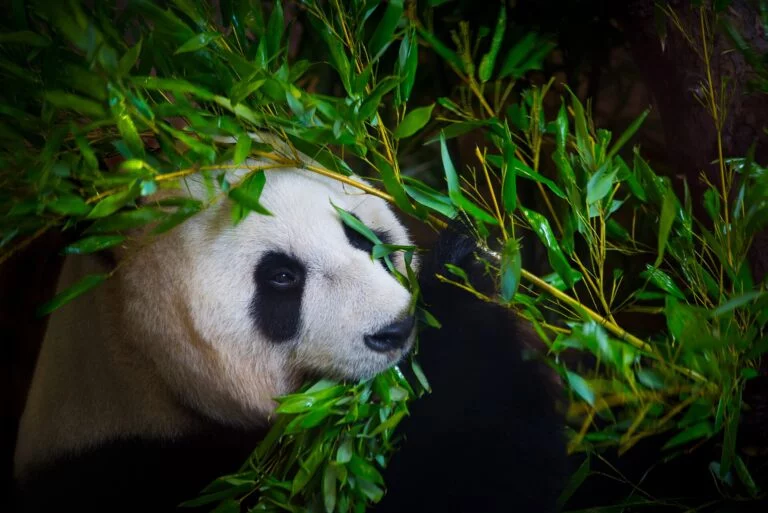
Part of it is the face. The black patches enlarge the apparent size of the eyes, and oversized eyes in a round face are the standard trigger for the response humans have to infants. Part of it is the posture: a panda sits up to eat, holds its food in something that works like a thumb, and looks, briefly, like a person having lunch.
Part of it, too, is the reputation for being hopeless at breeding, which is only half deserved. The failed 1966 attempt to mate London Zoo’s Chi-Chi with Moscow’s An An was heavily covered in the press and helped fix that idea. A female panda is fertile for something like 36 to 48 hours a year, which is less a character flaw than a very narrow window.
And part of it is the diet. Bamboo makes up about 99 percent of what a giant panda eats, and an adult can put away tens of kilos of it a day. There is something absurd about a carnivore that spends half its waking life chewing grass, and absurdity travels.
The logo
The single biggest boost to the panda’s global standing was graphic design. In 1961 the founders of the World Wildlife Fund wanted a symbol that would reproduce cleanly in black and white, and Peter Scott drew one based on Chi-Chi at London Zoo. Sixty-five years later the logo has barely changed, and hundreds of millions of people who could not name a single Chinese mammal know that outline.
Panda merchandise
Browse panda-themed panda plushies and gear at our store, store.welovepandas.org.
Sources
- Smithsonian Magazine: how America fell in love with the giant panda
- WWF: the history of the panda logo
- Field Museum, Chicago
This article is part of our giant panda guide, which links every species, evolution and zoo article on the site.
Updated 14 September 2026: corrected the panda-loan timeline and agreement terms after review against primary sources.



The Teddy Roosevelt panda hunt is one of those bits of conservation history I have to remind myself was real. Pretty much every charismatic species has a chapter like this in its past.
David in 1869 to DNA confirmation in the 1970s is just over 100 years. Wild that it took that long for taxonomists to agree pandas are bears. Cool example of how slow science can be.
Pandas replacing the dragon as the symbol of China in the Western mind is true but kind of an uncomfortable fact. Soft power via cuteness is a different game than power via mythology.