

Giant Panda Habitat: Where They Live, Why It Shrank, and How It Is Coming Back
Last updated: November 5, 2026
8 min read
Giant pandas live in temperate bamboo forest at 1,200 to 4,100 m elevation, spread across six mountain ranges in three Chinese provinces: Sichuan, Shaanxi, and Gansu. Their occupied habitat shrank sharply during the 20th century thanks to commercial logging, agricultural conversion, and road construction. The trend reversed after China’s 1998 national logging ban, and the Giant Panda National Park, piloted from 2017 and formally established in October 2021, now manages roughly 22,000 km2 as one protected landscape aimed at reconnecting the 33 fragmented subpopulations the last full census identified.
Key facts at a glance
- Total occupied habitat (fourth national census): about 25,800 km2, or 2.58 million hectares.
- Giant Panda National Park: roughly 22,000 km2 across three provinces, formally established October 2021. The 2017 pilot plan covered 27,134 km2.
- Range provinces: Sichuan, Shaanxi, Gansu.
- Mountain ranges: Minshan, Qionglai, Daxiangling, Xiaoxiangling, Liangshan, Qinling.
- Elevation: 1,200 to 4,100 m, with Qinling pandas tending higher.
- Forest type: Temperate broadleaf and mixed conifer forest with a dense bamboo understorey.
- Subpopulations: 33 fragmented blocks, 18 of which hold fewer than 10 pandas each.
- Home range size: 4 to 6 km2 per panda.
Where giant pandas live today
Modern giant pandas live in a narrow ribbon of temperate forest along the eastern edge of the Tibetan Plateau, where the warm, wet east of China meets the dry, cold west. The total occupied habitat is about 25,800 km2, fragmented into 33 subpopulations across six mountain ranges. This is a small range compared to other large mammals: roughly the size of Wales. Within it, pandas are picky. They need temperate forest with a dense bamboo understorey, on steep enough ground to keep most human activity out, between roughly 1,200 and 4,100 m.
That shrinking habitat is central to the panda’s conservation story. We trace the full picture in our piece on why giant pandas became endangered in the first place.
The six mountain ranges
- Minshan: Northern Sichuan and southern Gansu. The largest single panda subpopulation, holding roughly half of all wild giant pandas.
- Qionglai: Central Sichuan, west of Chengdu. Home of the famous Wolong reserve.
- Daxiangling: Small range south of Qionglai with a thin, narrow strip of habitat.
- Xiaoxiangling: Very few pandas, and the site of the Liziping release programme.
- Liangshan: Southernmost panda range, 124 animals at the fourth census, isolated from the other Sichuan ranges.
- Qinling: In Shaanxi province, north of Sichuan and separated by the Hanzhong Basin. Home to the genetically distinct Qinling subpopulation, with its slightly browner coat.
Three provinces
Although panda range crosses three provinces, the centre of gravity is Sichuan: five of the six ranges and roughly 75% of all wild pandas are there. Shaanxi holds the Qinling subpopulation, around 18%, and Gansu holds the northern fringes of the Minshan range with 132 animals, about 7%. The southern slope of Gansu’s Min Mountains is the only Gansu panda habitat, and it sits adjacent to a much larger contiguous Sichuan block.
What panda habitat actually looks like
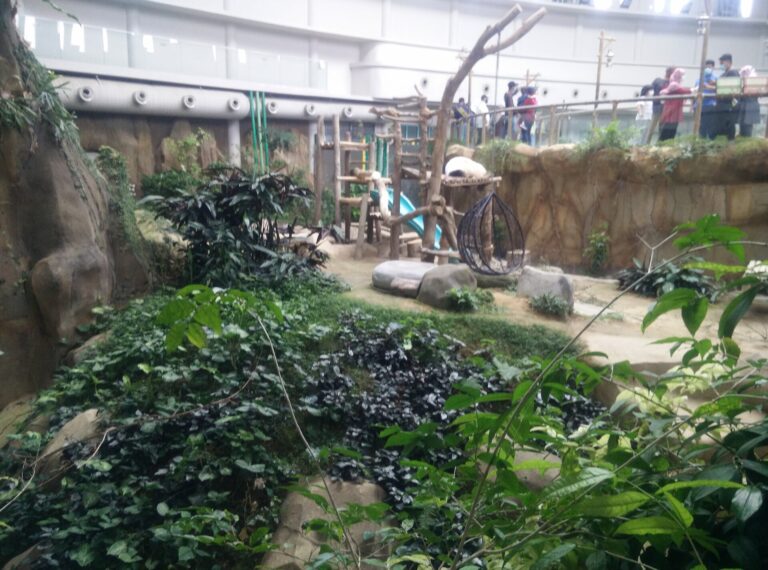
Panda habitat is not the open meadow of zoo enclosures. It is dense, wet, mountainous forest. The overstorey is typically a mix of broadleaf evergreens, broadleaf deciduous trees such as birch and maple, and conifers including fir and hemlock depending on elevation. Below the canopy, a thick bamboo understorey covers most of the ground, sometimes for kilometres on end. Pandas feed on more than 40 bamboo species, although any single population usually relies on just a handful.
Climatically, panda habitat is cold and wet. Winters are long, with significant snowfall at higher elevations. Summers are warm and damp. Steep slopes, broken terrain, and cliffs are the rule. This is why human pressure has historically been bounded: panda habitat is genuinely difficult to convert to farmland or pasture, and the pandas that have hung on have done so in the steepest, least accessible blocks.
Historical range
Giant pandas used to live across far more of China than they do now. Fossil and archaeological evidence shows them in northern China, eastward toward the Yangtze delta, and southward into northern Vietnam and Myanmar. That historical range was an order of magnitude larger than today’s. The retreat to today’s compact Sichuan, Shaanxi and Gansu corner has happened over thousands of years, and the pace accelerated dramatically in the 20th century.
Why panda habitat shrank
Three broad drivers explain the long retreat. First, Chinese agriculture pushed up the valleys and converted the lower forest belt to farmland. This is a slow, multi-millennium process. Second, state-driven timber harvest between roughly 1950 and 1998 cleared vast areas of mature forest in Sichuan and Shaanxi, including some of the best panda habitat. Third, bamboo flowering events, which are natural but occasionally synchronised, caused mass panda starvation in the 1970s and 1980s and accelerated local declines.
Bamboo flowering and the 1970s die-off
Bamboo is a strange plant: each species flowers, sets seed, and dies in a synchronised mass event, sometimes only once every few decades. When this happens to the bamboo species that a panda population depends on, the population is in serious trouble. In 1975 and 1976, a mass flowering of umbrella bamboo on the Sichuan and Gansu border killed an estimated 138 pandas, whose remains were recovered in the years that followed. In 1983 around 95 percent of the arrow bamboo in affected areas flowered and died. The rescue campaign that followed captured 108 pandas, of which 33 died in captivity. Together these events helped pull the wild population to its low point of around 1,114 by the mid-1980s. They also drove the modern understanding that pandas need access to multiple bamboo species and connected habitat to weather flowering cycles.
Why habitat is now recovering
The trend reversed in the late 1990s. Three policies did the work. The first and biggest was the 1998 national logging ban, brought in after the disastrous Yangtze River floods of that year. The ban ended commercial timber harvest across panda range almost overnight, and forest cover has recovered substantially since. The second was the Sloping Land Conversion Programme, which paid hill farmers to retire steep, marginal cropland and plant trees. The third was the buildout of the panda reserve network: 67 reserves had been declared by 2010, covering most of the occupied range and a meaningful share of potential corridor habitat.
The result is visible at the population level. The fourth national census counted 1,864 wild pandas, up 16.8% from the 1,596 counted in the previous survey. On the strength of that result, the IUCN downlisted the species from Endangered to Vulnerable in 2016. Chinese official statements in 2025 put the wild population at nearly 1,900 and protected panda habitat at 2.58 million hectares. The story is told in more detail in giant panda conservation efforts and our overview of whether giant pandas are now safe from extinction.
The 33 isolated subpopulations
The headline good news hides a less cheerful structural problem: the population is broken into 33 separate blocks. Some are large and healthy. Eighteen of them hold fewer than 10 pandas each, far below any estimate of the minimum viable population size for a slow-breeding bear. Small isolated subpopulations are at risk from local bamboo die-offs, inbreeding depression, and stochastic events such as landslides or wildfires. Without genetic exchange between blocks, the long-term trajectory is not as positive as the headline count suggests.
This is where the Giant Panda National Park comes in. The park merged the previously separate reserves and the land between them into one protected unit of roughly 22,000 km2, with active reforestation and corridor planting between the isolated blocks. Six ecological corridors have been built so far, and the park now connects the habitats of 13 local panda populations. Wildlife crossings, the removal of small hydropower stations in panda corridors, and consolidated monitoring are all part of the plan. The piece on the new Giant Panda Mega-Reserve goes into the full story.
Habitat and the bamboo cycle
Bamboo synchronicity is the single most important biological reason panda habitat needs to be connected and species-diverse. If a panda population depends on one bamboo species and that species flowers and dies, the panda has two options: starve or walk to another patch of habitat with a different bamboo. In a fragmented landscape, the second option does not exist, and the result is a local extinction. The two 20th century flowering events are the clearest illustration of why habitat continuity is not optional. Pandas need to be able to move.
The good news is that the bamboos pandas rely on do not all flower in synchrony. A well-connected national park, with panda movement between subpopulations, has a much better chance of riding out the next flowering event without population-level damage. The fragmented landscape of the 1980s and 1990s could not.
Red panda habitat: a parallel story
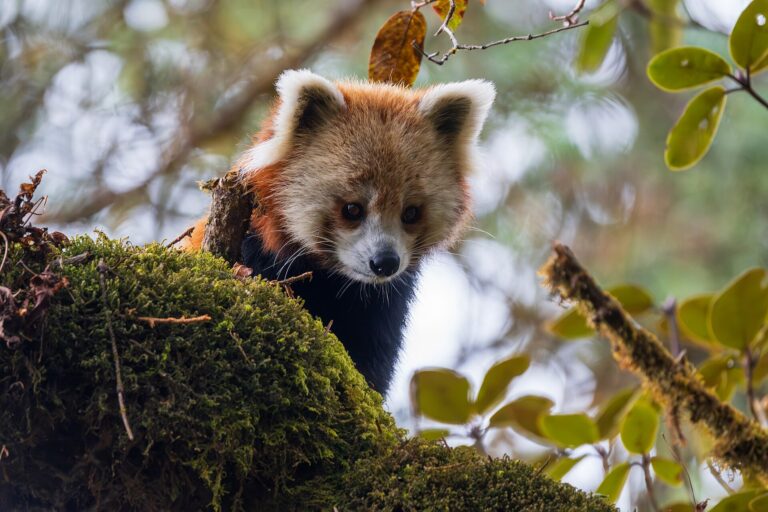
Red pandas live in similar temperate forest at similar elevations, but in the eastern Himalayas rather than Sichuan: a thin strip across Nepal, India, Bhutan, northern Myanmar, and southern China. Their habitat faces many of the same threats, but the politics is harder: five countries rather than one, with very different conservation budgets and capacities. There is no equivalent to the Giant Panda National Park for red pandas, although Bhutan and Sikkim have done good work at the national and state level. For the full red panda picture, see our red panda species guide.
The red panda faces real conservation pressure of its own. We explain why in our piece on why red pandas matter.
The two panda species share more than a name. Our guide to 50 panda facts about giant pandas and red pandas covers both.
Panda merchandise
Browse panda-themed panda home decor and gear at our store, store.welovepandas.org.
Read next
- Panda Facts: 50+ Surprising Things About Giant Pandas and Red Pandas (2026)
- Giant Panda Lifespan: How Long Do Pandas Live?
- Giant Panda Breeding Programs: Are They Working?
Frequently asked questions
Where do giant pandas live?
In six mountain ranges across Sichuan, Shaanxi, and Gansu in central China, at 1,200 to 4,100 m in temperate bamboo forest. Sichuan holds about 75% of all wild pandas, Shaanxi holds the Qinling subpopulation, and Gansu holds the northern fringe of the Min Mountains.
How much panda habitat is left?
About 25,800 km2 of occupied habitat at the fourth national census. Most of it now sits inside the Giant Panda National Park, roughly 22,000 km2, which was formally established in October 2021 to consolidate and reconnect the previous reserve network.
Did panda habitat shrink in the 20th century?
Yes, substantially. The losses came from commercial logging, agricultural conversion, and road and rail construction. The 1998 national logging ban stopped the trend and the population has been recovering since.
What is panda habitat actually like?
Cold, wet, mountainous, with a mixed conifer and broadleaf canopy and a dense bamboo understorey. Snow in winter, monsoon rain in summer, and steep broken slopes throughout.
Why are there 33 separate panda subpopulations?
Centuries of human pressure broke the original continuous range into 33 isolated forest blocks. Eighteen of them hold fewer than 10 pandas each. Reconnecting them is the central goal of the Giant Panda National Park.
What is the largest panda subpopulation?
The Minshan range, straddling northern Sichuan and southern Gansu. It holds roughly half of all wild giant pandas and is the most contiguous block of habitat in the species’ modern range.
Where is the Qinling subpopulation?
In Shaanxi province, north of Sichuan and isolated from the rest of panda range by the Hanzhong Basin. Qinling pandas have a slightly different skull and a noticeably browner coat, and are sometimes treated as the subspecies Ailuropoda melanoleuca qinlingensis.
How does the Giant Panda National Park help habitat?
By merging previously separate reserves into one administrative unit and prioritising the reforestation of corridors between the fragmented subpopulations. Six ecological corridors have been built, connecting the habitats of 13 local panda populations, and monitoring is now coordinated across the range with infrared cameras and drones.
Sources and further reading
- IUCN Red List: Ailuropoda melanoleuca
- UNESCO: Sichuan Giant Panda Sanctuaries
- WWF: Giant Panda National Park
- Fourth National Giant Panda Survey (State Forestry Administration, published 2015)
- Xinhua reporting on Giant Panda National Park, 2025 and 2026
For more on the panda’s biology and the conservation history behind today’s range, see our complete giant panda species guide, history of the giant panda, and natural predators of giant pandas.
This article is part of our giant panda guide, which links every species, evolution and zoo article on the site.




Roughly the size of Wales is a great frame for the occupied habitat. Most readers wildly overestimate how much land pandas occupy. The whole species lives in a Wales-sized ribbon.
The 1998 logging ban tied to the Yangtze flood disaster is one of those policy levers I wish more nations would copy. Disaster-driven environmental wins are not the way you want it to happen but sometimes the only way it does.
Qinling pandas tending higher in elevation is the bit I think gets glossed. They are genetically distinct enough that a few papers argue for full subspecies status.
Hina, exactly right. The Ailuropoda melanoleuca qinlingensis subspecies designation has been proposed since the 90s and there is good morphometric and genetic support. The 2005 Wan et al paper is the one to read.