How Long Do Pandas Sleep, and Where Do They Sleep?
Last updated: November 5, 2026
3 min read
Giant pandas sleep roughly 10 to 12 hours a day, but not in one long stretch. They alternate two to four hour bamboo sessions with short naps, often slumped against a trunk or sprawled on a slope. They do not hibernate, do not build dens for sleep, and will doze almost anywhere their food has left them.
Key facts
| Average daily sleep | Roughly 10 to 12 hours, in pieces |
|---|---|
| Pattern | Short naps between bamboo sessions, not one long block |
| Hibernation | No |
| Preferred sleep posture | Slumped against a trunk or sprawled belly-down |
| Sleep in trees | Yes, especially cubs and younger adults |
| Sleep cycle drivers | Bamboo digestion, temperature, season |

Why pandas sleep in short blocks, not all night
A giant panda’s day is shaped by bamboo. Bamboo is low in nutrients and the panda gut is short and meat-eater-shaped, which means food passes through quickly. A wild panda will eat for several hours, rest for two to four hours, and start again. Summer rest periods can exceed six hours. Over 24 hours this stacks up to roughly 10 to 12 hours of sleep, but it is split into many short bouts.
Captive pandas at Chinese bases such as Wolong and Bifengxia show similar patterns, with extra rest during the hottest part of the afternoon. Pandas are not neatly nocturnal or diurnal: feeding and resting bouts turn up at all hours, which makes the species broadly cathemeral, active in scattered bursts across the day and the night.
Where pandas actually sleep in the wild
Pandas do not build proper dens for sleeping. They use the landscape. Common sleep sites include the base of a large fir tree, a slope between two bamboo clumps, a flat shelf of rock, or a fork in a low branch. They prefer 1,500 to 3,000 m elevation in the Sichuan corridors and tend to choose sleep spots with a clear retreat path.
Cubs and sub-adults often climb to sleep. A cub will pick a horizontal branch several metres above the ground and wedge itself into the fork, sometimes with all four limbs hanging. Adults are too heavy for most branches and stay on the ground.
Mothers do build a den, but it is for cubs, not for sleep. A maternity den is usually a hollow log or rock cavity where the newborn cub spends its first weeks while the mother forages in short shifts.
Why pandas do not hibernate
Bears like the brown bear and American black bear hibernate for months because food disappears in winter and they can survive by burning fat reserves. Pandas live in a niche where bamboo is available year round. There is no nutritional reason to shut down for the winter, so they do not.
In fact pandas may move downhill in winter, following bamboo species that stay edible at lower elevation. Winter behaviour shifts mean longer feeding sessions and slightly shorter sleep, not the reverse. The full picture is in our explainer on whether pandas hibernate.
Captive sleep versus wild sleep
In a zoo a panda’s day is structured around two or three bamboo deliveries. Sleep tends to cluster around delivery times: a heavy meal, a long nap, a bit of climbing, more bamboo, another nap. The result is fewer but longer sleep blocks than in the wild, and a higher chance of seeing a panda mid-snooze if you visit in the afternoon.
Captive cubs sleep substantially more than adults, sometimes 16 hours a day in the first few months. This drops to adult levels around 18 months, which lines up with when bamboo replaces milk as the main food.
Related reading on welovepandas
- do pandas hibernate
- Species Profile: The Giant Panda
- Species Profile: The Red Panda
- 7 differences between pandas and other bears
- the giant panda life cycle
- panda nanny: best job on earth
Sources and further reading
This article is part of our Giant Panda guide hub.
Frequently asked questions
How many hours a day do pandas sleep?
Around 10 to 12 hours total, broken into multiple short naps between feeding sessions.
Do pandas hibernate?
No. Bamboo is available year-round in panda habitat, so there is no need to enter the long torpor that brown bears and black bears use.
Do pandas sleep in trees?
Cubs and younger adults often nap in trees. Older adults are usually too heavy for branches and sleep on the ground.
Do pandas snore?
They do make rasping breathing noises when deeply asleep. Mothers and cubs sometimes vocalize quietly while dozing, but a true loud snore is rare.
Do red pandas sleep the same way?
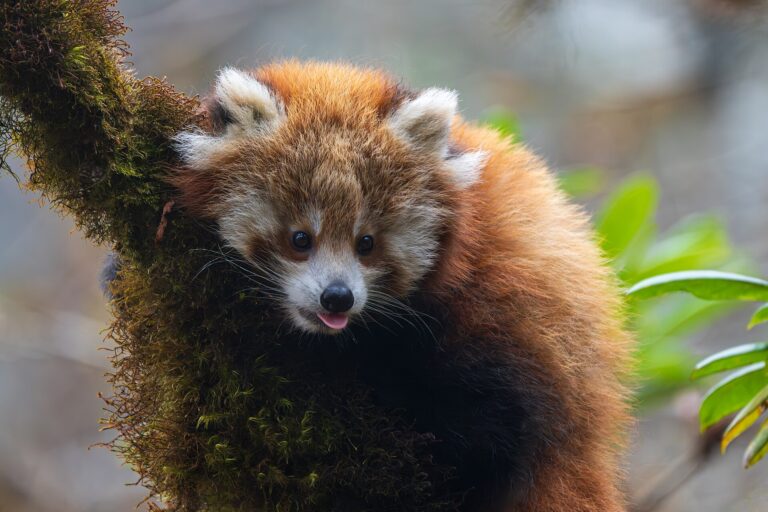
Red pandas are more arboreal. They sleep curled up on branches with the tail wrapped around the body, often for 12 to 14 hours a day, mostly in daylight.
This article is part of our panda facts guide, which links every article on panda biology, behaviour and culture.
Updated 14 September 2026: corrected factual details after a full review against primary sources.