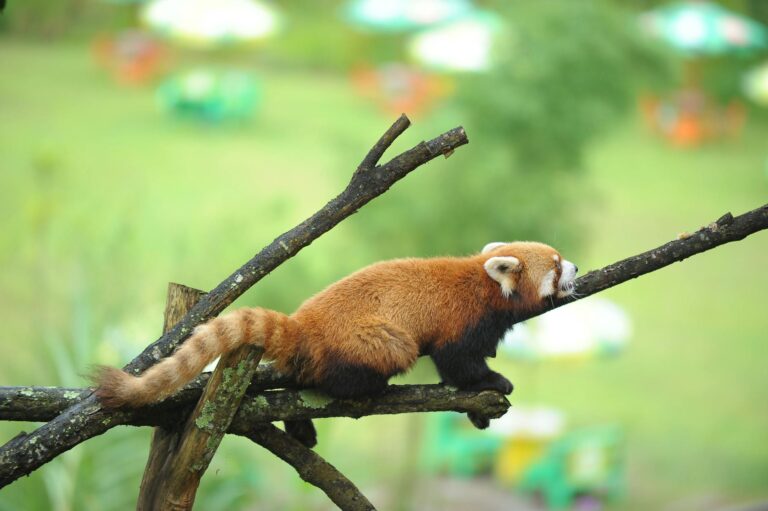
Red Panda Subspecies: Himalayan vs Chinese Red Panda
Last updated: November 18, 2026
5 min read
Red pandas come in two forms, the Himalayan red panda and the Chinese red panda. Whether they are two species or two subspecies of one species is still debated. A 2020 genome study proposed two species, Ailurus fulgens and Ailurus styani. The IUCN Red List still assesses one species, Ailurus fulgens, listed as Endangered since 2015, and a 2025 study argued for keeping the two as subspecies. This page uses the same wording as our red panda species profile.
Key facts
| Himalayan red panda | Ailurus fulgens as a species, or Ailurus fulgens fulgens as a subspecies |
| Chinese red panda | Ailurus styani as a species, or Ailurus fulgens styani as a subspecies |
| Two species proposed | 2020, Hu et al., Science Advances 6: eaax5751 |
| Divergence | About 220,000 years ago (Hu et al. 2020) |
| Boundary | Yarlung Tsangpo river, called the Siang in Arunachal Pradesh, India, and the Brahmaputra downstream |
| Status of the split | Debated. A 2025 study found gene flow across the Siang and recommended subspecies |
| IUCN status | Endangered since 2015, assessed as one species, Ailurus fulgens |
The 2020 proposal: two species
In 2020 a Chinese team led by Yibo Hu and Fuwen Wei published a study of 65 whole genomes, 49 Y chromosomes and 49 mitochondrial genomes in Science Advances. They found that the Himalayan and Chinese red pandas diverged about 220,000 years ago and, together with differences in skull shape and coat, concluded that they are two phylogenetic species: Ailurus fulgens for the Himalayan red panda and Ailurus styani for the Chinese red panda. Styani was already a subspecies name, so no new name was needed.
The study also moved the boundary. The Nujiang (Salween) river had been taken as the dividing line. The genomes showed that red pandas in southeastern Tibet and northern Myanmar belong to the Chinese form, and the authors named the Yarlung Tsangpo (Yalu Zangbu) as the most likely boundary. They had no samples from India or Bhutan and said these were needed to confirm it.
A 2021 study by the Zoological Survey of India filled that gap with samples from Arunachal Pradesh. Animals west of the Siang grouped with the Himalayan red panda and animals east of it, in the Dibang valley, grouped with the Chinese red panda. It proposed the Siang as the boundary.
The case for subspecies
In 2025 the same Indian team returned to the Siang with more data (Dalui, Sharma and Thakur, Journal of Biogeography). Mitochondrial DNA still showed two lineages about 300,000 years apart. Nuclear markers, though, showed ongoing gene flow across the river, and field photographs from the contact zone showed no clear physical differences. The authors concluded that the two forms are not fully isolated and recommended treating them as subspecies.
The IUCN Red List has not split the red panda. Its current assessment, from 2015, covers one species, Ailurus fulgens, listed as Endangered. Until the IUCN or the main mammal checklists settle the question, the safe wording is one species with two forms, with a two-species proposal under debate.
How they look different
Both are roughly cat-sized, with rusty coats, bushy ringed tails and a white face mask. According to Hu and colleagues, the Chinese red panda has a larger skull, a redder face with less white on it, and more distinct tail rings, with darker red dark rings and whiter pale rings. The Himalayan red panda has more white on the face and fainter tail rings.
These are tendencies rather than reliable field marks. The 2025 Indian study found no clear differences in animals from the contact zone. If you are at a zoo, the label is a better guide than the animal.
Range and habitat
The Himalayan red panda lives west of the Siang. In Nepal it has been recorded in 24 districts, as far west as the Tila Karnali river in Kalikot District, western Nepal, at about 81.66 degrees east (Shrestha et al. 2021). From there it runs east through Sikkim and the north of West Bengal in India, through Bhutan, and into central and western Arunachal Pradesh and southern Tibet.
The Chinese red panda lives east of the Siang: the Dibang valley in eastern Arunachal Pradesh, southeastern Tibet, Yunnan and Sichuan in China, and northern Myanmar. So India and China each hold both forms, Nepal and Bhutan hold only the Himalayan red panda, and Myanmar holds only the Chinese red panda. Laos is not a range country for either. For each country’s population estimate and habitat area, see red panda range by country.
Habitat is similar for both: temperate broadleaf and mixed conifer forest with a dense bamboo understorey, at roughly 2,200 to 4,800 metres (Hu and colleagues, 2020). Both are arboreal, solitary and eat bamboo for the great majority of their diet.
What it means for zoos and conservation
Zoos already keep the two forms apart. North American zoos manage Himalayan and Chinese red pandas as separate groups within the Species Survival Plan, and a 2021 genetic study of 67 zoo animals found enough difference to justify that. The European breeding programme focuses on the Himalayan form. Most zoo Chinese red pandas are in Japan: zoo records for 2017, published by Nagoya’s Higashiyama Zoo, counted 349 Chinese red pandas worldwide, 254 of them in Japan, against 612 Himalayan red pandas.
In the wild, Hu and colleagues found that the Himalayan red panda has very low genetic diversity and a high genetic load, and that its range across Nepal, India, Bhutan and southern Tibet needs cross-border cooperation. Within the Chinese red panda they found three genetic groups, each of which they suggested managing as its own unit. The 2025 Indian study recommends instead one subspecies-based plan that keeps the populations connected.
Related reading on welovepandas
Sources and further reading
- Hu et al. (2020), Genomic evidence for two phylogenetic species and long-term population bottlenecks in red pandas, Science Advances 6: eaax5751
- Joshi et al. (2021), Siang river in Arunachal Pradesh splits red panda into two phylogenetic species, Mammalian Biology
- Dalui, Sharma and Thakur (2025), Red panda phylogenetic conundrum: are there two distinct species?, Journal of Biogeography
- Shrestha et al. (2021), The endangered Himalayan red panda: first photographic evidence from its westernmost distribution range, Journal of Threatened Taxa
- IUCN Red List: Ailurus fulgens (2015 assessment)
- Dueck (2021), Genetic assessment of captive red pandas in American zoos, Zoo Biology
- EAZA: Red panda EEP
- Higashiyama Zoo, Nagoya: Styan’s red panda
Frequently asked questions
How many species of red panda are there?
One or two, depending on the source. The IUCN assesses one species, Ailurus fulgens, with two forms. A 2020 genome study proposed two species, the Himalayan (Ailurus fulgens) and the Chinese (Ailurus styani). A 2025 study found gene flow between them and argued for subspecies.
What divides the two?
The Yarlung Tsangpo river, called the Siang in Arunachal Pradesh. The 2020 study proposed it, and a 2021 study with Indian samples supported it.
Do the two meet in the wild?
Yes, along the Siang in Arunachal Pradesh. The 2025 study found gene flow across the river there.
Which is more threatened?
The IUCN has one Endangered listing that covers both, so there is no separate assessment. The 2020 study found that the Himalayan red panda has very low genetic diversity, which is a long-term risk.
Which kind do zoos hold?
Both. European zoos breed the Himalayan form. North American zoos keep both, in separate groups. In 2017 most zoo Chinese red pandas were in Japan, and Himalayan red pandas outnumbered Chinese ones in zoos worldwide, 612 to 349.
This article is part of our giant panda guide, which links every species, evolution and zoo article on the site.
Updated 16 November 2026: made the species and subspecies wording consistent, added the 2021 and 2025 Siang river studies, extended the Himalayan range to western Nepal, corrected the zoo lines, and linked every source.