

50 Panda Facts: Giant Pandas and Red Pandas (2026)
Last updated: November 5, 2026
10 min read
Fifty quick, sourced facts about giant pandas and red pandas: diet, lifespan, the sixth-finger pseudo-thumb, panda diplomacy, the IUCN reclassification from Endangered to Vulnerable in 2016, twin abandonment, and the surprising taxonomy of the red panda. Some of these you may have heard before. Most you have not. There are about 1,864 wild giant pandas left (China State Forestry 2014 census). Bamboo is 99 percent of the giant panda diet but their gut is still that of a carnivore. The red panda is not a bear at all; it sits in its own family, closer to weasels and raccoons than to pandas. Let us go through the lot.
Key facts at a glance
| Wild giant panda population | Nearly 1,900 in China’s November 2025 update |
|---|---|
| Giant panda IUCN status | Vulnerable (downlisted from Endangered in 2016) |
| Red panda IUCN status | Endangered (under 10,000 mature individuals) |
| Giant panda scientific name | Ailuropoda melanoleuca (“black and white cat-foot”) |
| Red panda scientific name | Ailurus fulgens |
| Bamboo as percent of giant panda diet | About 99 percent |
| Daily bamboo intake | About 12 to 38 kg for an adult |
| Measured energy digestibility | 9.2 to 34.0 percent in captive bamboo-only trials |
| Adult weight | Males 86 to 125 kg, females 70 to 100 kg |
| Wild lifespan | About 15 to 20 years |
| Captive lifespan | Commonly 20 to 30 years; reported record: Xinxing, 38 years and four months |
| Panda diplomacy loan cost | About $1 million USD per pair per year |
Giant panda facts (1 to 25)

Diet and digestion (facts 1 to 5)
- Bamboo is 99 percent of the diet. Giant pandas eat almost nothing but bamboo, with very occasional small rodents, fish, or bird eggs. The remaining 1 percent matters: it provides protein and fat that bamboo alone cannot supply.
- Adults eat roughly 12 to 38 kg of bamboo a day. The amount and parts selected vary with the animal and season.
- They have a carnivore-like gut. Captive bamboo-only trials measured energy digestibility from 9.2 to 34.0 percent, depending on the diet.
- Their umami receptor gene became non-functional. The timing suggests that this change followed the shift towards bamboo instead of causing it.
- They poop a lot. A wild panda produces around 40 to 50 droppings per day, sometimes more. Each one contains a high proportion of barely-digested bamboo fragments. Field researchers use the droppings for DNA censusing.
Anatomy and the pseudo-thumb (facts 6 to 10)
- The pseudo-thumb is not a thumb. The famous “sixth finger” is an enlarged wrist bone called the radial sesamoid, not a true digit. It works as an opposable thumb for gripping bamboo culms.
- Scientific name means “black-and-white cat-foot.” Ailuropoda melanoleuca: Ailuropoda (“cat-foot”) refers to the catlike paw shape, melanoleuca (“black and white”) to the obvious. Pere Armand David named the species in 1869.
- Pandas are bears. Family Ursidae, subfamily Ailuropodinae, sister to the rest of the bear family. DNA settled the debate in the 1980s; before that some scientists put them with raccoons.
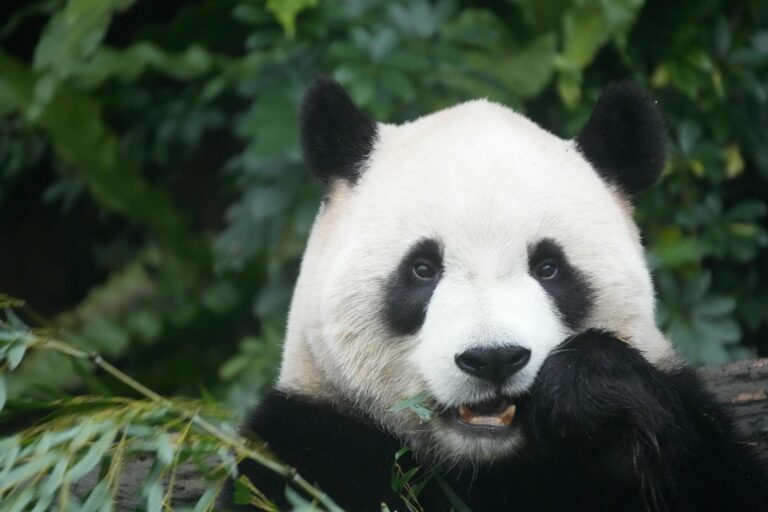
- The black-and-white pattern works. A 2017 paper in Behavioral Ecology argued that the black on the legs and shoulders camouflages pandas against shadows, while the white blends into snowy terrain, and the high-contrast face markings function in signalling to other pandas.
- Adult pandas have powerful jaws. Their bite force is enough to crack bamboo culms several centimetres thick. The molars are wide and flat, evolved specifically for crushing fibrous plant material.
Behaviour and communication (facts 11 to 15)
- Pandas are solitary. Adults live alone outside the spring breeding season and have only brief contact with other adults. Mothers and cubs are the only sustained social unit.
- They scent-mark heavily. Anogenital glands leave waxy deposits on trees and rocks, communicating individual identity, sex, and reproductive status. Field biologists can recognise individual pandas by scent-mark patterns.
- They climb to escape. Cubs and subadults are vulnerable to leopards and dholes, and their main defence is to climb a tree. Adult pandas climb less but can still get up a 10 metre trunk when needed.
- They are not silent, but they do not roar. Studies of captive pandas during the breeding season pick out calls including bleats, chirps, honks, moans, growls, barks and squeals. The bleat is the friendly contact call; the bark is a threat.
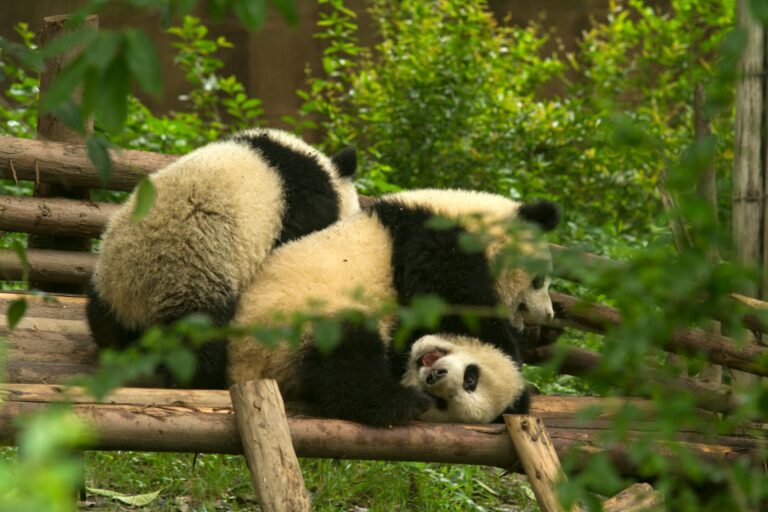
- Captive pandas play. Slides, rolling, mock wrestling, water play. The Chengdu Research Base is now famous for video of pandas tumbling down slopes, which the keepers encourage as enrichment.
Reproduction and cubs (facts 16 to 20)
- Pandas are born tiny. About 100 grams, 1/900 of the mother’s body weight. They are blind, hairless, and pink. No placental mammal has a more extreme size ratio between mother and newborn.
- Twin births occur in human care. A mother usually raises one cub at a time. Managed breeding teams can rotate twins between maternal care and an incubator. See why panda reproduction is so tricky.
- Sexual maturity is late. Females reach sexual maturity at about five years and males at about six years.
- Estrus is 36 to 48 hours, once a year. The shortest single annual receptive window of any bear. Miss it and the next opportunity is twelve months away.
- Gestation is 84 to 184 days. The variability comes from delayed implantation; the embryo can pause development for weeks before settling into the uterine wall.
History and culture (facts 21 to 25)
- Western science met the panda in 1869. Pere Armand David, a French missionary and naturalist, sent the first specimen to Europe from Sichuan. He also collected the dove tree and the golden snub-nosed monkey on the same trips.
- The first live panda reached the West in 1936. Su Lin, a cub, was brought from Sichuan to the Brookfield Zoo in Chicago by Ruth Harkness. Public interest in pandas in the West essentially dates from that moment.
- Panda diplomacy is a 1,300 year tradition. By one Japanese court record, Empress Wu Zetian sent two white bears to Emperor Tenmu in 685 CE, though whether they were pandas is disputed. Modern panda diplomacy is more transactional: loaned pandas cost about $1 million USD per pair per year, with cub-return terms set by each agreement. See a brief history of the giant panda.
- The WWF panda logo was designed in 1961. By naturalist Peter Scott, inspired by Chi Chi, who reached London Zoo in 1958 after passing through Moscow, Berlin, Frankfurt and Copenhagen. The logo has since raised hundreds of millions of dollars for conservation.
- The 1985 census found 1,114 wild pandas. The 2014 census found 1,864. The recovery is one of the success stories of modern conservation. Climate change is the long-term concern; some bamboo species are projected to shift uphill or out of the panda range by 2050. For the full causal chain, see what caused the panda to become endangered.
Red panda facts (26 to 40)
Taxonomy and species (facts 26 to 30)
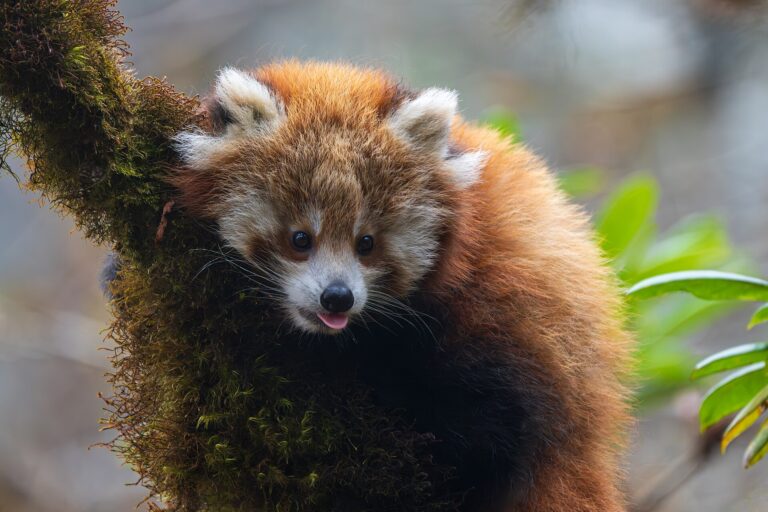
- The red panda is not a bear. It is in its own family, Ailuridae. DNA places it closest to the mustelid-procyonid clade (weasels, raccoons, skunks), not bears.
- There are two species, not one. A 2020 paper in Science Advances split the red panda into two species: the Himalayan red panda (Ailurus fulgens) and the Chinese red panda (A. styani). They have been reproductively isolated for at least 250,000 years.
- It is the original “panda.” The red panda was described by Frederic Cuvier in 1825, 44 years before the giant panda (1869). The name “panda” probably came first from the Nepali “ponya.”
- It has its own pseudo-thumb. Like the giant panda, the red panda has an enlarged radial sesamoid that helps it grip bamboo. This is a textbook case of convergent evolution: two unrelated species solving the same problem the same way.
- The red panda was the original “Firefox.” The Mozilla browser logo refers to a Chinese folk name for the red panda. The animal is unrelated to actual foxes.
Diet, range, and behaviour (facts 31 to 35)
- Red pandas eat mostly bamboo, but not only. Bamboo is around 95 percent of the diet; they also take fruit, insects, small mammals, and birds eggs. More flexible than the giant panda.
- They live across five countries. China, Nepal, Bhutan, India, and Myanmar. The range stretches across the Himalayas and into the Hengduan mountains. Giant pandas live only in China.
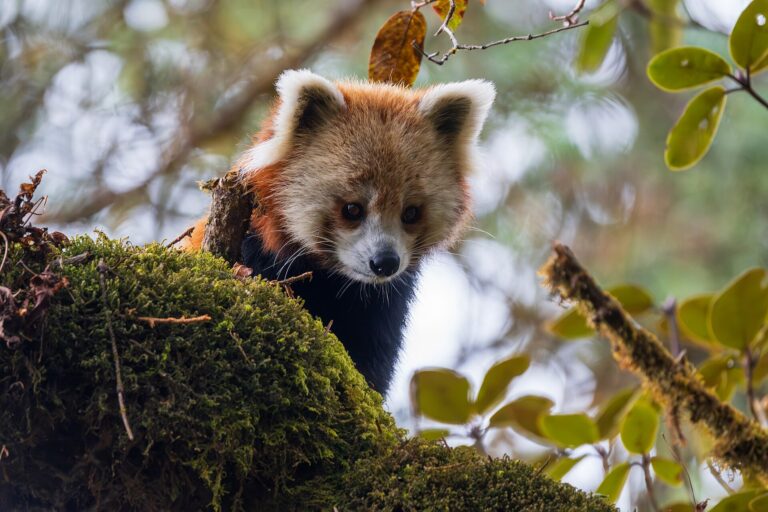
- They are mostly arboreal. Red pandas spend most of their time in trees, sleeping curled on branches and descending mainly to feed and move between feeding trees.
- They are cold-adapted. Dense fur, including fur on the soles of the feet, lets them stay active down to minus 10 Celsius. They wrap their bushy tails around themselves like a blanket while sleeping.
- They are nocturnal-crepuscular. Most active around dawn and dusk, sleeping through the heat of the day and the cold of midnight. This is different from giant pandas, which are active in shorter bouts throughout 24 hours.
Conservation (facts 36 to 40)
- Red pandas are Endangered. The IUCN estimates fewer than 10,000 mature individuals across all five range countries. Population is declining.
- Habitat loss is the main pressure. Forest clearance for farming, livestock grazing, and firewood collection. The Himalayan species is hit harder; the Chinese species has more protected habitat overlap with giant panda reserves.
- Hunting still happens. Red pandas are killed for fur (used in traditional hats in some regions) and for the pet trade. Nepal and India have particular problems with poaching.
- They are well represented in zoos. Captive red pandas breed reliably, unlike giant pandas. The global captive population is several hundred individuals across dozens of zoos.
- Red Panda Network is the dedicated NGO. Founded 2007, runs anti-poaching patrols and forest restoration in eastern Nepal. Probably the most effective single conservation organisation working on the species. See seven reasons red pandas matter.
Conservation and modern status (facts 41 to 50)
- Giant Panda National Park covers about 22,000 square kilometres. Formally established in 2021, it integrated 73 nature reserves into one protected area across Sichuan, Shaanxi, and Gansu. It holds around 1,340 wild pandas, roughly 70 percent of China’s total.
- The Sichuan Giant Panda Sanctuaries are UNESCO World Heritage. Inscribed in 2006, the site takes in seven nature reserves and nine scenic parks across 9,245 square kilometres, including Wolong, Mt Siguniang and the Jiajin Mountains.
- Wolong Hetaoping is one of the big three. The main Chinese captive breeding facilities are the Chengdu Research Base, which held 244 pandas at the end of 2024, plus Wolong Hetaoping and Bifengxia.
- Managed cub survival improved. Twin swapping, formula feeding and partial hand rearing raised reported neonatal survival to 71 percent during 1990 to 2002.
- Artificial insemination supports the breeding programme when natural mating does not work. Natural mating has produced higher pregnancy and birth rates. See is the breeding program failing for context.
- Xinxing was the oldest captive panda. The female Xinxing died at Chongqing Zoo on 8 December 2020, aged 38. Jia Jia, at Hong Kong’s Ocean Park, also reached 38 before her death in 2016. See the oldest giant pandas alive today.
- Pandas have natural predators. Leopards, dholes, yellow-throated martens, and Asiatic black bears can take cubs and subadults. Adult pandas have essentially no natural predator in modern China. See natural predators of giant pandas.
- Pandas are an umbrella species. Protecting panda habitat indirectly protects over 8,000 vertebrate and plant species, including snow leopards, takin, golden snub-nosed monkeys, and the Chinese giant salamander. See how panda conservation saves other species.
- Climate change is the long-term threat. Some bamboo species are projected to shift uphill or out of the current panda range by 2050. The corridor design of Giant Panda National Park is partly insurance against this.
- Pandas are a Chinese national treasure. Under National First-Class Protected Animal status, illegal hunting or killing can bring a prison sentence of ten years or more, plus a fine or confiscation of property in especially serious cases. The protection has been effective either way: direct hunting of pandas is functionally zero.
Frequently asked questions
How many pandas are left in the wild?
China’s November 2025 update reported nearly 1,900 wild giant pandas. The last full national survey counted 1,864 through fieldwork from 2011 to 2014. The red panda figure below 10,000 mature individuals comes from the 2015 IUCN assessment.
Are giant pandas still endangered?
The IUCN downlisted the giant panda from Endangered to Vulnerable in 2016 after population growth and habitat protection improvements. The Chinese government still treats the species as a National First-Class Protected Animal, with sentences of ten years to life for killing one. Climate change is the new long-term concern.
Why do pandas eat bamboo if they are bears?
Their gut is still carnivorous and inefficient at processing bamboo, but a gene mutation in the umami taste receptor (TAS1R1) blunted their interest in meat, and bamboo is the dominant year-round food in their mountain habitat. Over millions of years, this combination locked them into a bamboo diet despite their poor digestive efficiency.
How much bamboo does a giant panda eat per day?
An adult eats roughly 12 to 38 kg of bamboo a day. The amount and parts selected vary with the animal and season.
Is a red panda a panda?
It carries the name and shares the bamboo habit, but it is in its own family, Ailuridae. DNA places it closer to weasels and raccoons than to bears. The red panda also got the name first: it was described in 1825, 44 years before the giant panda. There are now two recognised red panda species (Himalayan and Chinese) split by a 2020 paper in Science Advances.
Do pandas have a sixth finger?
The “pseudo-thumb” is an enlarged wrist bone (the radial sesamoid), not a true digit, but it works as an opposable thumb for gripping bamboo. The red panda has independently evolved the same structure, which is a textbook example of convergent evolution.
How long do pandas live?
China’s forestry authority gives a wild giant panda average of about 19 years. Giant pandas in human care commonly live for 20 to 30 years. Xinxing reached a reported 38 years and four months.
What is panda diplomacy?
Most giant pandas abroad live under fixed-term scientific cooperation loans. Terms, fees and cub-return dates vary by agreement. Mexico’s Xin Xin descends from earlier diplomatic gifts. A disputed Japanese court record describes two white bears sent by Empress Wu Zetian in 685 CE.
Sources and further reading
- IUCN Red List: giant panda
- IUCN Red List: red panda
- WWF giant panda profile
- Smithsonian National Zoo giant panda fact sheet
- National Geographic giant panda profile
- UNESCO: Sichuan Giant Panda Sanctuaries
- Giant panda species profile
- Red panda species profile
- A brief history of the giant panda
- Giant panda life cycle from birth to adulthood
- Why panda reproduction is so tricky
- Seven unique differences between giant pandas and other bears
- The oldest giant pandas alive today
- How giant pandas became bamboo-dependent
- Natural predators of giant pandas
This article is part of our panda facts guide, which links every article on panda biology, behaviour and culture.
Updated 14 September 2026: corrected factual details after a full review against primary sources.


Saved this for my niece. She is doing a school project on endangered animals and the bit about the TAS1R1 gene is gonna make her teacher’s eyes pop. Thanks for not dumbing it down.
Small note: the red panda figure of under 10,000 mature individuals is the IUCN headline number but a few range-state surveys put it lower. The Nepal estimate has been revised down twice in the last decade. Worth a footnote maybe.
Thanks Priya, good point. I leaned on the 2015 reassessment number because the country-level surveys give wildly different estimates and pooling them is messy. I will add a note in the next refresh.
Wait, Xinxing lived to 38?? I thought ~25 was the captive ceiling. Now I want to read about her specifically.
The twin abandonment fact gets me every time. Imagine evolving in a way that means your species literally cannot raise both babies at once. Bamboo really did a number on this animal.