

Panda Trivia – Questions & Answers
Last updated: November 5, 2026
3 min read
The word “panda” covers animals that are not close relatives at all: the giant panda, its Qinling subspecies, and the red panda, which is not a panda in any meaningful sense. This page is a quick tour of all three, with the real facts behind each one, and it links out to three separate trivia games so you can test what you have learned.
If you have ever wondered why a red panda and a giant panda look nothing alike, the short answer is that the two are not closely related and the shared name is a quirk of zoological history.
The giant panda
The giant panda (Ailuropoda melanoleuca) is the national symbol of China and a global ambassador for conservation. It lives only in the mountains of central China, in Sichuan, Shaanxi and Gansu, where bamboo forest covers the slopes between roughly 1,200 and 3,400 metres. An adult giant panda gets through roughly 12 to 38 kilograms of bamboo a day. Intake and selection vary by animal and season.
It is a true bear, a member of the family Ursidae. Adults weigh roughly 70 to 125 kilograms. Despite the all-bamboo diet its gut is still a carnivore’s, so it digests bamboo inefficiently and has to eat enormous volumes to survive. In 2016 the International Union for Conservation of Nature moved the giant panda from Endangered to Vulnerable, after China’s fourth national survey counted 1,864 through fieldwork from 2011 to 2014.
The Qinling panda
The Qinling panda is a recognised subspecies of the giant panda, named after the Qinling Mountains of Shaanxi Province. It was formally described as Ailuropoda melanoleuca qinlingensis in 2005. Two things set it apart. First, colouring: instead of stark black and white, some Qinling pandas are dark brown and light brown, which is why the population is sometimes called the brown panda. Second, the skull is smaller and the head rounder than in the Sichuan pandas.
The Qinling population is small and isolated, on the order of a few hundred animals, cut off from the main panda range for long enough that genetic work puts the separation in the hundreds of thousands of years. Brown individuals are rare even within it, and a 2024 study linked the colour to a recessive deletion in the Bace2 gene. You can read more in our page on the wild pandas of the Qinling Mountains.
The red panda
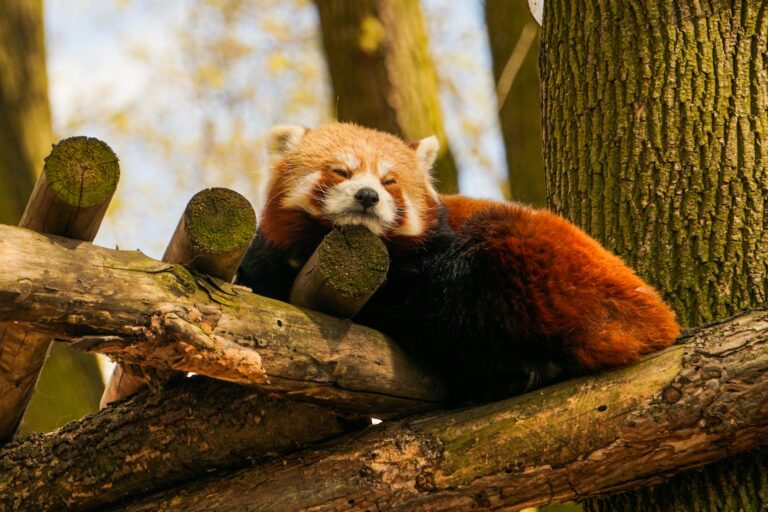
The red panda is often assumed to be a small cousin of the giant panda. It is not. It is not a bear and not a member of the giant panda’s family. It sits in its own family, Ailuridae, and its closest relatives are raccoons, skunks and weasels, all part of the superfamily Musteloidea.
Here is the twist of history: the red panda was described by Western science first, in 1825, and held the name “panda” alone. The giant panda was described decades later and picked up the name because of a few shared traits, chiefly a taste for bamboo and a similar false-thumb wrist bone used to grip stems. The red panda is, in a sense, the original panda, and the giant panda borrowed the name.
Red pandas are about the size of a large house cat, weighing roughly 3 to 6 kilograms. They live in temperate forest across the eastern Himalayas and southwestern China, in Nepal, India, Bhutan, Myanmar and China. The IUCN lists the red panda as Endangered, with a declining wild population threatened by deforestation and poaching. Since 2020, genomic work has split the red panda into two species, the Himalayan and the Chinese red panda, which our piece on red panda species and subspecies covers in detail.
Three pandas, three different stories
- Giant panda: a bear, black and white, central China, around 1,900 in the wild, status Vulnerable.
- Qinling panda: a subspecies of the giant panda found only in the Qinling Mountains, a few hundred animals, occasionally brown rather than black.
- Red panda: not a panda at all, a cat-sized animal in its own family, Himalayas and southwest China, status Endangered, and since 2020 treated as two species.
What they do share is a heavy reliance on bamboo. It is a low-energy food, so each of these animals has had to solve the same hard problem: how to live on a plant that barely pays for the effort of eating it.
Trivia games
Now that you know the difference between the three, put it to the test. We have a separate game for each animal, with the answers revealed under each question, so they work either as a quick game or as fast revision.
This article is part of our panda facts guide, which links every article on panda biology, behaviour and culture.
Updated 14 September 2026: corrected factual details after a full review against primary sources.




Good entry point for kids. Used this as a starter activity for a wildlife class and the giant vs qinling vs red panda triplet of quizzes is genuinely useful pedagogically.