

Panda Umbrella Species: Who Shares Their Habitat
Last updated: November 5, 2026
10 min read
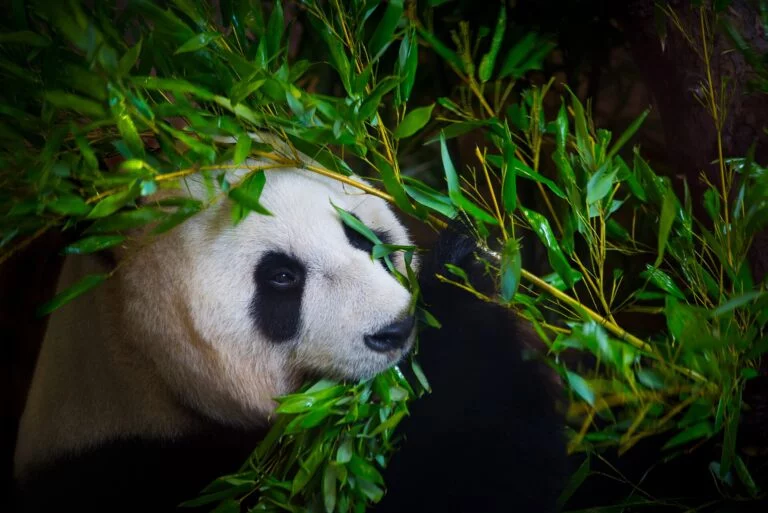
The giant panda is the textbook umbrella species. Protecting enough habitat to hold a viable panda population also protects snow leopards, takin, red pandas, golden snub-nosed monkeys, clouded leopards, Asiatic black bears, blood pheasants and Chinese giant salamanders, along with the more than 8,000 animal and plant species recorded inside Giant Panda National Park. When WWF picked a panda for its 1961 logo it chose an animal whose range sits on top of most of central China’s mountain biodiversity. That overlap has since been measured. So have the gaps.
Key facts at a glance
| Giant Panda National Park area | 27,134 km squared (established 12 October 2021) |
|---|---|
| Reserves consolidated into the park | 67 |
| Species protected | More than 8,000 wild animals and plants |
| Panda habitat inside endemism centres | Over 96 percent (Li and Pimm, Conservation Biology, 2016) |
| Endemic vertebrates the umbrella misses | 14 mammals, 20 birds, 82 amphibians |
| “Umbrella species” term | In use since the 1980s (Wilcox; later reviewed by Roberge and Angelstam) |
| WWF panda logo adopted | 1961 |
| UNESCO World Heritage listing | Sichuan Giant Panda Sanctuaries (2006) |
| Bamboo species pandas eat | More than 40 across the range |
What “umbrella species” actually means
The literature uses three overlapping terms for charismatic species that anchor protection efforts, and the panda is often called one when it really is another. A flagship species raises public awareness and funding for a habitat. A keystone species has an effect on its ecosystem out of all proportion to its abundance, the classic case being the sea otter, whose predation on urchins keeps kelp forests standing. An umbrella species needs so much intact habitat that protecting it indirectly protects everything else living there.
The giant panda is unambiguously a flagship and an umbrella. It is not a keystone in the strict sense: pandas eat a great deal of bamboo, but the bamboo would do fine without them.
What makes the umbrella work is the shopping list. Pandas need large tracts of mid-elevation temperate forest with a healthy bamboo understorey, low human density, several bamboo species within reach so they can switch as each one dies back, and corridors between sub-populations. Dozens of other Chinese mountain mammals, birds and plants need the same things. Draw a line around enough panda habitat to support a viable population and you have drawn a line around the montane temperate forest community.
The shared habitat
Modern panda habitat is six mountain ranges across three provinces: Sichuan, Shaanxi and Gansu. The dominant habitat is mixed broadleaf and coniferous forest between roughly 1,200 and 3,500 metres. Below that the land is farmed. Above it the forest gives way to alpine meadow and rock. Inside the panda zone the bamboo understorey is the defining feature, feeding the pandas (which are known to eat more than 40 bamboo species across their range) and providing structure for everything else. Giant Panda National Park, established on 12 October 2021, joined 67 previously separate reserves and protected areas into one connected block of 27,134 square kilometres.
The terrain is steep, human density was already low before the reserves were gazetted, and the road network is sparse. All three made panda habitat hard for people to use intensively, and made it the last refuge for species that need wilderness. Many of them had been pushed out of lowland China by centuries of agriculture long before the pandas were. They retreated to the mountains and have lived alongside pandas ever since.
Major mammal beneficiaries
The headline beneficiaries are the other large mammals of the Sichuan and Shaanxi mountains. Several are IUCN Vulnerable or Endangered in their own right, and most have a substantial share of their Chinese range inside panda reserves.
Snow leopard (Panthera uncia, Vulnerable)
Snow leopards live along the upper edge of panda country in the Minshan and Qionglai ranges, where panda forest gives way to rock and alpine meadow above roughly 3,000 metres. They do not hunt pandas: blue sheep, ibex and marmots are the prey. They do need the same intact, low-disturbance mountain terrain. The umbrella has only partly held for them. A 2020 study in Nature Ecology and Evolution found snow leopard distribution inside giant panda nature reserves has contracted by 38 percent since the 1960s, the smallest loss of the four large carnivores measured but a loss all the same.
Red panda (Ailurus fulgens, Endangered)
Red pandas and giant pandas share a lot of forest at the same mid-elevations and eat largely the same bamboo, though red pandas also take fruit, insects and small mammals. Where the ranges overlap, protecting one protects the other. The catch is geography: red pandas extend across Nepal, Bhutan, India and Myanmar, and most of the species’ range lies outside Chinese giant panda territory. Giant panda conservation helps, but it does not cover the red panda. See the red panda species profile for the wider picture.
Takin (Budorcas taxicolor, Vulnerable)
The takin is a goat-antelope of the high Sichuan and Qinling forests, weighing up to 350 kg. If you are looking for pandas in the wild and you do see a large mammal, the odds are it is a takin. Their range overlaps panda habitat almost completely, and the Sichuan subspecies (B. t. tibetana) is concentrated inside panda reserves.
Golden snub-nosed monkey (Rhinopithecus roxellana, Endangered)
One of the most striking primates anywhere, with a turquoise face and a long copper coat, the golden snub-nosed monkey lives in the same mid-elevation forests as the panda. It is endemic to central China and most of its population sits within or beside panda reserves. Pere Armand David collected the first specimens on the same Sichuan trips of the 1860s that brought the giant panda to Western attention; Alphonse Milne-Edwards described the species formally in 1870.
Asiatic black bear (Ursus thibetanus, Vulnerable)
The Asiatic black bear is the other bear of panda country. The two share the forest and both take bamboo shoots when they are up. Asiatic black bears are still hunted illegally for bile and body parts across much of Asia. Enforcement inside panda reserves is far stronger than in unprotected Asian forest, which makes these mountains one of the few places the species is doing well.
Clouded leopard, leopard cat and dhole
The mid-sized and smaller carnivores of panda habitat include the clouded leopard (Vulnerable), the leopard cat (Least Concern) and the dhole or Asian wild dog (Endangered). Dholes are pack hunters and one of the few animals that can take a subadult panda. They are also the clearest failure of the umbrella: the same 2020 survey put dhole range loss inside panda nature reserves at 95 percent since the 1960s, the steepest decline of any large carnivore measured there.
Birds and herpetofauna
The mid-elevation forests of Sichuan and Shaanxi are one of the world’s most important regions for endemic birds. The Chinese monal (Lophophorus lhuysii), blood pheasant (Ithaginis cruentus), golden pheasant (Chrysolophus pictus) and white-eared pheasant all live in panda habitat and benefit directly from reserve protection. The crested ibis (Nipponia nippon), reduced to seven wild birds in 1981, has its core habitat in Shaanxi, in country adjacent to the Qinling panda population.
Among amphibians the Chinese giant salamander (Andrias davidianus, Critically Endangered) matters most. It lives in the cold, fast streams draining panda forest, grows over 1.5 metres long and is the largest amphibian on earth. Hunting for food and habitat damage from dams drove its decline, and protecting the stream catchments inside panda reserves is one of the few conservation measures that has worked for it. Like the dove tree below, its first specimens known to Western science were collected by Pere Armand David.
Plants
The plant biodiversity of panda habitat is the part visitors never think about. The dove tree (Davidia involucrata), with white flower bracts that hang like handkerchiefs, is endemic to the same forests and was collected on the same David expeditions. Endemic rhododendrons, magnolias and dawn redwoods (Metasequoia glyptostroboides, a conifer thought extinct until it was found alive in central China in 1944) all grow in panda-protected catchments.
UNESCO puts the flora of the Sichuan Giant Panda Sanctuaries at between 5,000 and 6,000 species in over 1,000 genera, with 50 genera endemic to China and 67 plant species under national protection. Pharmacologists have a particular interest in these forests because so many traditional medicinal plants come from them, Coptis chinensis and several rhubarb species among them.
How well the umbrella works
The overlap has been mapped, not just assumed. Binbin Li and Stuart Pimm compared panda range with the distributions of China’s endemic forest birds, mammals and amphibians (Conservation Biology, 2016). Over 96 percent of panda habitat fell inside the centres of endemism for those three groups, about as strong a result as an umbrella species can produce.
The same paper counted what the umbrella misses: 14 mammal, 20 bird and 82 amphibian species whose ranges lie largely outside existing panda reserves. They cluster in Sichuan, Yunnan and Hainan, and in eastern mountain ranges where pandas do not live at all. Amphibians come off worst, because they are tied to particular streams and elevations rather than to forest cover.
Limits of the umbrella
Three groups of species fall outside panda conservation entirely. Low-elevation species first: the panda no longer lives in lowland China, so panda reserves do nothing for the South China tiger, the Yangtze finless porpoise, the Chinese alligator or the wetland birds of the lower Yangtze. Then high-altitude Tibetan plateau species: Tibetan antelope, kiang, wild yak and Tibetan brown bear all live above the panda zone and need their own reserve networks. Then marine species, where the panda is irrelevant by definition.
There is also a limit inside the panda’s own range, and it is the uncomfortable one. Sheng Li and colleagues tracked large carnivores across the panda reserve network and found their distributions have collapsed since the 1960s (Nature Ecology and Evolution, 2020): dhole down 95 percent, leopard down 81 percent, wolf down 77 percent, snow leopard down 38 percent. Panda reserves protect forest and bamboo well. On their own they have not kept the predator community intact, which is why the authors argue for managing these areas for trophic complexity rather than for one species.
This is why China runs other flagship programmes in parallel. The Tibetan antelope and snow leopard underpin Sanjiangyuan National Park on the plateau, the Yangtze finless porpoise underpins freshwater protection along the river, and the South China tiger keeps a captive breeding effort going. The panda umbrella is the most successful of them, not the only one.
Other Chinese flagship species
- South China tiger: no confirmed wild individual for decades and treated as extinct in the wild. The surviving animals are captive, and reintroduction is still at the site-assessment stage.
- Yangtze finless porpoise: Critically Endangered, but the 2022 basin survey counted 1,249 animals, up 23 percent on 2017 and the first increase on record.
- Yangtze sturgeon: declared Extinct in the Wild by the IUCN in July 2022. In 2025 the species spawned naturally in the Chishui River for the first time in more than 25 years.
- Crested ibis: down to seven wild birds in Yangxian, Shaanxi in 1981; over 12,000 by the end of 2025, and downlisted from Critically Endangered to Endangered.
- Tibetan antelope (chiru): Near Threatened, recovering on the Tibetan plateau after the collapse of the shahtoosh wool trade.
What it adds up to
The giant panda is not remarkable as a herbivore. It digests bamboo badly, breeds awkwardly and recovers slowly. For conservation purposes it is still the most valuable single species in China. It raises money from anyone with a television, panda loans carry a fee of about a million US dollars a year per pair that goes into conservation work in China, its range covers most of central China’s mountain biodiversity, and the political will to protect it has held through several decades of fast economic change. For more on where that leaves the species, see are pandas still endangered and Giant Panda National Park explained.
Panda merchandise
Browse panda-themed panda plushies and gear at our store, store.welovepandas.org.
Frequently asked questions
What is an umbrella species?
A species whose conservation indirectly protects many others through shared habitat. Draw a protected boundary big enough to hold a viable population of the umbrella species and you have drawn it around everything else that lives there. The giant panda is the textbook example.
How many species benefit from panda conservation?
More than 8,000 species of wild animals and plants live inside Giant Panda National Park, the 27,134 square kilometre reserve created in 2021 from 67 existing protected areas. Major beneficiaries include snow leopards, red pandas, takin, golden snub-nosed monkeys, Asiatic black bears, clouded leopards, Chinese giant salamanders and Chinese monal pheasants.
Are pandas a keystone species?
In the strict ecological sense, no. Their direct effect on the ecosystem is modest: they eat a lot of bamboo, but the bamboo would do fine without them. They are best classed as a flagship species (charismatic enough to drive funding) and an umbrella species (so habitat-dependent that protecting them protects what shares the habitat).
Why was the giant panda chosen as the WWF logo?
For recognisability as much as biology. Peter Scott drew the 1961 logo, and the panda was already familiar to the public through Chi Chi, who arrived at London Zoo in 1958. It was an instantly readable symbol for the kind of habitat protection WWF wanted to fund.
Does protecting pandas save snow leopards?
Partly. Snow leopards and pandas overlap along the upper edge of panda forest in the Minshan and Qionglai ranges, so reserve protection reaches them. It has not been enough: a 2020 study in Nature Ecology and Evolution found snow leopard distribution inside panda nature reserves has shrunk by 38 percent since the 1960s. Large carnivores need management aimed at them, not only at pandas.
What is the takin and why does it matter?
The takin (Budorcas taxicolor) is a goat-antelope of the high Sichuan and Qinling forests, up to 350 kg, listed Vulnerable. Its range overlaps panda habitat almost completely and the Sichuan subspecies is concentrated inside panda reserves. If you go looking for wild pandas and see a large mammal, it is probably a takin.
Are red pandas saved by giant panda conservation?
Partially. The ranges overlap in Sichuan, but red pandas extend into Nepal, Bhutan, India and Myanmar where giant pandas do not. The Sichuan red pandas benefit directly. The broader Himalayan range needs its own conservation footprint.
What is the dove tree?
A deciduous tree (Davidia involucrata) endemic to the Sichuan and Hubei mountains, named for the white flower bracts that look like resting doves from a distance. Pere Armand David, who brought the giant panda to Western attention in 1869, collected the first dove tree specimens on the same expeditions. Both live in the same forests.
Sources and further reading
- Li, B.V. and Pimm, S.L. (2016) China’s endemic vertebrates sheltering under the protective umbrella of the giant panda. Conservation Biology 30(2): 329 to 339.
- Li, S. et al. (2020) Retreat of large carnivores across the giant panda distribution range. Nature Ecology and Evolution 4: 1327 to 1331.
- UNESCO World Heritage Centre: Sichuan Giant Panda Sanctuaries
- IUCN Red List: giant panda, snow leopard, golden snub-nosed monkey
- WWF giant panda profile
- Giant panda species profile
- Red panda species profile
- Giant Panda National Park explained
- Giant panda sanctuaries worth visiting
- Are pandas still endangered?
- Why did giant pandas become endangered?
- Giant panda habitat
- Giant panda predators
- History of the giant panda
This article is part of our panda conservation guide, which links all our reporting on threats, breeding and release.



Tight definition between flagship, keystone, and umbrella species. Most popular science gets that distinction wrong. The point about pandas being flagship and umbrella but not really keystone is the one I wish more wildlife journalism actually got right.
8,000 species covered by the panda umbrella is genuinely staggering. The marketing-meets-ecology of the WWF picking a panda in 1961 might be the highest-leverage logo decision in conservation history.
Snow leopards and clouded leopards both inside panda reserves is what closes it for me. People do not realise how big the secondary win is.