

Giant Panda Life Cycle: Birth to Adult (Full Guide)
Last updated: November 5, 2026
10 min read
A giant panda is born almost embryonic at around 100 grams, doubles in size again and again through its first months, usually weans and becomes independent at 18 to 24 months, and reaches sexual maturity at about five to six years, and lives roughly 20 years in the wild or 25 to 30 plus in captivity. Few mammals on earth go through such an extreme transformation. A 100 gram newborn that fits in a human palm grows into a 100 kilogram adult that spends most of its waking life chewing bamboo. This is the full panda life cycle, milestone by milestone.
Key facts at a glance
| Birth weight | 85 to 142 g (around 100 g typical) |
| Cub size vs mother | About 1/900 of mother body weight |
| Eyes open | 6 weeks |
| First teeth | 14 weeks |
| First bamboo trial | 6 months |
| Weaning | Usually 18 to 24 months in the wild |
| Independence | 18 to 24 months |
| Sexual maturity (female) | About 5 years |
| Sexual maturity (male) | About 6 years |
| Adult weight | 70 to 125 kg |
| Average litter | 1 or 2 cubs (twins are common) |
| Wild lifespan | About 15 to 20 years |
| Captive lifespan | 20 to 30 years (record: Xin Xing, 38) |
Birth: the strangest moment in mammalian development
A newborn giant panda is one of the most under-developed mammalian babies on the planet. At birth it weighs around 100 grams, roughly the size of a stick of butter. It is pink, hairless, blind, and almost completely helpless. The mother is around 90 kilograms, so the cub is about 1/900 of her body weight. By comparison, a human newborn is about 1/20 of its mother. No other bear comes close to that ratio.
A newborn giant panda is around 1/900 of its mother’s body weight, pink, hairless, and blind. Photo: welovepandas archive.
Why are panda cubs born so tiny?
The leading hypothesis is the bamboo-energetics argument. Giant pandas eat almost nothing but bamboo, which is low in fat and protein. A mother panda cannot easily afford the metabolic cost of a long, energetically expensive gestation. So the species evolved an unusually short effective gestation: the embryo implants late and develops quickly, and the cub is essentially born as an external fetus that finishes most of its development on milk. The trade-off is high cub mortality in the wild, but for a bamboo specialist on a thin energy budget it appears to be the best deal evolution could strike.
The lactation stage does a lot of the work. Nie and colleagues, writing in Current Biology in 2019, showed that panda milk sits squarely among other carnivores in composition: high in protein energy, low in carbohydrate. A panda mother may skimp on gestation, but the milk she produces is rich stuff.
The flip side of this evolutionary bet is that the wild has very little tolerance for it. Twin cubs are common: a mother panda can produce two, but she struggles to produce enough milk to support both. In the wild she typically favours the larger or stronger cub and abandons the other within the first days. That single fact kept captive cub mortality high for decades until the twin-swap protocol fixed it (more on that below).
Neonate: 0 to 1 month
Photo by Snow Chang on Pexels
In the first month the cub does almost nothing except eat, sleep, and grow. The mother cradles it constantly. She rarely leaves the maternal den in the first week or so, not even to feed herself, and mothers lose significant body weight in this phase. Newborn pandas cannot thermoregulate, urinate, or defecate without maternal stimulation: the mother licks the cub clean and prompts elimination. If she stops, the cub dies.
Vocalisations
Cubs are surprisingly loud for their size. Researchers who have recorded them describe three main call types in the first weeks: a harsh squawk, a high-pitched squall, and a pulsed croak. Stoeger and colleagues found in 2012 that the acoustic features of these calls track the cub’s arousal state, with louder and longer calls in high-arousal situations. Later work found that neonate calls also carry an ultrasonic component, well above human hearing, in roughly the first fortnight of life. The mother’s response to a distress call is rapid and reliable, which is part of why captive protocols still favour mother-care wherever possible.
Infant: 1 to 6 months
The transformation through infancy is fast. By 4 weeks the black-and-white pattern is fully visible: eye patches, ear patches, leg socks, and the dark saddle across the shoulders. This is the pattern the cub will keep for life. At about 6 weeks the eyes open, although vision is poor at first and improves over several weeks. By 3 months the cub can crawl. By 4 months it is taking unsteady steps and starting to play.
The first teeth come in at around 14 weeks. By 5 to 6 months the cub starts trying solid food, mouthing bamboo leaves and stems and watching the mother eat. Nursing continues alongside the bamboo trials. A 6-month-old cub still gets most of its nutrition from milk but is starting to develop the chewing musculature and gut flora it will need for a bamboo diet. Captive records put cub weight at 6 months at roughly 8 to 10 kg, an enormous gain from birth, and around 30 to 45 kg by 12 months.
Juvenile: 6 to 18 months
This is the weaning and exploring phase. Cubs try bamboo during infancy, but milk remains important. Wild cubs usually wean at 18 to 24 months, while managed schedules vary. It is still with the mother, still following her closely, but increasingly able to forage and climb on its own. Climbing is important: at this size, with no serious weaponry, a juvenile panda’s main defence against a leopard or a dhole pack is to climb a tree.
The juvenile phase is also when the cub builds the gut microbiome it will use as an adult. Pandas retain carnivore-like gut anatomy. Their microbiome changes with age and diet and may assist some plant-carbohydrate digestion, but it has limited capacity to break down cellulose.
Subadult: 18 months to 5 years
Independence usually arrives between 18 and 24 months. The trigger is often the mother’s next oestrus: if she comes back into heat, she drives the older cub off so she can mate. If she does not conceive, the cub may stay close for longer. Once independent, the subadult panda has to establish its own home range, typically 4 to 6 km squared in the wild. Range establishment is slow. Subadults wander, get pushed around by older residents, and sometimes settle far from their birth area.
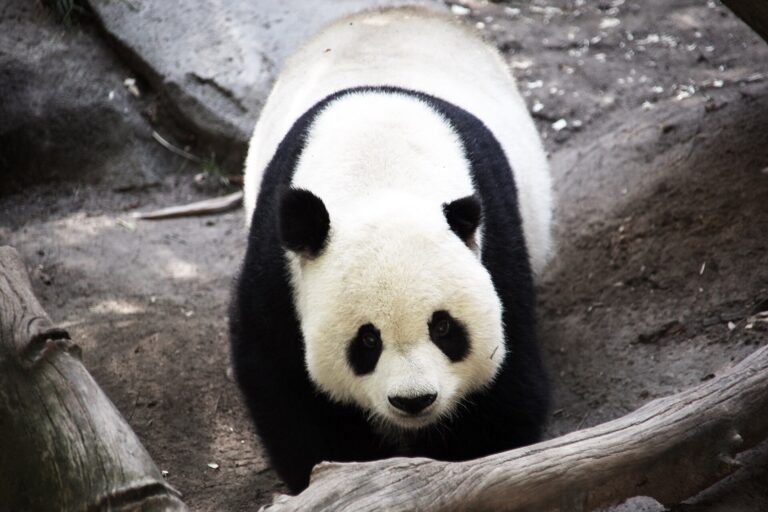
By age 4 the panda is essentially adult-sized: the full coat pattern, the full dentition for bamboo. But behaviourally and reproductively it is not quite adult yet. Females reach sexual maturity at about five years and males at about six years. This long pre-reproductive period is one reason pandas recover slowly from population shocks: a bamboo die-off can wipe out an entire cohort, and the species needs years to make up the lost reproductive output. For more on that, see our piece on what caused the giant panda to become endangered.
Adult: 5 to 20 years
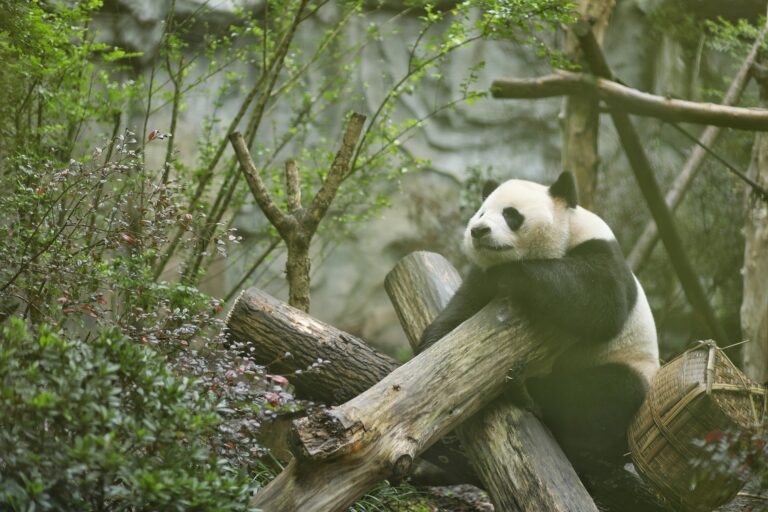
The adult phase is most of the panda’s life. Body weight stabilises at roughly 70 to 125 kg, with males heavier than females. The daily routine is dominated by eating: an adult giant panda spends much of the day chewing roughly 12 to 38 kg of bamboo, with intake and selection varying by season (leaves in winter, shoots in spring, culms year-round). The rest of the time is sleep, short travel, and seasonal social activity around breeding.
The annual breeding cycle
Adult pandas are solitary for most of the year. The exception is the spring breeding window in March to May, when females enter a single oestrus lasting roughly 24 to 72 hours and males travel to find them. Scent marking, vocalisations, and brief contests between males all happen in this short window. After mating, the female returns to solitary life and the male moves on. There is no pair bond, no paternal investment, and no second chance until next year. The full mechanics, including delayed implantation and pseudo-pregnancy, are covered in why panda reproduction is so tricky.
If conception succeeds, the cub is born in late summer or early autumn, typically August or September, after a gestation of 84 to 184 days. The variable gestation length is due to delayed implantation: the fertilised embryo can pause development for weeks before settling into the uterine wall. The mother retreats to a maternal den, gives birth, and starts the cub-rearing cycle described above. Because a female raises one cub at a time over a two to three year interval, her lifetime output is small, which is exactly why every wild cub matters.
Old age: 20 plus years
Photo by Snow Chang on Pexels
Wild pandas rarely live past 20. The big age-related problem is tooth wear. Bamboo is an abrasive food, full of silica, and pandas chew it for thousands of hours over a lifetime. By the late teens, molars are worn flat and the panda cannot process bamboo efficiently. In a hard winter that becomes fatal. Reproductive output falls off well before that.
Captive pandas do much better. They get veterinary dental care, softened bamboo, supplemental food, and treatment for age-related conditions. Xinxing of Chongqing Zoo died in December 2020 at a reported 38 years and four months. Jia Jia of Ocean Park Hong Kong lived for about 38 years and two months. As of 2026 the oldest panda living outside China is Xin Xin at Chapultepec Zoo in Mexico City, born on 1 July 1990. See the oldest giant pandas alive today for the current leaderboard.
Captive vs wild: cub survival and adult longevity
Captive cub survival used to be terrible. Through the 1990s only about a third of captive-born cubs survived. The reason was the twin problem: a mother panda picks one twin and ignores the other, and keepers had no reliable way to hand-rear the abandoned twin. The fix was the twin-swap protocol, first applied successfully at the Chengdu Research Base of Giant Panda Breeding in 1990 and refined at Wolong under Zhang Hemin, who has run the China Conservation and Research Centre for the Giant Panda there. The cubs are rotated between mother and incubator every few hours so each gets maternal milk, warmth, and grooming. Captive cub survival now runs at around 88 percent, and the protocol is standard at panda facilities worldwide.
Adult longevity in captivity is also much higher than in the wild. Wild lifespan is usually given as 15 to 20 years, with very few individuals reaching 25. Captive lifespan commonly runs 20 to 30 years and can exceed 35 with good care. The gap is mostly about dental disease, predation pressure on cubs and subadults, and seasonal food shortages. Wild pandas are not safer than captive ones; they are pushed harder by their environment.
Causes of death across the life cycle
- Cubs (0 to 12 months): abandonment of the second twin, hypothermia in poorly insulated dens, and rare predation by Asiatic black bears or yellow-throated martens.
- Juveniles and subadults (1 to 5 years): dispersal mortality while finding a home range, and predation by leopards and dhole packs.
- Adults (5 to 18 years): bamboo die-off years (1975 to 1976 and 1983 each killed adult pandas at scale), snares set for other species, and disease. Canine distemper has been documented in pandas.
- Old age (18 plus): tooth wear leading to malnutrition, arthritis, and winter cold sensitivity.
Natural predator pressure on adult pandas is essentially zero in modern China: a 100 kg adult panda can fight off any cat or canid it is likely to meet. The pressure is on cubs and subadults. Our piece on natural predators of giant pandas covers leopards, dholes, and martens in detail.
How the life cycle fits the bamboo cycle
One of the more interesting wrinkles in the panda life cycle is how it lines up with the bamboo it depends on. Bamboo species in panda habitat flower, set seed, and die in mass events on cycles of decades. When that happens, an entire mountainside of one bamboo species dies in a single year and takes years to regenerate. A panda that depends only on that species will starve. Pandas survive flowering events by switching bamboo species and moving through connected habitat where alternatives remain. For more on the bamboo dependency, see how giant pandas became bamboo-dependent.
The mismatch between a 20 year panda lifespan and a much longer bamboo cycle is also why habitat fragmentation is so dangerous. A wild panda needs the option to walk uphill or downhill to find a different bamboo species when its current one dies. A panda stuck in a fragmented reserve with only one bamboo species cannot do that. This is one of the strongest arguments for the corridor-based design of the Giant Panda National Park, covered in the new giant panda mega-reserve.
Quick numbers: panda growth in the first year
| Age | Weight | Key milestone |
|---|---|---|
| Birth | Around 100 g | Blind, hairless, pink, helpless |
| 4 weeks | Under 1 kg | Black-and-white pattern visible |
| 6 weeks | Around 1.5 kg | Eyes open |
| 3 months | 4 to 6 kg | Crawling, starting to play |
| 6 months | 8 to 10 kg | First bamboo trial |
| 9 months | 15 to 25 kg | Weaning complete |
| 12 months | 30 to 45 kg | Confident climbing, regular bamboo feeding |
Panda merchandise
Browse panda-themed panda plushies and gear at our store, store.welovepandas.org.
Read next
- Panda Facts: 50+ Surprising Things About Giant Pandas and Red Pandas (2026)
- Giant Panda: Complete Species Guide (Ailuropoda melanoleuca)
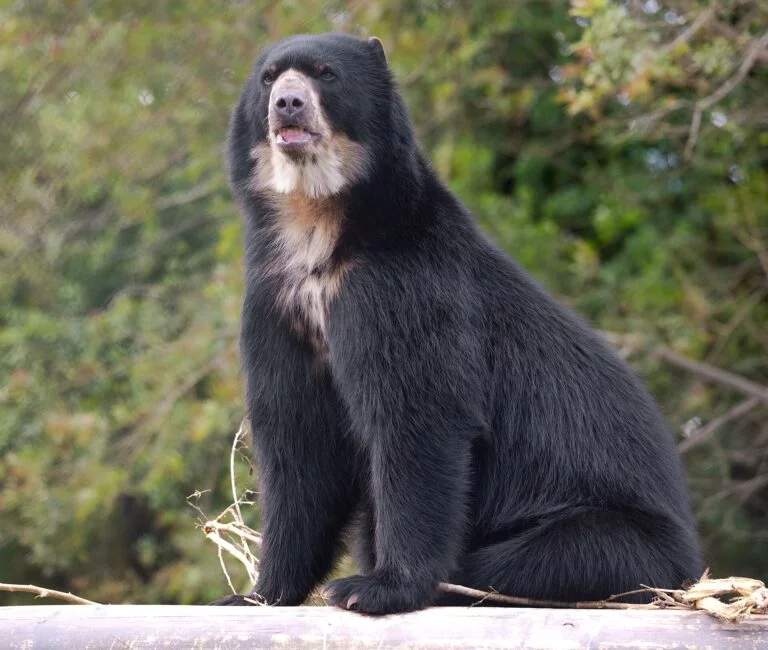
- Giant Panda vs Spectacled Bear: South America's Only Bear vs China's Star
Frequently asked questions
How big is a newborn giant panda?
About 100 grams, roughly the size of a stick of butter. The cub is pink, hairless, blind, and helpless, weighing around 1/900 of the mother’s body weight.
When do panda cubs open their eyes?
At about 6 weeks. Vision is poor at first and improves over several weeks. Hearing is also limited at birth and develops alongside vision. Until then the cub finds its mother by smell and touch alone.
When do baby pandas start eating bamboo?
First trials happen at around 6 months, alongside continued nursing. Weaning is complete by 8 to 9 months, after which bamboo is the primary food.
When do panda cubs leave their mothers?
Usually between 18 and 24 months. The trigger is often the mother’s next oestrus: if she comes back into heat, she drives the older cub off so she can mate again.
When do giant pandas reach sexual maturity?
Females reach sexual maturity at about five years and males at about six years.
How long is a panda cub black and white?
The black-and-white pattern is fully visible by about 4 weeks of age and is permanent. The cub keeps the same eye patches, ear patches, leg socks, and shoulder saddle for life.
Why are panda cubs born so undeveloped?
The leading hypothesis is that the bamboo diet is low in fat and protein, so a long energetically expensive gestation is not affordable. The cub is born essentially as an external fetus and finishes most of its development on milk, which in pandas is protein-rich and carbohydrate-poor, much like other carnivores.
How does cub survival compare in captivity versus the wild?
Captive cub survival used to be worse than the wild because of the twin abandonment problem: through the 1990s only about a third of captive-born cubs survived. The twin-swap protocol has pushed that to around 88 percent. See our piece on the panda nanny role for how it works in practice.
Sources and further reading
- IUCN Red List: Ailuropoda melanoleuca
- WWF giant panda profile
- Smithsonian National Zoo giant panda fact sheet
- Nie et al. 2019, Current Biology: Giant Pandas Are Macronutritional Carnivores
- Stoeger et al. 2012, Ethology: Acoustic Features Indicate Arousal in Infant Giant Panda Vocalisations
- Giant panda species profile
- Why panda reproduction is so tricky
- Is the giant panda breeding program failing?
- Cool facts about pandas you probably did not know
Updated 14 September 2026: corrected factual details after a full review against primary sources.



The 1/900 mother-cub weight ratio is genuinely jaw dropping. Half my biology degree was learning that big mammals invest heavily in fewer offspring. Pandas seem to invest very little upfront and then ramp up dramatically. Cool counterexample.
Delayed implantation is one of those mammalian tricks that always sounds like science fiction. Sea otters and badgers do it too apparently. Convergent reproductive engineering across very different bodies.