
Ancient Panda Isotopes Point to a Broader Diet
Last updated: November 5, 2026
4 min read
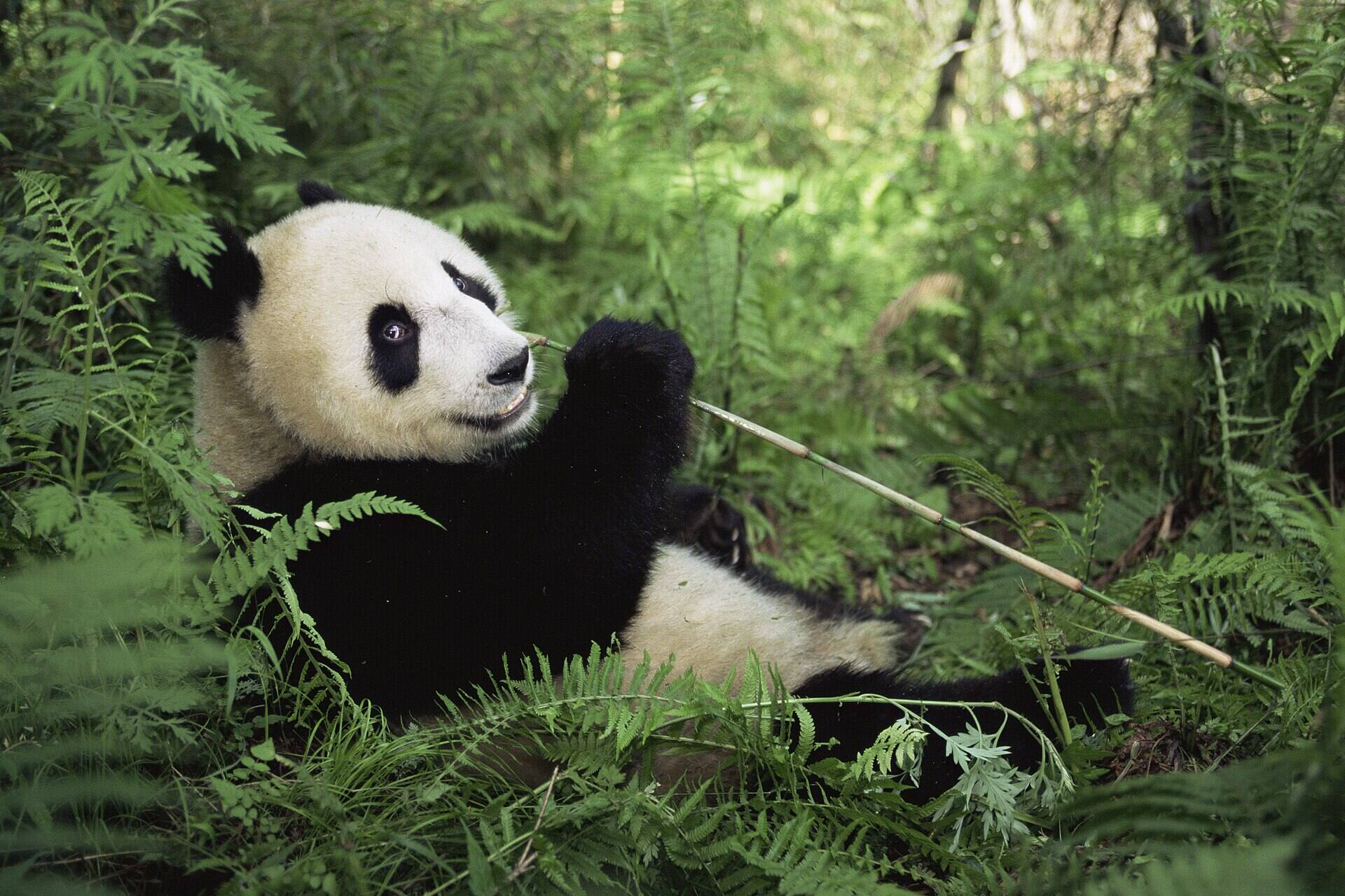
The giant panda alive today is one of the most extreme dietary specialists among mammals: roughly 99 percent of its diet is bamboo. A 2019 study in Current Biology, with Fuwen Wei of the Chinese Academy of Sciences as senior author, ran stable isotope analyses on ancient panda remains and concluded that pandas of a few thousand years ago had a substantially broader diet than the modern animal.
The paper is Han et al., 2019, “Diet Evolution and Habitat Contraction of Giant Pandas via Stable Isotope Analysis,” Current Biology 29:664-669.
What the isotope chemistry actually tells us
Stable isotope analysis measures the ratios of carbon-13 to carbon-12 and nitrogen-15 to nitrogen-14 in preserved bone collagen and tooth enamel. Those ratios shift in predictable ways depending on what an animal eats. C3 plants, which include most temperate forest plants and bamboo, leave a different carbon signature than C4 plants such as tropical grasses and many crops. Higher nitrogen-15 enrichment indicates animal protein, because nitrogen ratios climb up the food chain.
Han and colleagues sampled 12 ancient pandas from seven archaeological sites in southern and southwestern China, some of the subfossil material radiocarbon dated to between roughly 5,000 and 9,000 years before present, and compared them with modern pandas collected between the 1970s and the 2000s along with a panel of other mammals. The ancient animals occupied an isotopic niche about three times wider than the modern one, which is not what an exclusive bamboo feeder looks like.
So what did ancient pandas actually eat?
The data does not tell us which particular plants or animals made up the broader diet, only that the signature is inconsistent with a near-total bamboo monoculture. Their digestive tract is still anatomically a carnivore’s: short, simple, and missing the multi-chamber stomach of a true ruminant. The bamboo specialisation is a behavioural and microbiome adaptation layered over a body that started out built for meat.
For more on what modern pandas eat day to day see our piece on the bamboo species pandas eat.
When and why did pandas switch to bamboo?
The authors describe the change as two-phase: pandas moved from meat eating or omnivory to a committed plant diet first, and only later narrowed onto bamboo. When that second step happened is not resolved, and the team said as much, planning further sampling across the last 5,000 years to pin it down.
What is clearer is that at least part of the shift is old. The TAS1R1 umami taste receptor gene, which detects the amino acids that make meat taste of meat, is non-functional in modern pandas. Zhao and colleagues, writing in Molecular Biology and Evolution in 2010, estimated that the gene stopped being maintained by selection about 4.2 million years ago, though with a wide confidence interval of roughly 1.3 to 10 million years. Whatever happened in the Holocene, the taste for meat was going long before it.
What this means for panda conservation
The findings matter for two practical reasons. First, modern pandas depend on a small number of bamboo species in a range that climate models treat harshly. Songer and colleagues, modelling panda habitat in the International Journal of Ecology in 2012, projected close to 60 percent loss of suitable habitat by 2080 under both scenarios they ran, with losses of 60 to 97 percent in every mountain range except the northern Qinling. The fact that pandas were once more flexible does not mean modern animals can switch on demand, but it does suggest captive supplementation with non-bamboo foods may be physiologically tolerated.
Second, the result reframes the panda from evolutionary dead end, a common line in 1990s zoology, to a recent specialist constrained by recent environmental change. That is a more recoverable trajectory.
FAQ
Do modern pandas ever eat meat?
Occasionally and opportunistically. Wild pandas have been observed eating pikas, bird eggs and carrion when they come across them. Roughly 1 percent of the diet comes from non-bamboo sources, and it is not something they rely on.
How much bamboo does a modern panda eat per day?
Adults eat roughly 12 to 38 kg a day. The amount and bamboo parts selected vary with the animal and season.
How do scientists know which bamboo grew where thousands of years ago?
Pollen cores from lake sediments preserve bamboo and other plant pollen with reliable dating, which gives palaeoecologists a vegetation map for the late Pleistocene and Holocene across much of central and southern China.
How strong is the 2019 result?
The direction of it is well accepted, with two caveats the authors raise themselves. Twelve ancient specimens is a small sample, and the isotope signal does not cleanly separate plant protein from animal protein, so the study shows a broader diet without saying what was in it.
Could rewilded pandas be trained to eat a broader diet?
Captive feeding at the Wolong and Bifengxia bases already includes apples, carrots and high-fibre pellets alongside bamboo. The bamboo dependence is built into the gut microbiome and the digestion timing, so a radical shift is unrealistic, but small omnivorous additions are well tolerated.
Sources and further reading
- Han et al. 2019, Current Biology: diet evolution and habitat contraction of giant pandas
- Phys.org write-up of the study
- Zhao et al. 2010, Molecular Biology and Evolution: pseudogenization of Tas1r1
- Songer et al. 2012, International Journal of Ecology: modelling climate impacts on panda habitat
- IUCN Red List: Ailuropoda melanoleuca
This article is part of our giant panda guide, which links every species, evolution and zoo article on the site.
Updated 14 September 2026: corrected the daily bamboo intake figure against the current house source.



Isotope work on ancient panda tooth enamel is the right kind of paper for this question. The shift from omnivore to bamboo specialist apparently happened in stages, not all at once.
This study should be required reading for anyone arguing pandas are simply bad at being bears. They were proper omnivores for most of their evolutionary history.