Giant Panda vs Sloth Bear: How Two Asian Bears Compare
Last updated: November 5, 2026
4 min read
Giant pandas and sloth bears share a continent and a family and almost nothing else. The giant panda is a Chinese bamboo specialist. The sloth bear is a South Asian termite specialist with a habit of carrying cubs on its back. Both are Ursidae, and that is roughly where the similarities end.
Key facts
| Family | Ursidae (both species) |
|---|---|
| Panda range | Sichuan, Shaanxi and Gansu, China |
| Sloth bear range | India, Nepal, Sri Lanka and Bhutan |
| Panda diet | Bamboo, around 99 percent |
| Sloth bear diet | Termites and ants, plus fruit and honey |
| Panda status | Vulnerable, population increasing |
| Sloth bear status | Vulnerable, population decreasing |
Same family, very different bodies
The two are close in size without being the same shape. Wild male pandas reach about 113 kg and females rarely pass 104 kg, at 1.2 to 1.8 m long. Male sloth bears run 80 to 145 kg and females 55 to 105 kg, at 1.4 to 1.9 m. A big sloth bear therefore outweighs a big wild panda.
The panda has a heavy round skull, broad zygomatic arches to anchor the muscles that crush bamboo, and the famous pseudo-thumb. The sloth bear is leaner and longer-limbed, with big curved claws for tearing open termite mounds and a flexible snout that works like a vacuum hose.
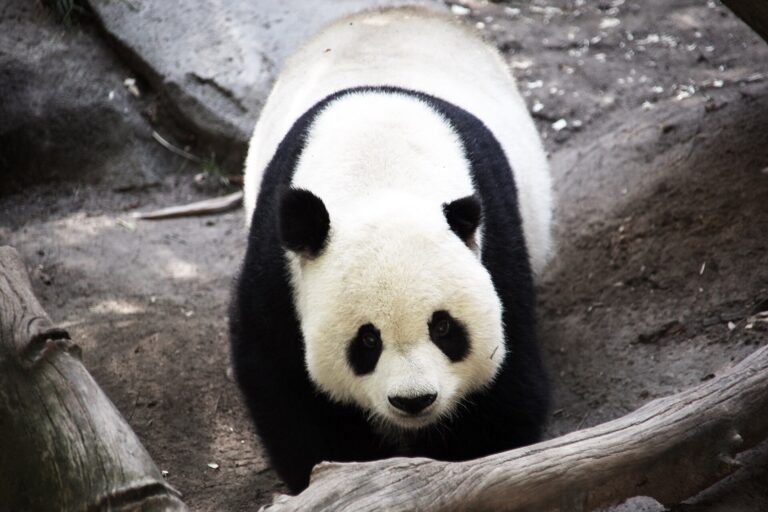
Coats differ too. Pandas have the black and white pattern everyone can draw from memory. Sloth bears are shaggy black with a pale muzzle and a white V or U on the chest, and their ears are unusually large and floppy.
Specialist diets, both extreme
Pandas eat bamboo and very little else year round. Adults eat roughly 12 to 38 kg a day. They still have a short carnivore gut that handles that much fibre badly, which is why the volume has to be so high.
Sloth bears eat termites. They break open a mound with their claws, blow the loose earth away, then close their nostrils, purse their lips and suck the insects out of the gallery system. Adults are missing the two central incisors of the upper jaw, and the gap that leaves is the channel the insects come through. Fruit, honey and the occasional carcass fill out the diet, but termites and ants are the staple.
Behaviour: cubs and aggression
Sloth bears are the only bear that routinely carries its cubs on its back. Cubs ride from the day they leave the den until they are around nine months old, which is thought to keep them clear of the leopards and tigers that would take them on the ground.
They are also the bear most likely to injure a person. A survey of Madhya Pradesh by Rajpurohit and Krausman counted 735 human casualties from sloth bears between April 1989 and March 1994, 48 of them fatal. Most of those encounters were accidents rather than predation: a bear foraging in dense cover, a person walking into it at close range, a defensive charge. Giant pandas are far calmer and attacks on people are rare, although a wild panda is still an animal that can badly hurt you.
Conservation
Both are listed as Vulnerable, and the two trends point in opposite directions. The panda is recovering, with roughly 1,900 left in the wild and decades of reserve expansion behind that number. The sloth bear is declining across most of its range through habitat loss, poaching for body parts, and the long tail of the dancing-bear trade in India, which is now banned.
To compare the panda with the rest of its family, read how pandas differ from other bears.
Frequently asked questions
Are pandas and sloth bears related?
Both sit in the family Ursidae, on branches that parted a long time ago. The panda lineage split from the other bears around 19 million years ago. The sloth bear belongs to the subfamily Ursinae, where genetic work places it as the earliest branch, ahead of the black bears, the brown bear and the polar bear.
Why are sloth bears so aggressive?
Weak eyesight, dense scrub and a habit of foraging near villages add up to a lot of surprise encounters at short range. The charge is defensive rather than predatory, which is little comfort at the receiving end.
Do sloth bears really vacuum up termites?
Yes. They seal their nostrils, purse their lips and inhale hard. The two missing upper incisors leave a permanent gap in the front of the mouth that the insects are drawn through.
Which is more endangered?
Both carry the same Vulnerable listing, but the panda population is rising and the sloth bear population is falling.
Where can I see a sloth bear?
Daroji Sloth Bear Sanctuary near Hampi in Karnataka is the obvious choice, since it was set up specifically for the species and viewing is done from watchtowers in the late afternoon. Several central Indian reserves hold them too, and a number of large zoos keep them.
Related reading on welovepandas
- Giant panda species guide
- How pandas differ from other bears
- How pandas became bamboo dependent
- Natural predators of giant pandas
- Panda facts
Sources and further reading
- IUCN Red List: Melursus ursinus (sloth bear)
- IUCN Red List: Ailuropoda melanoleuca (giant panda)
- International Association for Bear Research and Management, sloth bear species account
- Rajpurohit and Krausman 2000, Human-sloth-bear conflicts in Madhya Pradesh, India, Wildlife Society Bulletin 28: 393 to 399
- Smithsonian’s National Zoo and Conservation Biology Institute, giant panda fact sheet
- Karnataka Forest Department, Daroji Sloth Bear Sanctuary
This article is part of our giant panda guide, which links every species, evolution and zoo article on the site.
Updated 14 September 2026: corrected the daily bamboo intake figure against the current house source.