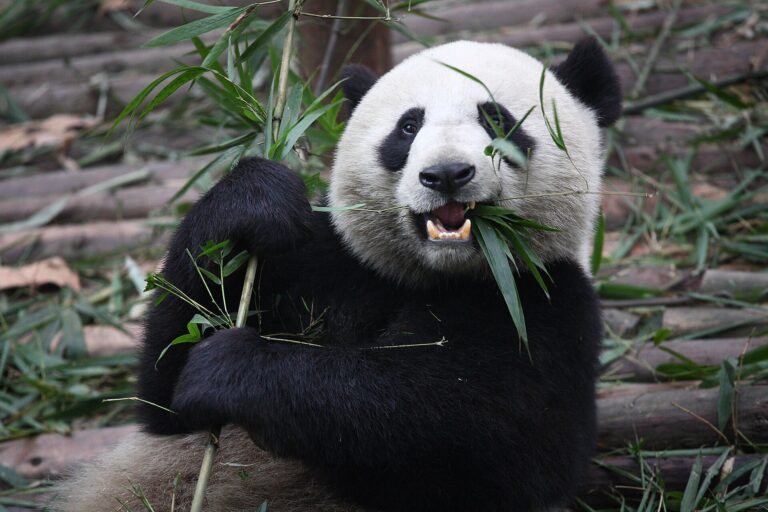
The Panda Sense of Smell: Genes, Scent Marks and Gland Bacteria
4 min read
For a giant panda in dense bamboo, smell is a main way to find food and to read other pandas. Food, neighbours, rivals and potential mates all leave a smell, and the panda reads them.
Researchers have started to put numbers on this. Genome work counts the genes behind the panda nose, and field work tracks where pandas leave their scent. Together they describe an animal that lives in a world of odour.
A nose built for finding bamboo
The giant panda is an obligate bamboo feeder, and a 2023 genome study in the journal Animals notes that it relies on smell to recognise its food. Telling one bamboo species or one part of a plant from another is a daily task for an animal that eats for much of the day. Our guide to the panda diet is a good place to start if you want the full menu.
Smell works through olfactory receptor genes. Each gene builds a receptor that catches a different family of odour molecules. The same study counted them in the giant panda genome and found 639 olfactory receptor genes. Of those, 408 are functional, 94 are partial and 137 are pseudogenes, which means they have been switched off by mutations.
How the panda count compares with other bears
The authors compared the panda with five other bears. They found 448 olfactory receptor genes in the spectacled bear, 617 in the American black bear, 582 in the brown bear, 521 in the polar bear and 792 in the Asian black bear. The panda figure includes functional genes, partial genes and pseudogenes, so these totals are best read as a rough guide to each species’ smell toolkit.
The panda total is the second highest of the six, behind the Asian black bear. What stands out is not size but make-up. The panda genome carries 31 gene subfamilies that none of the other five bears share, covering 35 genes. The authors also found that sequences similar to four human receptor genes are missing in the panda, and they suggest this may relate to the panda’s change from carnivore to herbivore.
The researchers are careful here. They say the odour molecules recognised by the human genes that match the panda’s unique genes still need further research. So the study cannot yet say what a panda smells that a brown bear does not.
Scent that is built to be found
Smell is also how pandas talk to each other. A 2023 study in Ecology and Evolution describes scent marking as the primary mode of communication in giant pandas. Marking costs energy, and pandas live on a low-energy diet, so where they mark matters.
The team combined dropping counts, which show how much a patch of forest is used, with counts of scent marks. Pandas preferred to mark ridges that carry animal trails, and most marked trees were the locally dominant species. More than 90 percent of the marks were secretions from the anogenital gland, the longest-lasting type. More than 80 percent faced the trails. The authors conclude that pandas go out of their way to make sure their marks are found.
That fits the behaviour described in our post on why pandas do handstands. The handstand puts the mark high on the trunk.
Bacteria that brew the smell
The scent itself has an unexpected source. A 2021 paper in the ISME Journal studied the anogenital gland secretions and found a diverse community of fermentative bacteria in the gland. These microbes carry enzymes for pathways such as lipid breakdown, which can produce volatile odour compounds.
The study also compared the gland with the digestive tract. Volatile compounds were more diverse and more abundant in the gland secretions than in droppings. The authors read this as evidence that the gland’s microbes are specialised for making chemical signals. The same idea, microbes doing chemical work for the host, shows up inside the gut too, as we cover in the panda gut microbiome.
Seasonal chemistry and breeding
A team working in Foping Nature Reserve collected 102 gland secretions from marking trees and analysed them by gas chromatography and mass spectrometry. DNA showed that all but one of the marks came from males. Several compounds, especially the volatile ones, appeared only during the mating season, and the relative amounts of many others shifted with the season.
The authors think these changes help with finding mates, attracting them and competing with other males. The chemistry of wild marks also differed from earlier results on captive pandas. They suggest that unsuitable chemical signals may contribute to poor breeding success in captive programmes, though that remains a proposal for further work. For the behaviour that follows, see how pandas find a partner.
What is still unknown
Scientists have counted the panda’s smell genes and described its scent chemistry. The genome study could not yet match the panda-specific receptors to particular smells. The studies above look at genes and secretions, not at behavioural tests of detection, so they cannot rank panda smell against other bears.
If you have watched pandas sniff their enclosures at a zoo, you have seen the part of the animal that matters most. What have you noticed them investigating? Add what you know in the comments.
Sources
- Comparative Analysis of Olfactory Receptor Repertoires Sheds Light on the Diet Adaptation of the Bamboo-Eating Giant Panda, Animals (MDPI), 2023
- Signal detection theory applied to giant pandas, Ecology and Evolution (Wiley), 2023
- Symbiotic bacteria mediate volatile chemical signal synthesis in a large solitary mammal species, The ISME Journal, 2021
- Seasonal and reproductive variation in chemical constituents of scent signals in wild giant pandas, Science China Life Sciences, 2019
Photo: Phil Mitchell, Pexels Licence, via www.pexels.com.
This article is part of our panda facts guide, which links every article on panda biology, behaviour and culture.