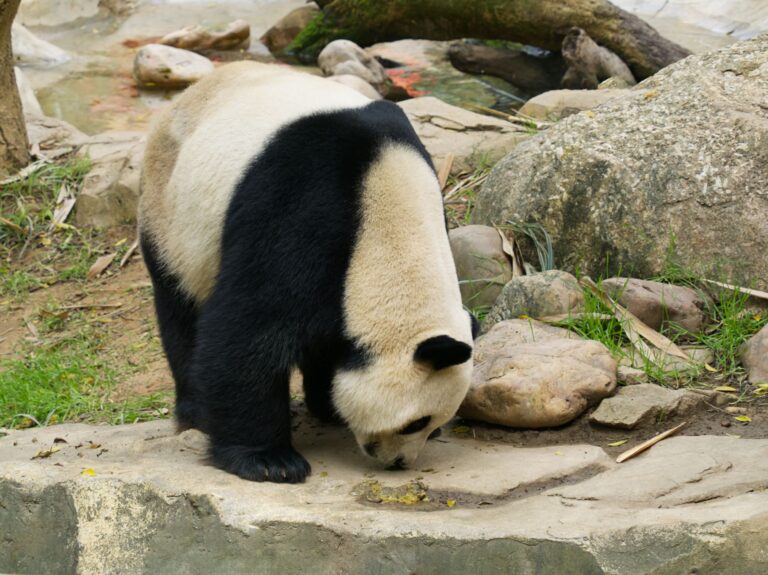
Can Pandas Swim? What We Know About Pandas in Water
Last updated: November 5, 2026
3 min read
Giant pandas can swim. They do not love the water, but they will wade through streams, sit in shallow pools to cool off, and cross small watercourses when the terrain forces it. Captive cubs have been filmed paddling enthusiastically. The image of the panda as a clumsy land animal needs an update.
Key facts
| Can adults swim? | Yes, basic paddle stroke, no extended distances |
|---|---|
| Why pandas enter water | Cooling, crossing, drinking, occasional play |
| Best swimmers | Cubs and juveniles |
| Drinking | Once or twice a day from a stream, on top of the water in bamboo |
| Big rivers | Barriers between panda populations, not crossing points |
| Red panda swimming | Rare, mostly avoided |
Why pandas get wet at all
Most of a panda’s day is spent eating bamboo, and a lot of its water comes from the plant itself: fresh spring shoots are mostly water. Even so, a panda will walk to a stream and drink once or twice a day, taking a litre or more at a time. Most of those streams are too narrow or shallow to require swimming, but some are wide enough to push a panda into the water for a metre or two.
Captive pandas use pools differently. On hot summer days adults will lie belly-up in a shallow basin, sometimes for an hour at a time. That is about cooling. Pandas are well insulated against winter cold and heat-stressed easily in summer, which is why every serious panda facility outside Sichuan builds chilled indoor space and shaded water.
How a panda actually swims
Observed pandas paddle with all four limbs and keep their heads above water. Their swimming biomechanics have not been studied in enough detail to assign different roles to each pair of limbs.
Endurance is not great. There are no records of pandas making long open-water crossings, and crossings that do happen tend to be at shallow points where the animal can keep its feet on the gravel for most of the way.
The rivers pandas do not cross
This is the part that matters for conservation. Small mountain streams are a minor inconvenience. The large Sichuan rivers are not: they show up in the genetics as boundaries between panda populations rather than as routes between them. The Dadu, for example, sits between separate groups that have had very little to do with each other. A species that cannot swim a big river, in a landscape being cut up by roads as well as water, ends up in exactly the isolated pockets that corridor planning is trying to reconnect.
Cubs are surprisingly enthusiastic
Footage from Chinese reserves shows cubs splashing in shallow pools at six to twelve months of age. They will paddle, dunk, climb out and dive back in. This is partly play and partly thermoregulation, since cubs overheat even more easily than adults.
Some panda enclosures include pools, and individual pandas may enter them. Research has not shown that pools reduce stereotypic behaviour.
Red pandas avoid water
Red pandas are physically capable of swimming but very rarely choose to. Their coat is dense and slow to dry, and a wet red panda loses insulation fast. They cross streams by leaping branch to branch, walking along logs, or fording the shallowest point they can find.
Red panda enclosures also need safe access to drinking water. Water should not be treated as a secure enclosure barrier.
Related reading on welovepandas
- Species Profile: The Giant Panda
- Species Profile: The Red Panda
- The giant panda life cycle
- Giant panda habitat under pressure
- 21 cool panda facts
Sources and further reading
This article is part of our Giant Panda guide hub.
Frequently asked questions
Can pandas swim long distances?
No. The four-paw paddle works for short crossings. Long open-water swims have not been recorded.
Why do pandas like water in zoos?
Mostly for cooling. Pandas are built for cold mountain forest and struggle in summer heat, so a shallow pool is a way to dump it.
Can panda cubs swim?
Yes. Cubs paddle enthusiastically from around six months and seem to enjoy splashing far more than adults do.
Do red pandas swim?
Rarely. Their dense coat insulates poorly once wet, so they go out of their way to stay dry.
Do wild pandas cross major rivers?
Not really, and that is the point. Big rivers act as boundaries between panda populations, which is part of why the wild population is split into so many isolated groups.
This article is part of our panda facts guide, which links every article on panda biology, behaviour and culture.
Updated 14 September 2026: corrected factual details after a full review against primary sources.