
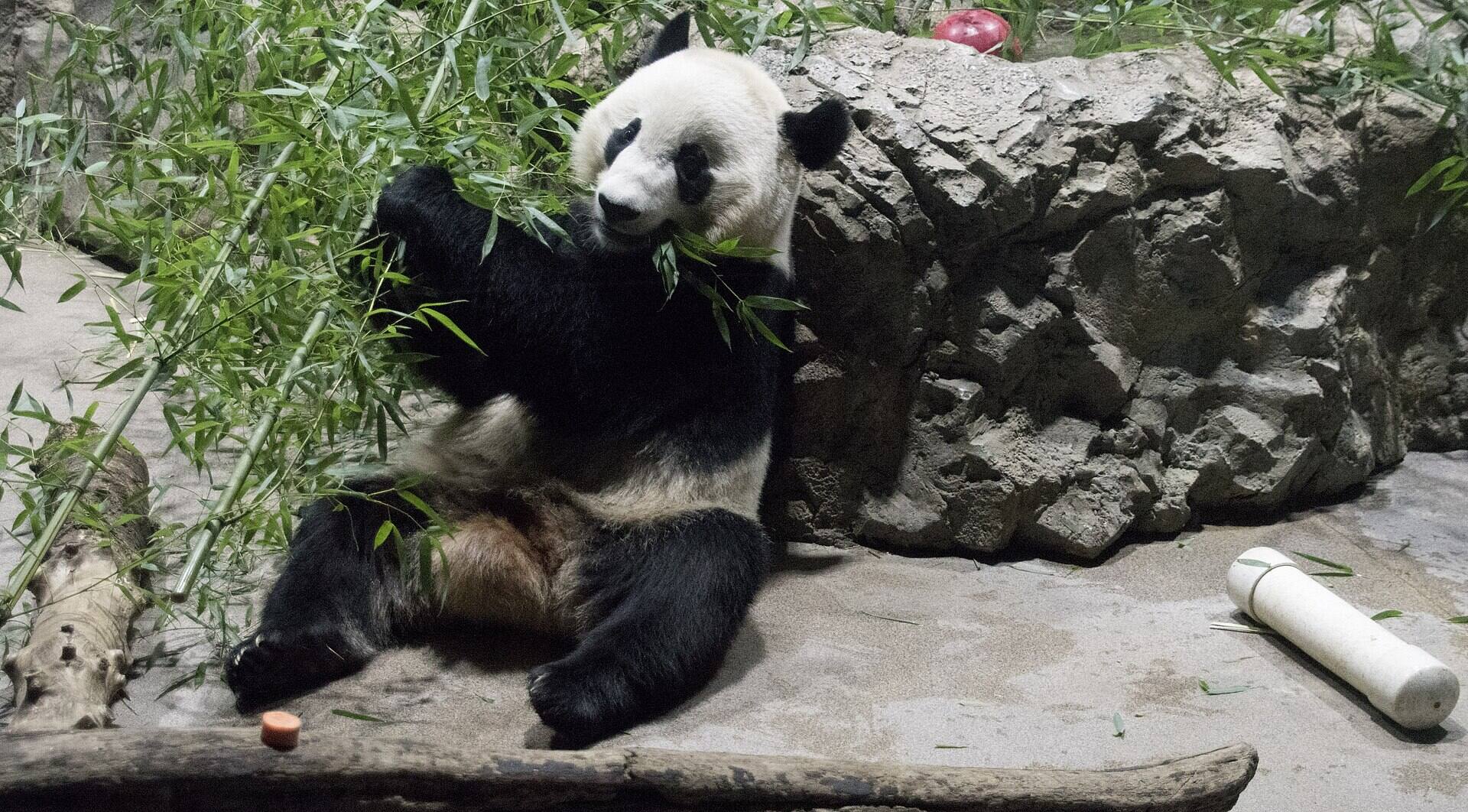
Giant Panda Reproduction: Why Breeding Is So Hard
Last updated: November 5, 2026
10 min read
Giant panda reproduction is famously difficult because five problems stack on top of each other: a single short annual oestrus, pseudo-pregnancy, delayed implantation, the demands of raising twins, and mate compatibility. Captive programs have found a workable answer to most of them, but the underlying biology is still the most awkward reproductive system in any bear. This is how the panda actually breeds, what goes wrong, and what the published numbers really say about how much captive breeding has improved.
Key facts at a glance
- Female estrus: once a year (March to May), roughly 36 to 48 hours total
- True receptive window: often only 12 to 24 hours inside estrus
- Mating bout duration: 30 seconds to a few minutes per mount
- Sexual maturity: about 5 years for females and about 6 years for males
- Gestation: 84 to 184 days, highly variable because of delayed implantation
- Cub birth weight: 85 to 142 g
- Typical litter: 1 or 2 cubs, twins common
- Inter-birth interval in captivity: 2 to 3 years
- Captive cub survival since twin-swapping became standard: reported at around 88 percent
The five compounding difficulties
Plenty of mammals are hard to breed in captivity, but giant pandas are harder than most. The reasons stack rather than substitute. Below is the full list, in roughly the order each problem hits a captive breeding team trying to produce a cub in any given year.
1. The 36 to 48 hour annual estrus
A female giant panda comes into heat once a year, between March and May. The whole estrus phase lasts roughly 36 to 48 hours from start to finish, and the true peak receptive window, when conception is actually possible, is often only 12 to 24 hours inside that. Miss the window and you wait another year. Hormone work on captive females has narrowed it further still: analysis of urinary hormones across dozens of breeding periods found that females conceived most readily when the first mating happened within about ten hours of the luteinising hormone peak. This is the headline difficulty. Everything else compounds on top.
2. Pseudo-pregnancy
A non-pregnant female panda can produce a hormonal profile, a behaviour pattern, and even a mammary-gland response that look exactly like a real pregnancy. She nests, she goes off her food, she retreats from keepers, and her progesterone levels climb. Then nothing happens. This is pseudo-pregnancy, and it is far more common in pandas than in most mammals. Captive breeding teams routinely see females who appear to be well into a real pregnancy and turn out to be carrying nothing. The implication is that pregnancy cannot be confirmed by hormone profile alone. Ultrasound is needed, and the cub is so small relative to the mother that it usually only shows up reliably in the last couple of weeks.
3. Delayed implantation
After fertilisation, the panda blastocyst can float free in the uterus for weeks or months before implanting. This is called embryonic diapause or delayed implantation, and it is common in bears generally, but pandas take it to an extreme. The consequence is that gestation lengths vary from about 84 to 184 days, which makes due-date prediction almost impossible in the wild and difficult even in captivity. The cub itself only takes a few weeks of active intrauterine development. The rest is delay.
4. Twin abandonment in the wild
Twins are common in pandas: roughly half of captive births are twins. The problem is that a mother panda cannot produce enough milk for two cubs. In the wild, she picks the larger or stronger cub within hours of birth and abandons the other. The abandoned cub dies. This is the only way to raise even one cub successfully on a bamboo diet that does not generate enough milk for two. For decades, this single fact made twin survival catastrophic. For details on how captive teams reversed this, see the giant panda nanny role.
5. Captive male behavioural deficits
This one is the most embarrassing of the five. Captive male pandas raised without ever seeing adult mating behaviour often have no idea what to do when presented with a receptive female. They have all the right anatomy and the right hormones, but the behavioural sequence of approach, mount and intromission does not assemble correctly. Breeding teams now address this by exposing young males to video of mating pairs (the famous “panda porn” clips), by housing inexperienced males where they can observe experienced ones, and by pairing inexperienced males with experienced females who can guide the encounter.
How modern captive programs handle each problem
Hormone monitoring and ovulation prediction
Modern captive programs run regular urine sampling on adult females from late winter onward. Researchers track oestrogen and progestagen profiles, and increasingly the luteinising hormone surge, to predict the estrus peak inside a narrow window. That timing work is the single biggest reason conception rates improved: teams now know within roughly a day when to mate or inseminate, rather than guessing. The Chengdu Research Base of Giant Panda Breeding and the Wolong centre both run programmes of this kind, and China maintains a frozen semen bank so that genetically useful males can be used at the right moment even when they are not on site.
What the artificial insemination numbers actually show
It is worth being careful here, because the improvement is real but it is often overstated. A long-run analysis of captive reproductive records found a birth rate of about 61 percent after natural mating, about 51 percent where natural mating and artificial insemination were combined, and about 19 percent for artificial insemination on its own. Other reviews have put worldwide AI success at around a quarter of attempts. In other words, AI is a valuable backup that has got much better with hormone timing and cryopreserved semen, but the best outcomes still come from a female who mates naturally, with AI used behind it as insurance.
The standard captive protocol reflects that: natural mating first, AI as backup, both if needed. If a male and female are both experienced and the timing is right, natural mating gets first try. If the male is inexperienced or the mating is botched, AI is performed under sedation within hours. Semen from more than one male is sometimes used in a single insemination. Frozen semen also allows material to travel between facilities: when Edinburgh Zoo inseminated Tian Tian, the team used fresh semen from Yang Guang topped up with frozen semen from Bao Bao, a genetically valuable male who had lived at Zoo Berlin until 2012.
The twin-swap technique
Twin swapping is the clearest example of a captive intervention that simply worked. Vets at Chengdu developed it in the early 1990s after watching mothers fail to raise both cubs. The mother is allowed to keep one cub at a time. The other twin sits in a heated incubator on formula. Every few hours the cubs are swapped, so both get maternal milk, warmth and grooming, and the mother behaves as though she is raising one cub throughout. Keepers may rotate the pair up to ten times a day in the early weeks. The protocol is now standard at Chinese panda facilities and at partner zoos abroad, and captive cub survival has been reported at around 88 percent since it became routine, against roughly a third in the early 1990s. For the breeding-program context, see is the giant panda breeding program failing.
Behavioural training and panda mating videos
For inexperienced males, captive programs use behavioural priming: video of mating pairs played in the enclosure during the days before pairing, scent marking from experienced males, and an introduction sequence that escalates from visual contact through scent contact through fence contact to direct introduction. The popular media calls some of this “panda porn.” It is closer to behavioural enrichment than anything else. Wolong has reported that keeping young males in social groups alongside experienced females, and letting courtship play out, has done more lasting good than the videos ever did.
The mating sequence in detail
When estrus arrives, female pandas advertise. They vocalise with distinctive bleats and chirps, scent-mark with anogenital glands on trees and rocks, and become more active and more tolerant of male presence. In the wild, several males may converge on a single female within a few days, and competition for access leads to short fights. The female is in charge of the encounter: she chooses when she is receptive, and she will rebuff any male she is not ready to mate with.
The mating posture is unusual. The female presents in a deep crouch with her hindquarters elevated and tail raised. The male approaches from behind and mounts. Individual bouts are short, typically 30 seconds to a few minutes, with multiple bouts in a session. In the wild a female will often mate with two or more different males over the course of estrus, and dual paternity within a twin litter has been confirmed in captivity.
Pregnancy and birth
Gestation is the most variable feature of panda reproduction. Active gestation, from implantation to birth, is only a few weeks. The rest of the 84 to 184 day total is delayed implantation. This is why panda mothers can give birth anywhere from late July to late October even when mating happened inside the same March to May window. Ultrasound is the only reliable way to confirm pregnancy, and the cub is so small relative to the mother that it is often only visible in the last week or two. Keepers know a birth is coming when the mother stops eating, retreats to her maternal den, and stops responding to keeper attention.
Birth itself is fast. The cub emerges blind, hairless, pink, and around 100 grams, and the mother immediately cradles it against her chest and starts licking. If there are twins, the second is usually born within a few hours. In captivity, keepers are ready to move the second twin into an incubator and start the rotation protocol. In the wild, the second twin almost always dies within days. For the full life cycle from this point on, see the panda life cycle from birth to adulthood.
Reproductive lifespan
A female panda reaches sexual maturity at about five years, and captive females have gone on breeding much later than was once assumed. Mei Xiang gave birth to Xiao Qi Ji at the Smithsonian in 2020, at 22, which was widely reported as the oldest such birth in the United States. The inter-birth interval is 2 to 3 years in captivity and longer in the wild, so lifetime output is modest either way. Pandas are slow reproducers, which is part of why population recovery from the 1980s low point has taken four decades.
Males reach sexual maturity at about six years. Frozen semen extends the effective reproductive life beyond that: cryopreserved samples let a genetically valuable male contribute long after he has stopped breeding, or after he has died, which is exactly what happened in the Edinburgh case above. This is one of the main tools captive teams use to protect genetic diversity in a small founder population. For the bigger conservation picture, see our piece on how panda conservation saves other species.
Red panda reproduction: a quick comparison
Although they share the name, red pandas are not closely related to giant pandas and their reproduction works very differently. Red panda females are seasonal breeders, with estrus running from January to early March. Litters are larger: 1 to 4 cubs, with 2 the most common. The cubs are born in tree dens in early summer and stay hidden in the den for around three months. Red panda cub mortality in captivity is also high, but not for twin-abandonment reasons: infection, hypothermia and maternal inexperience do most of the damage. See the red panda species profile for more.
For how a giant panda grows from a tiny pink newborn into an adult, see our guide to the giant panda life cycle. Red pandas are worth knowing in their own right, not just as a panda namesake: read our piece on why red pandas matter.
Panda merchandise
Browse panda-themed panda plushies and gear at our store, store.welovepandas.org.
Read next
- Panda Facts: 50+ Surprising Things About Giant Pandas and Red Pandas (2026)
- Giant Panda Breeding Programs: Are They Working?
- Giant Panda vs Spectacled Bear: South America's Only Bear vs China's Star
Frequently asked questions
Why is panda reproduction so difficult?
Five problems stack on each other: a 36 to 48 hour annual estrus, pseudo-pregnancy that fakes hormone tests, delayed implantation that makes gestation variable, twin abandonment in the wild, and captive males that often do not know how to mate. Captive programs have found practical workarounds for each, but the underlying biology stays awkward.
How often do giant pandas mate?
Females come into heat once a year, between March and May, with a 36 to 48 hour estrus window. The true peak receptive window is often only 12 to 24 hours inside that. If mating fails or is missed, the next opportunity is a full year away.
How long is a panda pregnancy?
84 to 184 days, highly variable because of delayed implantation. Only a few weeks of that is active intrauterine development. The rest is the embryo paused as a blastocyst. Pregnancy is hard to confirm because the cub is so small relative to the mother and is often only visible on ultrasound in the last week or two.
What is panda pseudo-pregnancy?
A condition where a non-pregnant female panda’s hormone profile and behaviour mimic a real pregnancy. She nests, goes off her food, and her progesterone climbs, but no cub is on the way. It is far more common in pandas than in most mammals and complicates captive breeding because hormone tests alone cannot tell real from false.
Do panda mothers really abandon one twin?
In the wild, almost always. A mother panda cannot produce enough milk to feed two cubs on a bamboo diet, so she picks one and abandons the other within hours of birth. In captivity, keepers rotate twins between the mother and an incubator every few hours so both survive. Reported captive cub survival is now around 88 percent.
What is delayed implantation in pandas?
After fertilisation, the panda blastocyst can float free in the uterus for weeks before implanting in the uterine wall and starting active development. The result is that total gestation length varies from 84 to 184 days even though active development is only a few weeks.
Do captive male pandas struggle to mate?
Often, yes. Captive males raised without seeing adult mating behaviour have the right hormones and anatomy but cannot assemble the correct sequence of approach, mount and intromission. Programs address this with video priming, scent training, social housing alongside experienced animals, and pairing inexperienced males with experienced females.
What is the success rate of panda artificial insemination?
Lower than most coverage implies. A long-run analysis of captive records found roughly 61 percent births after natural mating, roughly 51 percent for natural mating combined with AI, and roughly 19 percent for AI alone. Other reviews put worldwide AI success at around 25 percent. Hormone timing and frozen semen have improved those odds, but AI works best as a backup to natural mating rather than a replacement for it.
Sources and further reading
- IUCN Red List: Ailuropoda melanoleuca
- WWF giant panda profile
- Smithsonian National Zoo giant panda fact sheet
- China Conservation and Research Centre for the Giant Panda
- Published analyses of urinary hormone profiles and artificial insemination outcomes in captive giant pandas
- Giant panda species profile
- Giant panda life cycle from birth to adulthood
- Is the giant panda breeding program failing?
- The panda nanny role
- Five giant panda sanctuaries to see
- Cool facts about pandas you probably did not know
Updated 14 September 2026: corrected factual details after a full review against primary sources.





36 to 48 hour estrus once a year is wild. That is genuinely a worst-case reproductive design. I would love to know what the evolutionary pressure was that made that the optimum.
The pseudo-pregnancy footnote here is wild. They literally produce all the hormonal signals of a real pregnancy with no embryo. I cannot imagine how frustrating that is for breeding teams.
Worked at a zoo with a panda pair for a couple of years. The twin swap procedure at Wolong is real wizardry. Hand-rearing one cub for 24 hours while the mother raises the other, then switching, is so simple in concept and so hard to actually pull off.