Giant Panda vs Spectacled Bear: South America’s Only Bear vs China’s Star
Last updated: November 5, 2026
4 min read
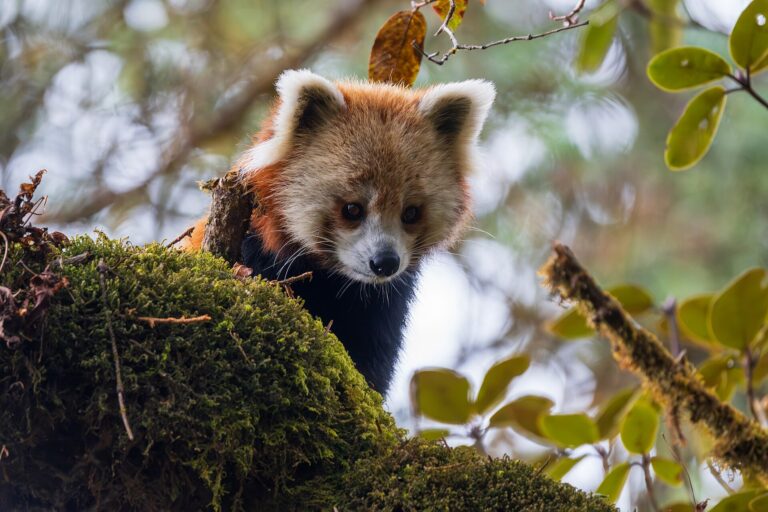
The giant panda and the spectacled bear get compared a lot, and the usual reason given for it is wrong. The spectacled bear is not the panda’s closest living relative. The panda is the odd one out in the whole bear family, sitting on its own branch, equally distant from all seven other living bear species. What makes the pairing worth writing about is something else: both shifted strongly towards plant-heavy diets, although the spectacled bear remains an opportunistic omnivore, on opposite sides of the planet, and only one of them got a global conservation industry built around it.
Key facts
| Spectacled bear scientific name | Tremarctos ornatus |
| Subfamily | Tremarctinae, shared with the extinct short-faced bears |
| Relationship to the panda | Not especially close. The panda’s lineage split off before Tremarctinae and Ursinae separated from each other |
| Spectacled bear range | Andes, Venezuela to Bolivia |
| Spectacled bear diet | Mostly plants, bromeliads and fruit, with some meat |
| Conservation status | Vulnerable (both species) |
Where each one actually sits in the bear family
Molecular and fossil work agrees on the shape of the bear family tree. The giant panda belongs to its own subfamily, Ailuropodinae, which separated from everything else in the Early Miocene, somewhere around 19 million years ago. Everything that was left then split again into Tremarctinae, the short-faced bears, of which the spectacled bear is the sole survivor, and Ursinae, which is every other living bear from the polar bear to the sun bear.
The consequence is easy to state and often stated wrongly. The giant panda is sister to all other living bears. A spectacled bear is no more closely related to a panda than a sloth bear or a brown bear is. If you want the panda’s nearest living relatives you have to accept that the answer is “all the rest of them, equally”. The spectacled bear’s distinction is that its own branch is the second oldest, not that it is nearer the panda.
What the two species do share is convergence. Both are big-jawed mountain bears that took a plant-heavy diet a long way from where the rest of the family went, and both have the heavy skulls and broad molars that go with grinding tough plant material for hours a day.
Two specialists, two continents
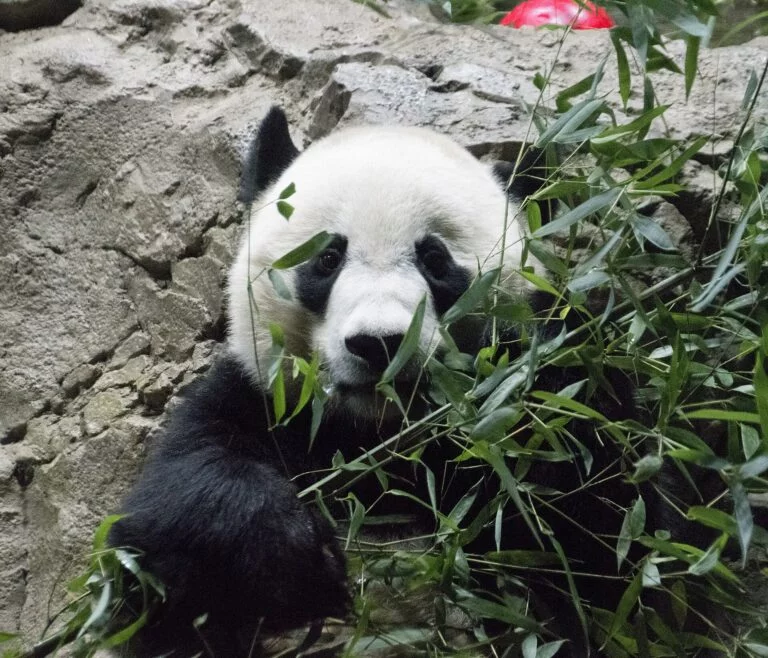
The giant panda lives in the mountains of central China and eats bamboo, to the point that bamboo is about 99 percent of its intake. The spectacled bear lives in the Andes from Venezuela to Bolivia and eats bromeliads, fruit, palm hearts and cactus, with the occasional small animal or bit of carrion. Both are largely plant-eating mountain bears, but the spectacled bear kept a far broader menu, which is one reason it has not painted itself into the same ecological corner.
On size, the overlap is real but the spectacled bear is more variable. Males run from about 100 to 200 kg, which puts a big male above a typical giant panda, while females are far smaller, often between 35 and 80 kg. Both species have stocky bodies, short tails and powerful jaws.
Cultural roles
The giant panda is China’s national symbol and one of the most recognised animals alive. The spectacled bear’s cultural claim is more oblique: Paddington, in Michael Bond’s 1958 book, comes from darkest Peru, and the only bear in Peru is the spectacled bear. Bond did not set out to write about the species, and the connection has been made retrospectively, but Peru has run with it and the association is now firm enough that Peruvian conservation groups use it.
Funding follows fame. Conservation money for spectacled bears is a fraction of what flows to pandas. Field research is thin and even basic population estimates are rough.
Conservation challenges
Both species are listed as Vulnerable on the IUCN Red List. The spectacled bear faces habitat loss from agriculture, mining and road building across the Andes, and conflict with livestock owners is a recurring problem. Published estimates put the total population at no more than about 18,000 animals, with the number of mature individuals variously estimated between roughly 2,500 and 10,000. The spread in those numbers is itself the finding: nobody knows within a factor of several how many spectacled bears there are.
Compare that with the giant panda, which gets a national census. China’s fourth survey counted 1,864 wild pandas and produced a figure precise enough to argue about. The difference is not biology. It is that the panda’s range sits inside one country with a centralised conservation apparatus and a strong political interest in the answer, while the spectacled bear is spread across five or six countries with much thinner monitoring.
Related reading on welovepandas
- How pandas differ from other bears
- Species profile: the giant panda
- A brief history of the giant panda
- Ancient pandas ate meat as well as bamboo
Sources and further reading
- IUCN Red List: Tremarctos ornatus
- IUCN Red List: Ailuropoda melanoleuca
- Abella et al., “Kretzoiarctos gen. nov., the oldest member of the giant panda clade”, PLOS ONE (2012)
- IUCN SSC Bear Specialist Group
Frequently asked questions
Are pandas and spectacled bears closely related?
No more than pandas and any other bear. The giant panda’s lineage split off from the rest of the bear family around 19 million years ago, before the spectacled bear’s subfamily separated from the rest, so all seven other living bear species are equally distant from the panda.
Where do spectacled bears live?
Along the Andes from Venezuela to Bolivia, including Colombia, Ecuador and Peru. It is the only bear species in South America.
What do spectacled bears eat?
Mostly plants: bromeliads, fruit, palm hearts and cactus. They occasionally take small animals or carrion.
Is Paddington Bear a spectacled bear?
By implication. The 1958 book has him arriving from darkest Peru, and the spectacled bear is the only bear that lives there. Michael Bond did not write him as a specific species, but the identification has stuck.
Which is more endangered?
Both are Vulnerable. Spectacled bear numbers are larger than the panda’s but far less certain, and the species is spread across several countries with much weaker monitoring.
This article is part of our giant panda guide, which links every species, evolution and zoo article on the site.
Updated 14 September 2026: corrected factual details after a full review against primary sources.