Bamboo Flowering and Pandas: What Happens in a Die-Off
4 min read
A giant panda spends most of its day eating one group of plants, and those plants have an odd habit. Many bamboo species grow for decades, then flower together over a few years, set seed, and die. For a bear that eats almost nothing else, that is a serious problem.
The flowering itself is well described. The cause is not. This post covers what is known about bamboo die-offs, what researchers measured in the Qinling Mountains, and why a panda needs a second bamboo species to fall back on.
Why bamboo flowers once and dies
Bamboos are monocarpic: they die after flowering and setting seed. Many species flower at intervals as long as 65 or even 120 years. Plants in one cohort flower over a period of several years, and any plant grown from a cutting of that cohort flowers too, even when it has been planted somewhere else.
A 2016 paper in Frontiers in Plant Science describes this life history as a long clonal growth phase, sometimes over 100 years, followed by mass synchronous flowering and death. Why bamboo evolved this way is still debated. The same article lists several competing ideas, and its authors say their data support one of them most: the habitat modification idea. In that idea, a bamboo patch spreads for a long time, then flowers and dies, leaving ample resources and little competition for its seedlings.
Bamboo flowers are mainly wind pollinated. That works well when a whole stand flowers together. The trigger behind the timing is described on Wikipedia as still largely a mystery.
What researchers saw in the Qinling Mountains
The Frontiers study followed an arrow bamboo, Fargesia qinlingensis, at Taibaishan National Natural Reserve in Shaanxi. The authors call it one of the giant panda’s main food resources in the Qinling Mountains. Flowering peaked in 2003, and the team watched the stand for five years afterwards.
- Live stems fell sharply in the flowered areas over the five years. They also fell in the un-flowered patches nearby, which surprised the authors. One possible explanation they give is stems growing from rhizomes that run out of flowering areas.
- New shoots came back only in the un-flowered patches. None appeared in the flowered sites during the study.
- Branches and leaves of flowering stems held less crude protein than those of un-flowered stems.
- No seedlings were established until 2004. Seedlings were denser and grew better in the flowered sites than in the un-flowered patches.
- Fewer seedlings appeared than the number of florets would predict, which the authors read as a sign that animals ate part of the seed crop. They say they had no direct data on seed eating.
Seedlings were slow. The paper cites earlier work in which four-year-old seedlings of another arrow bamboo, Bashania fangiana, were no more than 10 to 15 cm tall, and it measured 14 cm for four-year-old seedlings in its own flowered sites.
How long the food takes to come back
The same paper collects estimates of how long bamboo needs to grow back to full size after flowering. They are 19 years for F. qinlingensis in the Qinling Mountains, 15 to 20 years for two arrow bamboos in the Qionglai Mountains of Sichuan, and 16 to 19 years for F. denudata in the Min Mountains of Gansu. The authors write that these estimates are remarkably similar for temperate bamboos.
So the pandas in an affected valley face a gap of around two decades. The study is about bamboo, not pandas, and it does not report how many pandas were in the area. What it does say is that die-offs cause a loss of habitat and diversity for several years, which can threaten endangered species such as the giant panda.
Why a panda needs two kinds of bamboo
Wikipedia’s giant panda article puts the practical consequence in one sentence: because all the bamboo of a species flowers, dies and regrows together, a panda must have at least two different bamboo species within its range to avoid starvation.
That fits how the Smithsonian’s National Zoo describes the animal: a species of the dense bamboo understory in broadleaf and conifer forest, built with big molars and strong jaw muscles for tough stems. A body that specialised cannot switch to another food in a single season. It can only switch to another bamboo, and only if one grows nearby. Our post on which bamboo species pandas actually eat covers the options in each mountain range.
What this means for habitat
A bamboo die-off is natural. The danger comes when the panda cannot walk away. Small, isolated patches of forest give a hungry bear no second valley to try. That is why connected habitat matters, as we describe in our posts on the Sichuan panda corridors and on giant panda habitat.
There is also something this research does not settle. The study cannot say how rodents, seed eaters and other animals shape regrowth, and it states its results on the predator idea are conflicting. The flowering clock inside the plant is also unexplained. Those are open questions, not gaps in this post.
If you have read other accounts of bamboo flowering, or have seen it yourself, add what you know in the comments.
Sources
- Wang W, Franklin SB, Lu Z, Rude BJ (2016), Delayed Flowering in Bamboo: Evidence from Fargesia qinlingensis in the Qinling Mountains of China, Frontiers in Plant Science
- Bamboo blossom, Wikipedia
- Giant panda, Wikipedia
- Giant panda, Smithsonian’s National Zoo
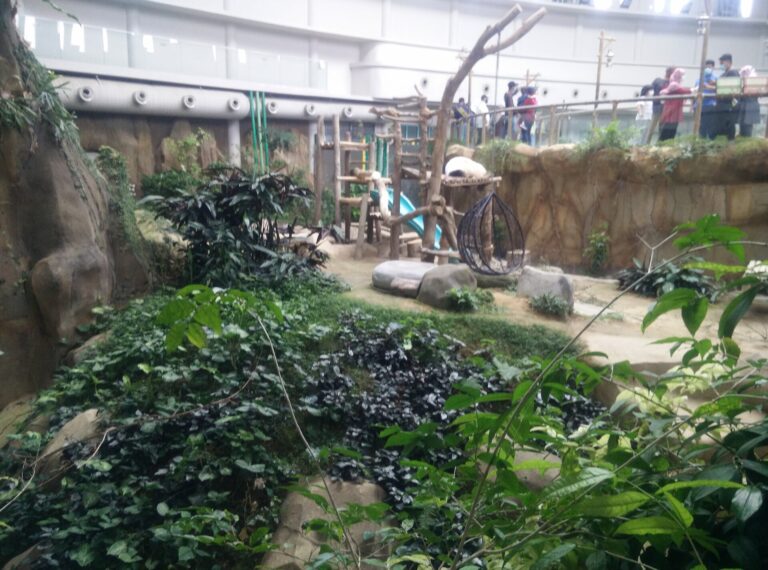
Photo: Tim Evanson, CC BY-SA 2.0, via commons.wikimedia.org.