Panda Teeth: How Bamboo Wears Down a Carnivore’s Mouth
4 min read
A giant panda spends 10 to 16 hours a day feeding, on a plant that carries tiny grains of silica, mostly in its leaves. Every one of those chews lands on teeth that were built for a very different job. That mismatch is the main story of the panda mouth, and it explains why dental wear is a real welfare question for older pandas in zoos.
This post looks at what researchers have measured about panda teeth: their shape, their enamel, what in bamboo does the damage, and how long a set of teeth may last. Some of the newest numbers come from computer models and lab tests, so I flag where a result is a prediction and not a field measurement.
Carnivore teeth, herbivore menu
Grazing animals such as horses and cattle tend to have tall, high-crowned teeth that keep erupting as they wear. Pandas do not. A 2026 paper in Animals notes that giant pandas retain short, low-crowned (brachydont) teeth inherited from their carnivorous ancestors, even though bamboo makes up about 99 percent of what they eat and a panda takes in 12 to 38 kg of it a day. The authors call this a morphological paradox.
What pandas have instead is a broad, irregular, roughly square chewing surface on the back teeth, and a jaw joint that lets the lower jaw slide sideways. The same paper describes how that lateral movement lets different teeth do different jobs at different stages of processing a stalk. The San Diego Zoo Wildlife Alliance describes the result plainly: strong jawbones and cheek muscles that crush thick stalks with flattened back teeth, and more jaw strength than any other bear. For the jaw force itself, see my post on panda bite force.
Peeling before chewing
Anyone who has watched a panda eat has seen it strip the outside off a bamboo stem. The San Diego Zoo notes that pandas use their teeth to peel off the tough outer layers to reveal the soft inner tissue of the stalk.
A 2025 study in Scientific Reports asked whether the peeling protects the teeth. The team looked at two bamboo species used as panda food in zoos and grown at a Dutch nursery, Phyllostachys aureosulcata and Phyllostachys bissetii. They found that leaves held about 6.9 percent inorganic material by weight and the stem cortex about 1.1 percent. In the leaves the minerals formed phytoliths, hard silica particles 30 to 40 micrometres across. In the cortex the minerals were on a nanometre scale. The outer surface of the cortex was also harder than the layer below it.
The authors say the cortex peeling may relate to the physical properties of the cortex, and that more than one cause of tooth wear may act together. They also mention an older suggestion that pandas skip the cortex to avoid cyanide compounds found in some bamboos. This work covered two species in a lab, so it does not tell us what every wild panda does with every bamboo. It does show that bamboo is not one uniform material, and that the parts of the plant differ in how abrasive they are. My guide to the bamboo species pandas eat covers which plants are on the menu.
Enamel built to take a beating
Pandas do not escape the wear. They resist it. The Scientific Reports paper cites earlier work giving panda enamel a surface hardness of 3.37 GPa, close to the 3.2 GPa figure for human enamel. A lab study published in 2026 looked at why that enamel holds up. Mature enamel is mostly mineral, but it keeps a small organic fraction. The researchers removed organic material from panda enamel samples with a chemical treatment and then scratched them. The load at which the enamel began to fail in the scratch test fell from 12.53 to 6.07 millinewtons, and the damage changed from shallow grooves to cracks and chipping.
That points to the small organic part of the enamel helping it resist scratches. It is a result on treated samples in a lab, not on a living panda, and the authors describe it as suggestive. Still, it fits the bigger picture: panda enamel is tuned for a tough diet.
How long do the teeth last?
A team at Sichuan Agricultural University and the China Conservation and Research Center for the Giant Panda built a computer model of tooth wear. It used a measured enamel hardness of 344 HV and bite forces of 1,030 N at the canine, 1,142 N at the second premolar and 2,005 N at the second molar. In the model the molars wore fastest and the canines slowest.
The predicted working life of the teeth was 47 to 55 years for canines, 19 to 34 years for premolars and 23 to 29 years for molars. Chewing direction mattered. Canines wore faster when bamboo was held sideways, while the cheek teeth wore faster when bamboo was chewed lengthwise.
Treat those ages with care. The authors say the model is two-dimensional, treats bamboo as a uniform hard cylinder, rests on one animal’s tooth shape and was tied to a single age reference point. It is a proof of concept and not a lifespan measurement. Pandas in the wild are also thought to live 15 to 20 years, so a premolar life of around 19 to 34 years in a model is not a claim about wild bears.
Why it matters in zoos
In human care pandas often live into their twenties and beyond, long enough for wear to show. The authors report that elderly captive pandas with advanced wear avoid hard bamboo culms and spend less time feeding, and that some refuse food or show signs of stress that may come from pain while chewing. That is why they suggest dental check-ups and diet changes for older animals, with premolars and molars the teeth to watch.
It also links to the rest of the panda lifestyle. A bear that must eat for most of its waking day needs teeth that last. For how pandas cope with the nutrition side of that diet, see how a bear became a bamboo specialist.
What is still not known
I could not find published wear measurements from a large sample of wild pandas, so the real rate of wear in the wild is still open. The numbers above come from models and lab samples. Do you know of a field study of panda teeth, or have you watched a zoo panda peel its bamboo? Add what you know in the comments.
Sources
- Computer simulation of tooth wear in giant pandas (MDPI, Animals (Chen et al. 2026))
- Phytoliths of bamboo affect the feeding pattern of giant panda (Springer Nature, Scientific Reports (2025))
- Deproteinization and the mechanics of mature giant panda enamel (MDPI, Animals (2026))
- Giant panda animal page (San Diego Zoo Wildlife Alliance)
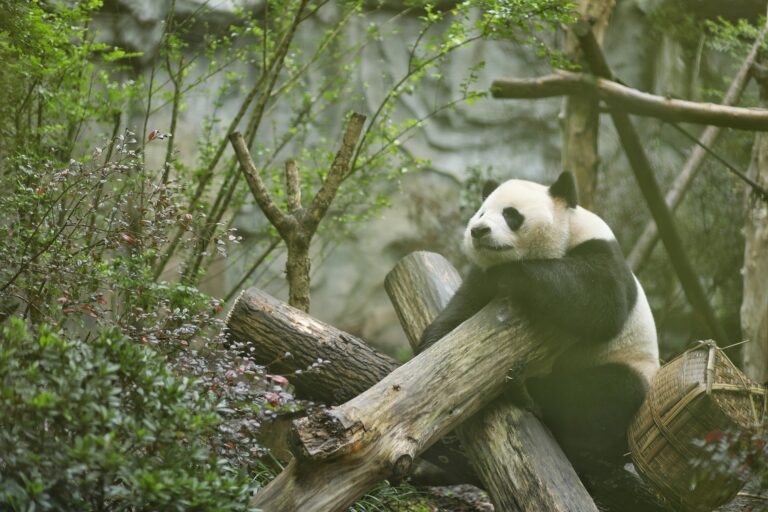
Photo: Chen Wu, CC BY 2.0, via commons.wikimedia.org.