Panda Taste: Lost Umami, a Sweet Tooth and Bitter Bamboo
5 min read
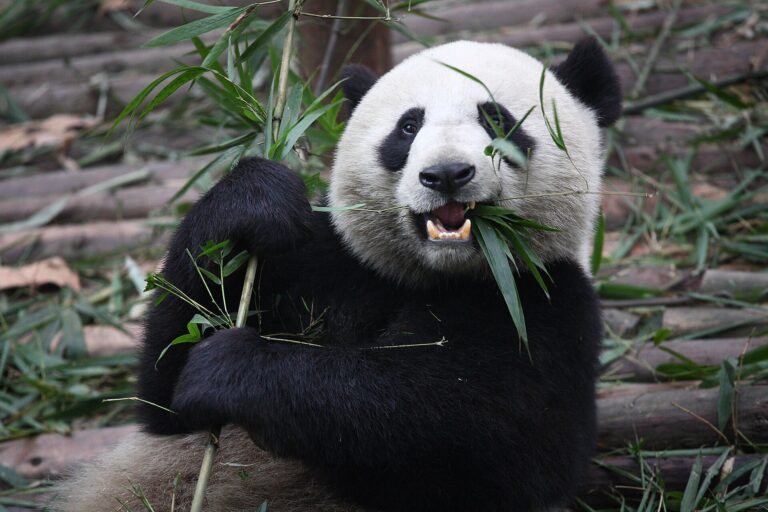
A giant panda sits with a pile of bamboo and chews for hours. It does this with a tongue that, as far as the genetics show, cannot taste umami, the savoury note that meat and broth are famous for. The animal descended from meat eaters and now eats almost nothing else but grass, and its sense of taste carries the marks of that switch.
Taste is a small, specific part of the panda story, and the research on it is better than you might expect. Here is what the research reports, and where they stop.
A gene for meat flavour that no longer works
Umami taste depends on a receptor built from two proteins, one of which is made by a gene called TAS1R1 (the older name in some papers is T1R1). Cows and horses keep a working copy. The giant panda does not. When the giant panda genome was sequenced, the gene turned up as a pseudogene, a copy that has picked up damage and no longer does its job. A 2011 analysis in PLoS One reports that the finding was confirmed in a different panda sample, and puts the estimated time of the mutation at about 4.2 million years ago.
The date matters because it coincides with the panda’s dietary change. The same paper notes that the loss reinforced a plant-eating lifestyle, though it also makes an honest point: cows and horses are herbivores that still have the gene, so losing it cannot be the whole reason pandas turned to bamboo.
The gene is not lost only in the giant panda. A 2017 comparative genomics study in PNAS sequenced the red panda genome and found that TAS1R1 has been pseudogenized in both pandas. The two animals sit in different families of the order Carnivora, yet both landed on a bamboo diet and a false thumb. The study treats the umami gene loss as one more case of convergent evolution. If you want the thumb side of that story, we cover it in The Panda Thumb: How a Wrist Bone Became a Sixth Finger.
Carnivore-like on the inside
A tongue that has dropped umami is not the only odd thing about the panda’s biology. A 2019 paper in Current Biology lists the loss of functional T1R1 among the herbivore traits, next to the skull, jaw muscles, teeth and pseudo-thumb. Against those it sets a digestive tract, digestive enzymes and a gut microbiota that resemble a carnivore’s. The authors then looked at what pandas actually take in. Their diet clustered in macronutrient space among carnivores, not herbivores, and the absorbed ratios were close to the ingested ones. The same carnivore-like pattern showed up in panda milk.
The authors conclude that the move from carnivorous and omnivorous ancestry to specialised herbivory may have been less abrupt than it looks. Our post on the panda gut microbiome picks up the digestive half of that argument.
The sweet tooth that surprised researchers
If umami is gone, you might expect sweet taste to be gone too. Some strict carnivores have lost their sweet receptors and show no interest in sugar. Researchers tested the idea on pandas, and the 2014 PLoS One study found the opposite. In behavioural tests the pandas avidly consumed most natural sugars and some, but not all, artificial sweeteners. Cell-based assays of the panda sweet receptor showed similar patterns.
That is odd for an animal whose main food, bamboo, is very low in simple sugars. The authors suggest that the sweet receptors may have jobs outside the mouth, which plant eaters could need, but they present it as a possibility to explain the result and not a settled answer. What the study does show is that a panda will take sweet food when offered it.
Bamboo is bitter, and the panda has the genes for it
Bamboo contains bitter compounds, and bitter receptors are the taste system’s warning against harmful food. Carnivores usually carry the smallest set of them. A 2013 survey in Zoological Research found 17 to 20 bitter taste receptor (T2R) genes in five carnivore genomes, including the giant panda and the polar bear, with 12 to 16 intact genes among them.
The panda looks different once you compare it with other meat eaters more closely. A 2018 study in Integrative Zoology characterised 195 TAS2R genes across nine carnivore species. Both the giant and red pandas had more putatively functional bitter receptor genes than other carnivores. The damaged genes were different in each panda, which suggests the two animals adapted to bamboo independently. The giant panda also showed a few positively selected sites on one gene, TAS2R42.
In short, the panda lost the receptor for savoury flavour and kept, and probably tuned, the ones that detect bitterness in a diet that is more than 90 percent bamboo.
Why Qinling pandas may find leaves less bitter
The clearest worked example comes from the Qinling Mountains. A 2020 study in Ecology and Evolution followed up earlier work showing that two amino acid changes, A52V and Q296H, in the bitter receptor gene TAS2R20 are under directional selection in Qinling pandas. The team expressed the panda receptor in engineered cells and found that it responds specifically to quercitrin, a compound found in bamboo leaves. The Qinling variant is significantly less sensitive to quercitrin. The authors also measured quercitrin in bamboo leaves and found more of it in the Qinling Mountains than in leaves from panda habitat elsewhere.
Their reading is that bamboo leaves taste less bitter to Qinling pandas, which fits those pandas’ higher preference for leaves. It is a lab result on one receptor and one compound, and it does not by itself prove what an individual panda feels. It does give a measurable link between a gene variant, a plant chemical and a food choice. You can read about the region’s famous brown panda in Qizai, the Brown Panda, and about the plants themselves in Which Bamboo Species Do Pandas Actually Eat?
What is still unknown
- Whether the missing umami receptor changes how food tastes to a living panda. The evidence in the papers cited here is genetic.
- Why a plant eater that lacks the umami gene still has a carnivore’s digestion. The 2019 paper raises the question and offers an explanation about the speed of the diet change, not a proof.
- What drives the day to day choice between shoots, leaves and stems. A 2025 paper in Frontiers in Veterinary Science found 57 bamboo-derived microRNAs in the blood exosomes of seven pandas in three groups (adult males, adult females and a juvenile female) and reports links to taste and olfactory signalling and to dopamine metabolism. The authors say this may influence food preferences. It is an early result in a small set of animals and needs follow-up.
The 2011 paper also pointed at dopamine and the appetite-reward system as a direction for work on the panda’s food choices, so the idea has been around for more than a decade without a final answer.
Smell does a good share of the work of finding food as well, which our post on the panda sense of smell covers.
Do you know of a keeper who has tried new flavours on a panda, or a study we have missed? Add what you know in the comments.
Sources
- Comparative genomics reveals convergent evolution between the bamboo-eating giant and red pandas, PNAS, 2017
- Why does the giant panda eat bamboo? A comparative analysis of appetite-reward-related genes among mammals, PLoS One, 2011
- Giant Pandas Are Macronutritional Carnivores, Current Biology, 2019
- The bamboo-eating giant panda has a sweet tooth, PLoS One, 2014
- Smallest bitter taste receptor (T2Rs) gene repertoire in carnivores, Zoological Research, 2013
- Lineage-specific evolution of bitter taste receptor genes in the giant and red pandas implies dietary adaptation, Integrative Zoology, 2018
- TAS2R20 variants confer dietary adaptation to high-quercitrin bamboo leaves in Qinling giant pandas, Ecology and Evolution, 2020
- Cross-kingdom regulation of gene expression in giant pandas via plant-derived miRNA, Frontiers in Veterinary Science, 2025
Photo: Skip Brown, CC0, via commons.wikimedia.org.