The Panda Thumb: How a Wrist Bone Became a Sixth Finger
Last updated: November 5, 2026
4 min read
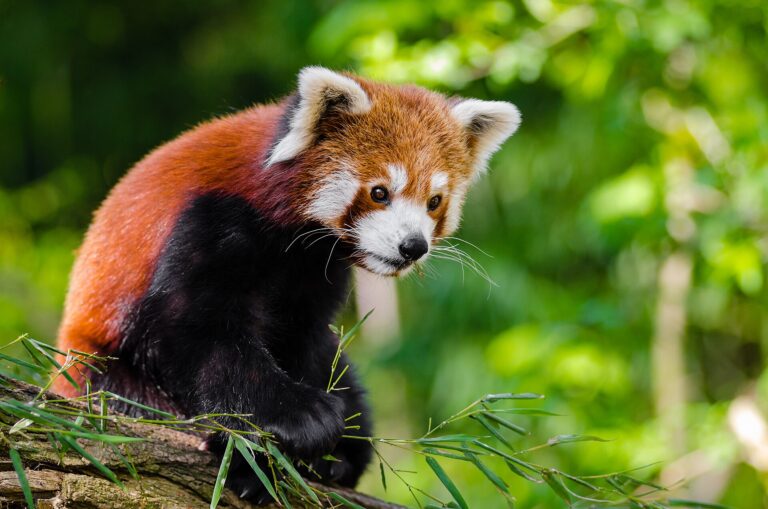
The famous panda thumb is not a thumb. It is an enlarged wrist bone, the radial sesamoid, that pandas press against their fingers to grip bamboo stems. Giant pandas and red pandas evolved the trick independently, which makes it one of the cleanest cases of convergent evolution in mammals.
Key facts
| Anatomical name | Radial sesamoid (a modified wrist bone) |
|---|---|
| Function | Opposable grip on bamboo stems |
| Found in | Giant panda and red panda, evolved separately |
| Made famous by | Stephen Jay Gould, 1980, in The Panda’s Thumb |
| Number of true digits | Five, plus the pseudo-thumb |
| Oldest evidence, giant panda line | About 6 million years (Ailurarctos, Shuitangba, Yunnan) |
| Oldest evidence, red panda line | About 9 million years (Simocyon batalleri, Spain) |
What the panda thumb actually is
Pandas have five normal fingers like other bears. The sixth digit, the one that looks like an opposable thumb, is a heavily enlarged wrist bone called the radial sesamoid. In most mammals that bone is small and supports tendons crossing the wrist. In pandas it has grown into a thick, finger-shaped pad the animal can press against its true thumb to hold a cane.
The structure has a fleshy pad over it and its own muscle attachments. From the outside it looks and behaves like a thumb. Under the skin it is not a finger at all, just a bone borrowed from the wrist and put to a new job.
Stephen Jay Gould wrote a famous essay about this in 1980, the title piece of his collection The Panda’s Thumb, using it as an example of evolution as a tinkerer rather than an engineer. It does not design the perfect tool. It modifies whatever is to hand. I find that worth pausing on whenever I watch a panda eat: the dexterity looks so clean from the outside that it is easy to forget the animal is solving a mechanical problem with a repurposed wrist bone.
How giant pandas use the thumb to eat bamboo
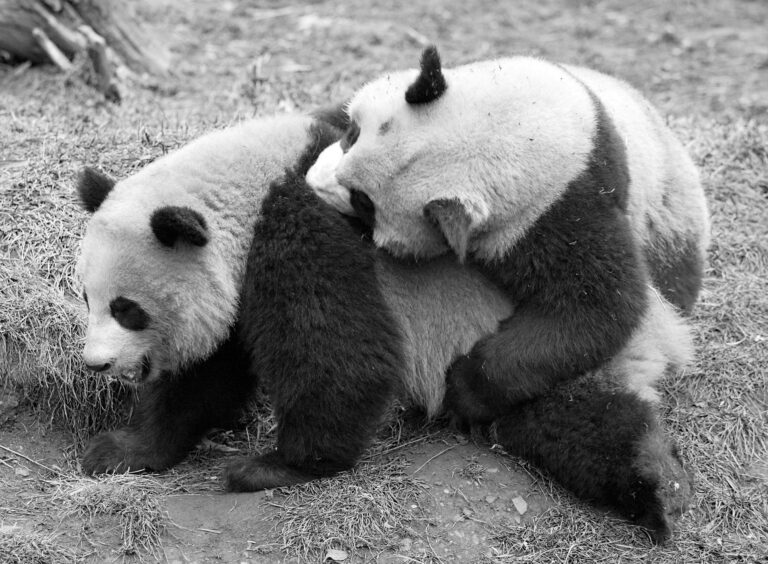
A giant panda spends 10 to 16 hours a day eating bamboo. It pulls a stem from a clump, strips the leaves with its teeth, then holds the cane with the pseudo-thumb pressed against the other fingers. The grip is precise enough to rotate the stalk while the molars work on it.
Without the pseudo-thumb the panda could only paw at bamboo with a flat palm. With it, the animal becomes a careful eater that wastes very little. An adult panda processes roughly 12 to 38 kg of bamboo a day, with intake and selection varying by season, and almost every stem passes through this six-fingered grip.
The full bamboo-eating sequence runs like this:
- Sit upright against a slope or trunk for support
- Reach a stalk with one forepaw and grip it with the pseudo-thumb
- Bite off a section near the base
- Strip the leaves with the incisors while the paw rotates the cane
- Crush the woody stem with the broad molars
Red pandas evolved the same thumb separately
Red pandas are not bears. They sit in their own family, Ailuridae, in the same superfamily as raccoons and weasels. They also have a radial sesamoid pseudo-thumb, and they also use it on bamboo. The two lineages split roughly 43 million years ago, long before either was a bamboo specialist.
That is convergent evolution: the same problem, how to hold a thin woody cane while you chew it, solved twice from completely different starting points. The red panda side of the family got there first. Simocyon batalleri, an extinct ailurid relative from around 9 million years ago, already had an enlarged sesamoid, though the evidence suggests it worked as a climbing aid before it ever worked on bamboo. On the giant panda side, the oldest known false thumb belongs to Ailurarctos, from the roughly 6 million year old site of Shuitangba in Yunnan. It is slightly longer than the modern version and lacks the inward hook that gives living pandas their finer control.
Why this matters for evolution and conservation
The pseudo-thumb is one of the strongest pieces of evidence that the giant panda was not designed by a watchmaker. The animal retains a carnivore-like digestive tract, but its skull, jaw muscles and teeth are strongly adapted to processing bamboo. The wrist bone, the gut microbiome and the oversized molars are all workarounds.
For conservation that matters because the bamboo lifestyle is brittle. Lose the bamboo and the animal cannot pivot. The pseudo-thumb is a tool fit for one job, which makes habitat protection in the Min, Qinling and Liang mountains more urgent than it would be for a generalist.
Related reading on welovepandas
- Species profile: the giant panda
- Species profile: the red panda
- How pandas became bamboo dependent
- How pandas differ from other bears
- Ancient pandas ate meat as well as bamboo
- Ailurarctos, the ancient ancestor of the giant panda
- Why red pandas matter
Sources and further reading
- Wang, X. et al. (2022) Earliest giant panda false thumb suggests conflicting demands for locomotion and feeding. Scientific Reports 12, 10538.
- Salesa, M.J. et al. (2006) Evidence of a false thumb in a fossil carnivore clarifies the evolution of pandas. PNAS 103(2): 379 to 382.
- Gould, S.J. (1980) The Panda’s Thumb.
This article is part of our Giant Panda guide hub.
Frequently asked questions
Do pandas really have six fingers?
Effectively yes. Five are true fingers with full skeletons. The sixth is a modified wrist bone, the radial sesamoid, grown into a finger-shaped pad that works as an opposable thumb.
Is the panda thumb on both hands?
Yes. Both forepaws have a radial sesamoid pseudo-thumb. The hindpaws do not.
Do red pandas have a thumb too?
Yes, a separate but very similar one. The same wrist bone enlarged in two unrelated lineages, in the red panda line probably for climbing first and bamboo later.
Who first described the panda thumb?
The anatomy was known in the nineteenth century. The evolutionary story was made famous by Stephen Jay Gould in his 1980 essay collection The Panda’s Thumb.
How old is the panda thumb?
The oldest known false thumb in the giant panda line is about 6 million years old, from Ailurarctos at Shuitangba in Yunnan. In the red panda line the fossil Simocyon batalleri pushes an enlarged sesamoid back to about 9 million years.
Does the panda thumb make pandas dexterous?
Only for bamboo. Pandas grip and rotate canes with real precision, but the pseudo-thumb is not a general-purpose finger. They cannot manipulate small objects the way primates can.
This article is part of our panda facts guide, which links every article on panda biology, behaviour and culture.
Updated 14 September 2026: corrected factual details after a full review against primary sources.