Panda Eyesight: Colour, Eye Position and What Is Known
4 min read
Ask people how a giant panda sees the world and you will hear two answers. Some say pandas are nearly blind. Others say they see in black and white, like their coat. The research that exists points away from the black-and-white answer, and it leaves a lot unmeasured.
The papers on panda vision are few and small. This post sticks to what they report and flags what they do not cover.
Pandas can tell colours from grey
The clearest test is a study published in Learning & Behavior in 2006. They worked with two adult giant pandas, one male and one female. Each panda was shown a coloured stimulus (green, blue, red, white or black) paired with greys of 16 different shades, and had to choose the coloured one. Brightness was controlled, so the panda could not win by picking the lighter or darker option.
To count as passing, a panda had to choose correctly in 16 of 20 trials, which is 80 percent, for three sessions in a row. Both pandas passed for green and for red. The female also passed for blue. The male was not tested on blue, so that result stands for one animal.
The authors described the study as a replication of an older experiment on black bears. Their conclusion was that panda colour vision looks comparable to that of black bears and other carnivores that are not strictly nocturnal.
That is a modest claim. The test shows that pandas can separate hues from grey. It does not say how rich their colour world is, or whether a panda sees a red leaf the way a person does. Two animals is a small sample.
Eyes that face forward
A 2024 paper in the Journal of Comparative Neurology looked at how the retina of the giant panda is organised. In the mammals studied to date, the retinal ganglion cells, the cells that send the signal to the brain, are packed into a horizontal band called a visual streak. The panda team reported something different: a streak that runs vertically.
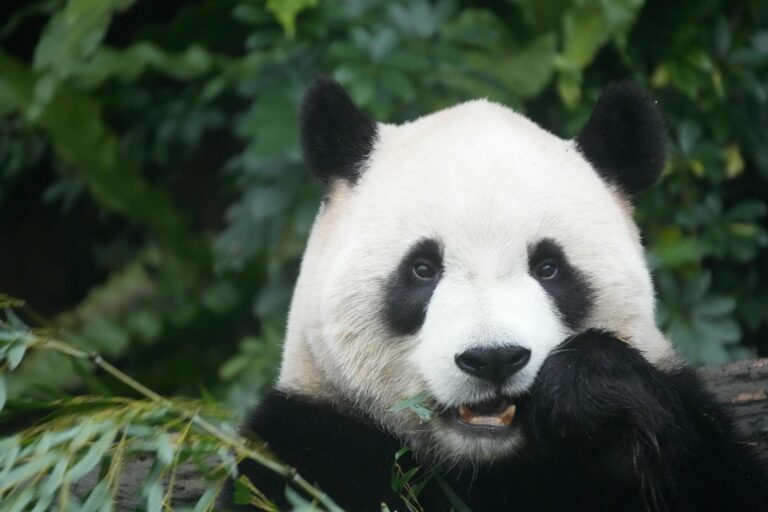
They link that finding to other features of the panda eye, including its forward-placed position on the face, and argue that together these describe a well-adapted binocular visual system. Their results suggest the giant panda may handle binocular information in an unusual way, and a mathematical simulation they ran favoured that idea.
Read that as a proposal backed by anatomy and modelling. The abstract describes retinal anatomy and a simulation, not panda behaviour, so how much the vertical streak helps in daily life is still open.
Testing the retina of wild pandas
Checking an eye in a wild panda is hard. A 2021 study in Veterinary Ophthalmology built a quick method for it. The team anaesthetised nine free-ranging giant pandas and measured the electrical response of the retina to flashes of light, a test called electroretinography.
They recorded in the dark, after 20 minutes of dark adaptation, at three flash strengths. They also recorded in the light, after 10 minutes of light adaptation. The first set reflects how the retina works at low light, and the second how it works in bright light. The authors reported mean readings for each condition and concluded that a portable machine with a short protocol is a practical way to assess retinal function in the field.
The value of the paper is a set of reference numbers. The pandas were of unknown retinal status, so the readings show the range recorded in wild animals rather than a proven healthy norm. It is a field tool, and it does not rank panda eyesight against that of other species.
How cubs start out
Vision begins late. The Smithsonian’s National Zoo notes that cubs do not open their eyes until they are 6 to 8 weeks old, and they are not mobile until about 3 months. Our guide to the giant panda life cycle covers the full timeline from birth.
Where sight fits among the other senses
Sight is only one of the senses. Our posts on the panda sense of smell and on panda vocalizations cover those.
Vision still matters at close range, and the studies above show a working colour sense and an eye with some unusual features. What they do not give us is a number for sharpness, a field of view, or a direct comparison with a bear or a dog. The studies above do not report them, so be wary of any page that quotes them without a source.
What we know and what we do not
- Known: two tested pandas could separate green and red from grey, and one could do it with blue.
- Reported: a vertical visual streak in the retina, with forward-facing eyes, which the authors tie to binocular vision.
- Measured: retinal responses in nine wild pandas, giving a range of readings for field vets.
- Not covered by these studies: how sharp panda vision is, or how much colour detail a panda sees in the wild.
If you have seen a panda react to colour or movement at a zoo or reserve, tell us what you noticed in the comments. Please say where and when.
Sources
- Kelling et al., Color vision in the giant panda, Learning & Behavior (2006)
- Wang et al., Morphological characteristics of retinal ganglion cells in giant pandas, Journal of Comparative Neurology (2024)
- Tu et al., Electroretinography in the wild giant panda, Veterinary Ophthalmology (2021)
- Smithsonian’s National Zoo, Giant Panda